3 VIX ETFs to Trade Heightened Market Volatility
Navigate market volatility with VIX ETFs: Strategic tools for trading uncertainty and hedging portfolios.
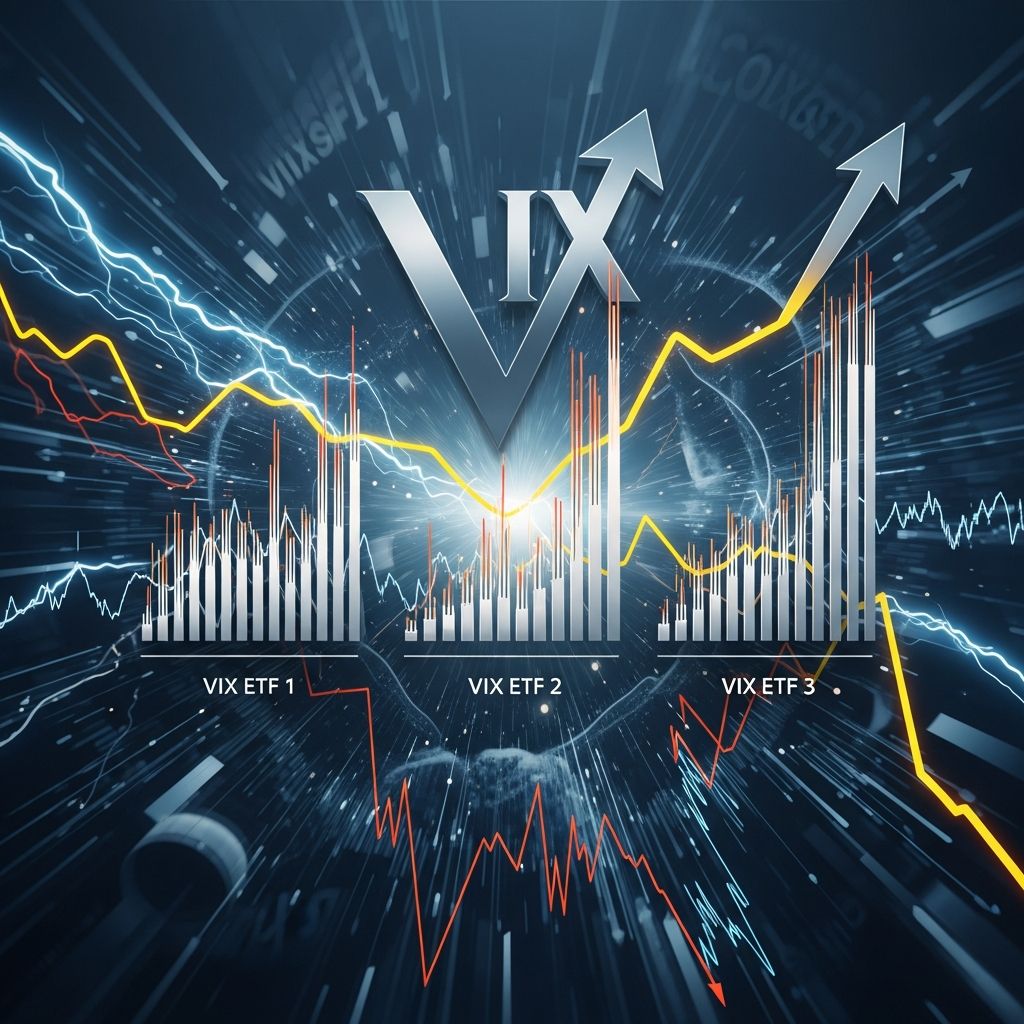
The Volatility Index, commonly known as the VIX, represents an important measure of market expectations regarding near-term volatility. Often referred to as the ”fear gauge” of the market, the VIX tracks the 30-day implied volatility of the S&P 500 Index based on options pricing. When investors become anxious about market conditions, the VIX tends to rise, and conversely, when market sentiment improves, the index typically declines.
For traders and investors looking to capitalize on or hedge against periods of elevated market uncertainty, VIX-based exchange-traded funds (ETFs) offer accessible vehicles for gaining exposure to volatility. These instruments provide liquidity and ease of trading compared to direct VIX futures or options trading. Understanding the mechanics, benefits, and risks of VIX ETFs is essential for successfully incorporating them into a trading or investment strategy.
Understanding the VIX and Volatility Trading
The VIX measures market volatility by calculating the implied volatility of S&P 500 index options. When market participants anticipate significant price swings, demand for protective put options increases, which drives up their prices and consequently raises the VIX level. The index ranges from approximately 10 to 80 or higher, with lower values indicating complacency and higher values signaling fear or uncertainty in the markets.
Volatility itself presents both challenges and opportunities. While sudden market swings can erode portfolios quickly, they also create trading opportunities for those properly positioned. VIX ETFs allow investors to gain exposure to volatility without directly trading VIX futures contracts, which require specialized knowledge and carry significant complexity and risk.
Why Trade VIX ETFs?
- Portfolio Hedging: VIX ETFs often move inversely to stock market movements, providing portfolio protection during downturns
- Diversification: Volatility represents an asset class that behaves differently from traditional stocks and bonds
- Accessibility: ETFs offer easier entry points than directly trading VIX futures or options
- Liquidity: Most VIX ETFs trade on major exchanges with reasonable trading volumes
- Transparency: ETF structures provide clear holdings and daily pricing information
The Challenges of VIX ETFs
Despite their appeal, VIX ETFs come with notable challenges that investors must understand. The most significant issue stems from contango and backwardation in VIX futures markets. Contango occurs when longer-dated VIX futures trade at higher prices than near-term contracts, creating a ”roll yield” drag as ETF managers must continuously sell expiring contracts and buy longer-dated ones at higher prices. This dynamic causes long-dated VIX ETFs to experience decay over time, even when the VIX index itself remains relatively stable.
Additionally, the VIX rarely sustains elevated levels for extended periods. Spikes in volatility often resolve quickly as market participants reassess conditions and sentiment gradually normalizes. This means that long-term holders of VIX ETFs frequently experience losses despite initial protective intentions. Short-term traders may benefit from these moves, but buy-and-hold investors typically find VIX ETF positions deteriorate over weeks and months.
Key Risks to Consider:
- Decay Risk: Contango in VIX futures markets can cause even short-term holding losses
- Mean Reversion: The VIX tends to revert toward historical averages, limiting extended upside potential
- Complexity: VIX ETFs employ sophisticated strategies that may be difficult for novice investors to understand fully
- Tracking Error: Most VIX ETFs don’t perfectly track VIX movements due to structural limitations
- Volatility of Volatility: These ETFs can experience extreme price swings themselves
Three Notable VIX ETFs for Trading Volatility
Several VIX ETFs exist for different trading objectives and time horizons. Below are three prominent options that traders and investors utilize when positioning for volatility:
1. Direxion Daily VIX Bull 3X Shares (UVXY)
The Direxion Daily VIX Bull 3X Shares ETF attempts to deliver three times the daily performance of the S&P 500 VIX Short-Term Futures Index. This inverse leveraged structure means that for every 1% increase in the underlying index, UVXY seeks to rise approximately 3%. Conversely, for every 1% decline, the ETF aims to drop roughly 3%.
UVXY is designed primarily for short-term traders making tactical bets on near-term volatility spikes. The leveraged structure amplifies gains during significant market dislocations but also magnifies losses during periods of declining volatility. The ETF rebalances daily, which means it can suffer from compounding effects when volatility moves sideways or declines gradually rather than spiking sharply.
UVXY Key Characteristics:
- Expense Ratio: Approximately 0.95% annually
- Focus: Short-term VIX moves and volatility spikes
- Best For: Tactical traders with short time horizons
- Trading Volume: Typically high, ensuring reasonable liquidity
- Leverage Multiple: 3x daily
2. iPath Series B S&P 500 VIX Short-Term Futures ETN (VXX)
The iPath VIX Short-Term Futures ETN provides exposure to a rolling basket of short-term VIX futures contracts. Unlike equity-based ETFs, this product is an exchange-traded note, meaning it represents a debt obligation of Barclays Bank rather than a traditional fund holding portfolio securities. VXX tracks the S&P 500 VIX Short-Term Futures Index.
VXX is structured to capture near-term VIX movements without leverage, making it suitable for investors seeking direct volatility exposure without the amplification effects of leveraged products. However, like most VIX ETFs, VXX has historically experienced significant decay over longer holding periods due to contango dynamics in VIX futures markets.
VXX Key Characteristics:
- Expense Ratio: Approximately 0.89% annually
- Focus: Direct short-term VIX futures exposure
- Best For: Intermediate traders and hedging strategies
- Product Type: Exchange-Traded Note (ETN)
- Leverage Multiple: 1x (no leverage)
- Primary Use: Risk management and short-term volatility plays
3. iPath Series B S&P 500 VIX Mid-Term Futures ETN (VXZ)
The iPath VIX Mid-Term Futures ETN offers exposure to medium-term VIX futures contracts, typically tracking the 4th through 7th month contracts. This extended time horizon approach aims to reduce the decay impact from daily rebalancing in short-term structures. VXZ is also an exchange-traded note backed by Barclays Bank.
By focusing on longer-dated VIX futures, VXZ theoretically experiences less rapid decay than short-term alternatives. However, it may respond less dramatically to immediate VIX spikes since mid-term implied volatility typically stabilizes more than front-month contracts. This makes VXZ more suitable for investors expecting sustained elevated volatility rather than quick spikes.
VXZ Key Characteristics:
- Expense Ratio: Approximately 0.89% annually
- Focus: Mid-term VIX futures exposure
- Best For: Longer-term volatility positioning
- Product Type: Exchange-Traded Note (ETN)
- Leverage Multiple: 1x (no leverage)
- Primary Use: Extended volatility hedging and positioning
Comparison of VIX ETF Characteristics
| Feature | UVXY | VXX | VXZ |
|---|---|---|---|
| Expense Ratio | ~0.95% | ~0.89% | ~0.89% |
| Leverage | 3x Daily | 1x | 1x |
| Futures Focus | Short-term | Short-term | Mid-term |
| Product Type | ETF | ETN | ETN |
| Best Time Horizon | Days to weeks | Weeks to months | Months |
| Decay Concerns | High | High | Moderate |
Trading Strategies for VIX ETFs
Successful VIX ETF trading requires understanding appropriate use cases and time horizons. These instruments work best within specific market contexts and should typically represent a smaller portfolio allocation rather than core holdings.
Hedging Strategy
Many institutional and individual investors maintain small positions in VIX ETFs as portfolio insurance. When equity markets decline, the VIX typically rises, causing VIX ETF values to appreciate. This inverse relationship can offset stock market losses, providing partial downside protection. However, holding these positions continuously exposes investors to decay, so tactical implementations work better than permanent hedges.
Tactical Trading
Short-term traders can capitalize on volatility spikes by establishing positions when market conditions appear unstable. UVXY’s leveraged structure makes it particularly suitable for traders expecting rapid, significant volatility increases over days or weeks. Such positions should typically be liquidated after the anticipated move occurs to minimize decay effects.
Volatility Mean Reversion
Contrarian traders sometimes establish short positions in VIX ETFs after the VIX spikes to extreme levels, betting on mean reversion. When volatility indicators reach historically elevated levels, the subsequent normalization often generates losses for VIX ETF holders, benefiting those shorting these instruments.
Important Considerations Before Investing
VIX ETFs are sophisticated instruments that require careful consideration before implementation. Investors should only allocate capital they can afford to lose and maintain positions sizes appropriate for their risk tolerance and account size. These products are generally not suitable for long-term buy-and-hold strategies or for investors with limited market knowledge.
Risk Management Essentials:
- Use stop-loss orders to limit unexpected downside exposure
- Never allocate more than 5-10% of a portfolio to volatility products
- Monitor positions closely and avoid leaving them unattended for extended periods
- Understand the specific futures contracts underlying each product
- Be aware of expense ratios and how they impact returns over time
- Consider the tax implications of frequently trading these instruments
Frequently Asked Questions (FAQs)
Q: Can VIX ETFs be used as permanent portfolio hedges?
A: While VIX ETFs can provide temporary downside protection, they are not suitable as permanent hedges due to decay and mean reversion dynamics. Most investors use them tactically rather than holding them continuously.
Q: What is the difference between VIX ETFs and VIX options?
A: VIX ETFs offer more accessible entry points and don’t require options trading expertise. However, VIX options may provide more precise risk control and specific strike selections for experienced traders.
Q: Why do VIX ETFs lose value over time?
A: Contango in VIX futures markets means longer-dated contracts trade at higher prices than near-term contracts. As ETF managers roll expiring contracts into longer-dated ones at higher prices, this ”roll yield” drag creates a performance headwind.
Q: Are leveraged VIX ETFs like UVXY suitable for beginners?
A: No. Leveraged VIX ETFs amplify volatility and can result in rapid, substantial losses. They are designed for experienced traders who understand their mechanics and maintain active monitoring.
Q: How do I determine the right VIX ETF for my strategy?
A: Consider your time horizon (UVXY for days/weeks, VXX for weeks/months, VXZ for months), risk tolerance (leverage vs. no leverage), and expected market conditions. Match your choice to specific tactical bets rather than general positioning.
Q: What historical performance has VXX achieved?
A: Due to contango and mean reversion, VXX has experienced significant long-term losses despite multiple market corrections. It performs best as a short-term hedging or trading tool rather than a buy-and-hold investment.
References
- The Cboe Volatility Index (VIX) — Cboe Global Markets. 2025. https://www.cboe.com/vix/
- Understanding Volatility ETFs and Exchange-Traded Notes — U.S. Securities and Exchange Commission (SEC). 2024. https://www.sec.gov/investor/
- Direxion Daily VIX Bull 3X Shares (UVXY) Fund Summary — Direxion Investments. 2025. https://www.direxion.com/
- Exchange-Traded Notes: Risks and Considerations for Investors — Financial Industry Regulatory Authority (FINRA). 2024. https://www.finra.org/
- Contango and Backwardation in Commodity Futures Markets — U.S. Commodity Futures Trading Commission (CFTC). 2024. https://www.cftc.gov/
- VIX Futures and Options: Trading Mechanics and Risk Management — Cboe Learning Center. 2025. https://www.cboe.com/learn/
Similar Articles








Read full bio of Sneha Tete