VFINX vs SPY: Mutual Fund vs ETF Comparison
Understand the differences between VFINX mutual fund and SPY ETF for S&P 500 investing.
VFINX vs SPY: Mutual Fund vs ETF Case Study
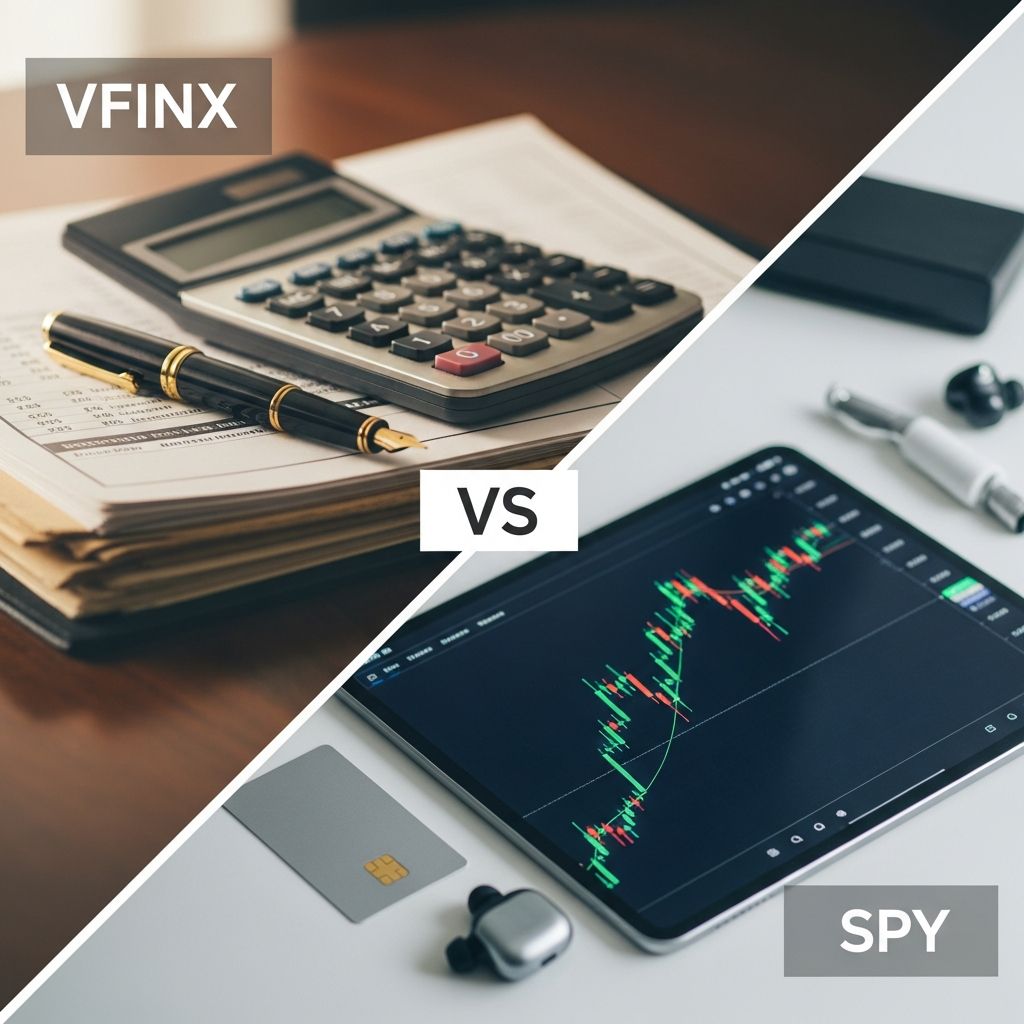
Investors seeking broad market exposure through S&P 500 index investing often face a common decision: should they choose VFINX, Vanguard’s mutual fund offering, or SPY, the popular exchange-traded fund? Both track the same index and offer low-cost exposure to 500 of America’s largest companies, yet they differ in meaningful ways that can impact long-term returns and investment experience. Understanding these distinctions is essential for building an optimal portfolio aligned with your financial goals and circumstances.
Understanding the Fundamentals
What is VFINX?
VFINX, the Vanguard 500 Index Fund Investor Shares, is a mutual fund managed by Vanguard that aims to track the performance of the S&P 500 Index. As a mutual fund, VFINX operates differently from exchange-traded funds in terms of trading mechanics, cost structure, and tax implications. The fund holds all 500 stocks included in the S&P 500 Index in approximately the same proportions as the index itself, providing investors with diversified exposure to large-cap American equities. Mutual funds like VFINX are traditionally purchased directly from the fund company or through a broker, with pricing calculated once daily after market close.
What is SPY?
SPY, the SPDR S&P 500 ETF, is an exchange-traded fund managed by State Street that also tracks the S&P 500 Index. Launched on January 22, 1993, SPY was actually the first ETF introduced to the U.S. market, predating many modern investment vehicles. Unlike mutual funds, ETFs trade on exchanges throughout the day like individual stocks, allowing investors to buy and sell shares at market prices. SPY holds the same 500 stocks as VFINX but operates with the structural advantages of an ETF wrapper.
Expense Ratios and Costs
One of the most important factors distinguishing these two investments is their expense ratio. VFINX carries a 0.14% expense ratio, while SPY’s expense ratio is 0.09%. Though this difference appears small—just 0.05 percentage points—it compounds significantly over decades of investing. On a $100,000 investment, this 0.05% difference translates to $50 annually, growing substantially as your portfolio expands.
Both funds are considered exceptionally low-cost compared to the broader investment landscape, where average expense ratios typically range from 0.3% to 0.9%. This affordability makes both attractive for buy-and-hold investors seeking passive index exposure. However, SPY’s structural advantages as an ETF allow it to achieve lower costs, a benefit that has persisted as these products have matured.
Performance Comparison
Year-to-Date and Short-Term Returns
When examining recent performance, both funds demonstrate remarkably similar results. Year-to-date returns show VFINX at 9.33% and SPY slightly ahead at 9.36%, a negligible difference. Over one-year periods, the funds show comparable performance with the tight tracking you’d expect from two index funds pursuing the same benchmark.
Long-Term Performance Analysis
Over longer time horizons, the performance gap remains minimal. Both VFINX and SPY have delivered annualized returns of approximately 13.69% to 13.70% over the past decade. This consistency reflects the efficient markets hypothesis—when two funds track the same index, performance differences should be negligible after accounting for their respective expense ratios.
Historical Performance Data
| Time Period | VFINX Return | SPY Return |
|---|---|---|
| Year-to-Date | 9.33% | 9.36% |
| 1-Year | 4.94% | 4.94% |
| 3-Year | 5.33% | 5.42% |
| 5-Year | 19.75% | 19.81% |
| 10-Year | 13.69% | 13.70% |
Risk-Adjusted Performance Metrics
Volatility Analysis
Both VFINX and SPY exhibit nearly identical volatility characteristics, with volatilities of 1.94% and 1.93% respectively. This similarity indicates that both investments experience comparable price fluctuations, meaning the risk associated with each fund—measured by day-to-day price movements—is essentially the same. This makes sense given they track identical indexes with the same holdings.
Sharpe Ratio Comparison
The Sharpe ratio, which measures risk-adjusted returns, shows VFINX at 1.01 and SPY at 0.98. These nearly identical values confirm that both funds deliver similar returns relative to their risk profiles. The marginal differences observed are so small as to be statistically insignificant and attributable to calculation timing or minor tracking variations.
Maximum Drawdown
During severe market downturns, both funds experience similar losses. The maximum drawdown for VFINX stands at -55.25%, while SPY’s maximum drawdown is -55.19%. This similarity reflects the fact that both hold the same securities and track the same index, so their performance during market crises diverges minimally.
Correlation and Diversification
The correlation between VFINX and SPY is 0.98, indicating a very strong positive relationship. This extraordinarily high correlation means the two funds move in lockstep with one another. If you held both in a portfolio, you would essentially be doubling your S&P 500 exposure without achieving meaningful diversification benefits. For most investors, holding both would be redundant.
Structural Differences: Mutual Fund vs ETF
Trading Mechanics
A fundamental difference between VFINX and SPY lies in how they’re traded. VFINX, as a mutual fund, can only be purchased or redeemed at the fund’s net asset value (NAV) calculated once daily after the market closes. This means investors cannot access intraday pricing and must wait until the following business day to receive confirmation of their transaction. SPY, as an ETF, trades throughout the day on stock exchanges, allowing investors to buy and sell at market prices in real-time, benefit from limit orders, and respond immediately to market developments.
Tax Efficiency Considerations
ETFs like SPY generally offer superior tax efficiency compared to mutual funds like VFINX due to structural differences in how they handle capital gains distributions and redemptions. The ETF structure allows for in-kind redemptions, where large investors can exchange fund shares for underlying securities without triggering capital gains events. Mutual funds typically handle redemptions with cash, potentially forcing the fund to sell appreciated securities and distribute capital gains to remaining shareholders. This structural advantage means SPY tends to generate fewer taxable capital gains distributions than VFINX over time.
Minimum Investment Requirements
VFINX typically has no minimum investment requirement when purchased directly from Vanguard, making it accessible to all investors. SPY, trading like a stock, requires you to purchase full shares or, at brokerages offering fractional shares, any dollar amount. The lack of investment minimums for VFINX can be advantageous for small investors, though this advantage diminishes significantly given that most modern brokerages offer fractional share trading for ETFs.
Account Type Considerations
Tax-Deferred Accounts
In tax-sheltered retirement accounts such as IRAs and 401(k)s, the tax efficiency advantages of SPY become irrelevant because capital gains and distributions are not taxed annually anyway. In these accounts, the decision between VFINX and SPY primarily comes down to expense ratio and convenience. Since VFINX has no minimum investment and slightly lower account requirements with Vanguard, it may be more practical for smaller accounts. Conversely, SPY’s lower expense ratio provides a consistent cost advantage regardless of account type.
Taxable Accounts
For investors holding these funds in taxable brokerage accounts, SPY’s tax efficiency advantage becomes material over multi-decade investment horizons. The reduced frequency and magnitude of capital gains distributions can result in meaningfully higher after-tax returns compared to VFINX. Tax-conscious investors prioritizing long-term wealth accumulation should weigh this advantage heavily when deciding between the two.
Practical Investment Considerations
Brokerage Integration
If you maintain accounts at Vanguard, purchasing VFINX is straightforward and incurs no transaction fees. At other brokerages, you may encounter transaction fees for purchasing Vanguard mutual funds, making SPY more economical. Conversely, Vanguard investors can purchase SPY without transaction fees as well, making accessibility relatively equal across major brokerages today.
Dollar-Cost Averaging
For investors implementing dollar-cost averaging strategies through regular monthly or bi-weekly investments, SPY’s intraday tradability can be advantageous. You can execute purchases at optimal times during trading hours rather than waiting for end-of-day mutual fund pricing. However, this advantage is minimal for buy-and-hold investors making occasional lump-sum contributions.
Making Your Decision
Choosing VFINX
VFINX makes sense if you maintain a primary relationship with Vanguard, have minimal investment amounts, prefer the simplicity of mutual fund investing, or specifically value Vanguard’s investor-owned structure and stewardship. Tax-deferred account holders may also find VFINX’s slightly higher expense ratio acceptable if they’re already Vanguard customers.
Choosing SPY
SPY is preferable if you prioritize the lowest possible expense ratio, maintain a taxable brokerage account and seek tax efficiency, prefer the flexibility of intraday trading, or value the liquidity and market price transparency that ETFs provide. SPY’s lower 0.09% expense ratio compounds into meaningful savings over decades of investing.
Frequently Asked Questions
Q: What is the difference between a mutual fund and an ETF?
A: Mutual funds price once daily at net asset value, while ETFs trade continuously throughout the day like stocks. ETFs generally offer better tax efficiency and lower expense ratios, while mutual funds may offer lower minimum investments and greater simplicity for some investors.
Q: Which fund has lower fees?
A: SPY has a lower expense ratio at 0.09% compared to VFINX’s 0.14%. Over a 30-year investment period, this 0.05% difference compounds significantly, potentially adding thousands of dollars to your wealth.
Q: Are VFINX and SPY good for long-term investing?
A: Yes, both are excellent for long-term buy-and-hold investing in the S&P 500. Their nearly identical performance, low costs, and diversified holdings make them ideal core portfolio holdings for most investors with multi-decade time horizons.
Q: Do I need to hold both VFINX and SPY?
A: No. With a correlation of 0.98, holding both would provide redundant S&P 500 exposure without meaningful diversification benefits. Choose one based on your circumstances and stick with it for consistent portfolio construction.
Q: Which is better for a Roth IRA?
A: In a Roth IRA, tax efficiency differences disappear since gains aren’t taxed annually. SPY’s lower expense ratio provides a consistent cost advantage, while VFINX offers no minimum investment at Vanguard. SPY’s marginal cost advantage likely makes it the better choice over decades.
Q: Can I trade VFINX throughout the day?
A: No. As a mutual fund, VFINX prices once daily after market close. SPY, as an ETF, trades throughout regular market hours at constantly updated market prices.
References
- VFINX vs SPY: ETF Comparison — PinkLion. 2025. https://pinklion.xyz/tools/etf-compare/VFINX/SPY
- VFINX vs. SPY — Investment Comparison Tool — PortfoliosLab. 2025. https://portfolioslab.com/tools/stock-comparison/VFINX/SPY
- Which do you prefer for S&P 500 investment: SPY or VFINX — Bogleheads Forum. 2025. https://www.bogleheads.org/forum/viewtopic.php?t=55076
Similar Articles








Read full bio of Sneha Tete