Velocity of Money: Definition, Formula & Economic Impact
Understand how money circulation drives economic growth, inflation, and financial stability.

Understanding the Velocity of Money
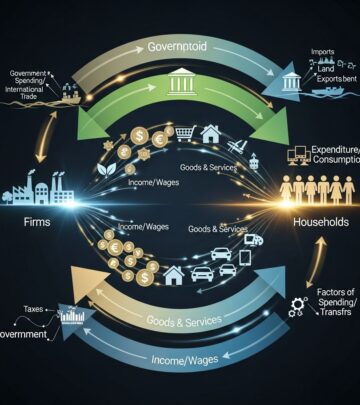
The velocity of money is a fundamental economic concept that measures how quickly money circulates through an economy. Specifically, it represents the average number of times a single unit of currency is used to purchase goods and services within a given time period. Rather than sitting idle in bank accounts or under mattresses, money constantly moves from one transaction to another, creating the lifeblood of economic activity. Understanding this concept is essential for policymakers, investors, and anyone interested in comprehending how economies function.
In practical terms, when you purchase a coffee at a café, that money enters the business owner’s account. The owner may then use that same money to pay an employee, who spends it at a grocery store, which uses it to restock inventory from a distributor. Throughout this chain of transactions, the single dollar bill has generated economic value multiple times over. This continuous movement and reuse of money is precisely what economists mean when they discuss the velocity of money.
The Definition and Core Concept
The velocity of money measures the number of times that one unit of currency is used to purchase goods and services within a given time period. It essentially indicates how many times per period money is changing hands or circulating to different owners in exchange for valuable goods and services. This concept directly relates the size of economic activity to a given money supply, establishing a crucial link between monetary policy and real economic outcomes.
At its core, velocity of money reflects people’s willingness and ability to spend. When velocity is high, it suggests that individuals and businesses are actively engaging in transactions, spending their money readily, and keeping capital in circulation. Conversely, when velocity is low, it indicates that people are holding onto their money, spending less frequently, and potentially hoarding cash—a situation often seen during economic downturns or periods of uncertainty.
The relationship between velocity and money demand is quantitative and measurable. The equation for this relationship states that Velocity equals Nominal Transactions divided by Nominal Money Demand. This mathematical framework allows economists to analyze precisely how changes in spending patterns affect the broader economy.
The Velocity of Money Formula
Calculating velocity of money involves a straightforward mathematical formula that relates gross domestic product to the money supply. The primary formula used by economists is:
Velocity = GDP / Money Supply
More formally, this can be expressed as: V = PQ / M, where:
- V = Velocity of money
- P = Price level (average prices of goods and services)
- Q = Quantity of real expenditures on newly produced goods and services
- M = Total nominal money supply in circulation
- PQ = Nominal GDP
To illustrate this formula with a practical example, consider a simplified economy where the total money supply is $100 million and the nominal GDP is $500 million. Using the formula, the velocity would be calculated as: V = $500 million / $100 million = 5. This result indicates that, on average, each dollar in the money supply was used five times during that period to purchase goods and services.
Another way to think about velocity is to consider a closed economy where two individuals each have $50. If they collectively spend $2,400 on goods and services during a year, the velocity calculation would be: $2,400 / $100 = 24, meaning the money was used an average of 24 times.
The money supply in these calculations typically refers to M1 or M2 measures. M1 includes physical currency and demand deposits (money in checking accounts), while M2 includes M1 plus savings accounts and money market accounts. The choice between M1 and M2 can affect the calculated velocity, so economists must be consistent in their methodology.
The Quantity Theory of Money
The velocity of money is a crucial component of the Quantity Theory of Money, one of the most important frameworks in macroeconomics. This theory establishes a direct relationship between the money supply, price levels, and economic output. The foundational equation is:
MV = PQ
Where M is money supply, V is velocity, P is price level, and Q is real output. This equation illustrates that the money supply multiplied by its velocity equals the total spending in the economy, which must equal prices multiplied by the quantity of goods and services produced.
The implications of this theory are significant. If velocity (V) and real output (Q) remain constant, and the money supply (M) increases, then the price level (P) must increase. In other words, too much money chasing the same amount of goods and services drives up prices, leading to inflation. This relationship explains why central banks closely monitor money supply growth and attempt to maintain it at levels consistent with their inflation targets.
However, the assumption that velocity remains constant has been challenged by real-world observations. Between 2008 and 2013, for example, the U.S. money supply grew at an average pace of 33 percent per year while output grew at just below 2 percent annually. According to the Quantity Theory prediction, inflation should have reached approximately 31 percent per year, yet inflation remained persistently below 2 percent. This discrepancy revealed that velocity had actually declined significantly, offsetting the monetary expansion and preventing the predicted inflation surge.
Why Velocity of Money Matters
Understanding velocity of money is essential for several reasons that directly impact economic policy and individual financial decisions:
Economic Health Indicator
Some economists consider velocity of money to be a relevant indicator of an economy’s overall health, correlating higher velocity with a more prosperous economy. When an economy is expanding, people and companies spend more money, which increases velocity. Conversely, during recessions or periods of economic stagnation, velocity typically declines as consumer and business confidence weakens.
Inflation Analysis
The speed of money exchange is one of the variables that determine inflation. By analyzing changes in velocity alongside money supply growth, economists can better predict and explain inflationary pressures. A sudden increase in velocity with a stable money supply can signal emerging inflation risks.
Monetary Policy Effectiveness
Central banks rely on velocity calculations to assess the effectiveness of their monetary policies. If the Federal Reserve increases the money supply but velocity remains stagnant, the expansion may have limited impact on economic growth. This relationship helps explain why quantitative easing policies during the 2008 financial crisis had more muted effects than some traditional models predicted.
Economic Activity Measurement
Velocity serves as a gauge of the economy’s strength and people’s willingness to spend money. When more transactions are being made throughout the economy, velocity increases and the economy is likely to expand. Conversely, when fewer transactions occur, velocity decreases and economic contraction may follow.
Factors That Affect Velocity of Money
Multiple factors influence how quickly money circulates through an economy. Understanding these factors provides insight into why velocity fluctuates over time and differs across countries:
Changes in Money Demand
The velocity of money has an inverse relationship with both money supply and money demand. Generally, when demand for money increases, people hold more cash for precautionary or transaction purposes, causing velocity to decrease. Conversely, when demand for money decreases, people spend their holdings more readily, increasing velocity. For example, lower demand for money often results in higher spending and increased investments, both of which accelerate money movement through the economy.
Interest Rates and Opportunity Costs
The opportunity cost of holding money significantly affects velocity. When interest rates are high, holding cash becomes expensive—individuals and businesses can earn more by investing or depositing money in interest-bearing accounts. This situation creates low money demand and increases velocity. Conversely, with low opportunity costs (low interest rates), velocity decreases because the incentive to hold cash rather than spend it diminishes.
Technology and Financial Innovation
Technological advances in payment systems and financial infrastructure have profound effects on velocity. As it becomes easier to transfer and transport money, funds become more quickly available for re-spending, which increases velocity. Digital banking, credit cards, mobile payment systems, and cryptocurrencies have all contributed to faster money circulation. The transition from cash-only economies to cashless systems typically results in higher velocity.
People’s Ability to Save
When people save through formal financial institutions rather than hoarding physical cash, their funds become available to businesses and consumers through credit markets and financial intermediaries. This increases velocity and leads to greater economic activity. Conversely, during economic crises or when confidence in banking systems erodes, people resort to hoarding cash, which lowers both the effective money supply and velocity.
Economic Confidence and Expectations
Consumer and business confidence play crucial roles in determining velocity. During periods of economic uncertainty or recession, both consumers and businesses become more cautious, reducing spending and lowering velocity. Periods of strong economic growth and optimism typically correlate with higher velocity as people and companies spend more freely.
Business Cycles
Velocity often correlates with business cycles, increasing during expansions and decreasing during contractions. As economic expansion accelerates and unemployment falls, consumer spending rises, and velocity increases. During downturns, the opposite occurs, with reduced spending and declining velocity.
The Relationship Between Velocity and Inflation
One of the most important relationships in macroeconomics exists between velocity and inflation. Holding the money supply constant, increases in velocity lead to higher prices. This is because velocity amplifies the effect of a given money supply on the overall price level. If the central bank maintains a fixed money supply but velocity doubles due to increased consumer spending and business activity, the economy effectively has twice as much purchasing power chasing the same amount of goods. The result is upward pressure on prices.
Conversely, even if a central bank dramatically expands the money supply, if velocity declines sufficiently—as happened in the post-2008 period—the inflationary impact may be muted or entirely offset. This explains why record monetary expansions during the financial crisis did not produce the hyperinflation that critics predicted. The sharp decline in velocity as consumers and businesses retrenched more than compensated for the increase in money supply.
Velocity in Different Economic Scenarios
During Economic Expansions
In periods of robust economic growth, velocity typically rises. Consumer confidence is high, unemployment is low, and businesses invest heavily in expansion. Money changes hands rapidly as consumers purchase goods and services, businesses pay suppliers and employees, and investors fund new ventures. This rapid circulation of money supports economic growth and is often associated with GDP increases of 2-3% annually or higher.
During Economic Recessions
Economic downturns are characterized by declining velocity. As unemployment rises and income falls, consumers reduce spending dramatically. Businesses cut investment and delay purchases. Banks tighten lending standards, making it harder for businesses to access credit. The result is money moving through the economy more slowly, sometimes dramatically so. The 2008 financial crisis saw one of the sharpest declines in velocity in modern economic history.
During Inflationary Periods
Interestingly, very high inflation can actually reduce velocity in some circumstances. When inflation becomes severe or hyperinflation occurs, people attempt to spend money as quickly as possible before it loses value, but they also reduce the real amount of cash they hold, preferring to invest in hard assets. This creates complex dynamics where nominal velocity might increase but real economic activity declines.
Frequently Asked Questions
What is a normal velocity of money?
Velocity varies by country and time period. In the United States, long-term average velocity has typically ranged between 1.5 and 2.0 in recent decades, though it declined significantly following the 2008 financial crisis. There is no single “normal” value, as velocity depends on technological sophistication, financial market development, and economic conditions.
How does velocity of money affect my investments?
Rising velocity can indicate inflationary pressures, which typically hurt fixed-income investments like bonds but may benefit equity investments in companies with pricing power. Declining velocity may signal economic weakness, which often leads to stock market declines and reduced corporate profits.
Can the government control velocity of money?
Direct control of velocity is difficult, but government policies indirectly influence it. Fiscal stimulus can increase spending and velocity. Interest rate policy affects the opportunity cost of holding money. Financial regulations and infrastructure investments in payment systems can facilitate faster money circulation.
Why did velocity decline after 2008?
Following the 2008 financial crisis, households and businesses dramatically increased savings rates and reduced spending due to lost wealth, income uncertainty, and damaged confidence. Financial deleveraging also reduced credit availability, further slowing money circulation.
Is higher velocity always better?
Not necessarily. While moderate velocity increases typically indicate healthy economic expansion, extremely high velocity combined with rapid money supply growth can signal dangerous inflation. Additionally, very rapid velocity in speculative bubbles can precede market crashes. Optimal velocity depends on overall economic conditions and inflation targets.
References
- Velocity of Money — Fiveable. 2025. https://fiveable.me/key-terms/ap-macro/velocity-of-money
- Velocity of Money — Wikipedia. 2025. https://en.wikipedia.org/wiki/Velocity_of_money
- What Does Money Velocity Tell Us about Low Inflation in the U.S.? — Federal Reserve Bank of St. Louis. September 2014. https://www.stlouisfed.org/on-the-economy/2014/september/what-does-money-velocity-tell-us-about-low-inflation-in-the-us
- What is the Velocity of Money? — GoCardless. 2025. https://gocardless.com/en-us/guides/posts/what-velocity-of-money/
- A Definitive Guide to the Velocity of Money — Indeed.com. 2025. https://www.indeed.com/career-advice/career-development/velocity-of-money
- Section 8: Velocity and the Quantity Theory of Money — Inflate Your Mind. 2025. https://inflateyourmind.com/macroeconomics/unit-9/section-3-united-states-federal-government-expenditures-23/
- Video: Velocity of Money | Definition, Formula & Examples — Study.com. 2025. https://study.com/academy/lesson/video/the-velocity-of-money-definition-and-circulation-speed.html
Similar Articles








Read full bio of Sneha Tete