Understanding Monthly Vehicle Lease Costs in 2026
Discover what drives monthly lease payments and how to evaluate fair pricing

Leasing a vehicle offers flexibility and predictability for drivers who prefer not to commit to ownership long-term. However, understanding what determines your monthly lease payment can help you identify whether you’re getting a competitive deal. The automotive leasing market has evolved considerably, with several interconnected factors now influencing the cost of taking a vehicle home each month.
The Foundation: How Lease Payments Are Calculated
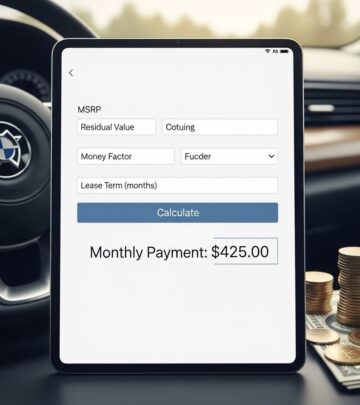
Monthly lease payments result from three primary components working together. The first is the capitalized cost, which represents the agreed-upon selling price of the vehicle. The second factor is the money factor, essentially an interest rate applied to your lease. The third is the residual value, which indicates what the leasing company estimates the vehicle will be worth when your lease concludes.
The relationship between these components determines affordability. A lower capitalized cost reduces your payment, as does a higher residual value—meaning the vehicle retains more value. Conversely, a higher money factor increases costs. Understanding these mechanics helps you recognize which negotiations might yield the most savings.
Benchmarking Your Lease Payment: The Percentage-Based Approach
Industry professionals often reference a straightforward metric for evaluating lease competitiveness. A well-negotiated lease typically costs approximately 1% of the vehicle’s manufacturer suggested retail price (MSRP) per month. This serves as a useful starting point for comparing offers.
Applying this metric to common vehicle scenarios illustrates the concept:
- A sedan priced at $35,000 MSRP should ideally lease for roughly $350 monthly
- An SUV valued at $50,000 MSRP would expectedly cost around $500 monthly
- A premium vehicle with a $70,000 MSRP might run approximately $700 monthly
- A mid-range vehicle at $40,000 MSRP would typically fall around $400 monthly
This benchmark provides context for initial negotiations, though actual payments vary based on multiple market conditions and individual circumstances. It’s important to view this as a guideline rather than an absolute standard.
Lease Payment Ranges Across Vehicle Categories
Different vehicle segments command varying lease payments due to their distinct price points, depreciation patterns, and market demand. Understanding category-specific benchmarks helps you assess whether an offer aligns with market norms.
Compact and Mid-Size Sedans
Smaller sedan options represent popular lease choices for budget-conscious drivers. Compact sedans with MSRPs between $28,000 and $32,000 typically feature monthly payments in the $250 to $320 range when dealers offer competitive incentives. Models like the Toyota Camry, Honda Accord, and Hyundai Sonata frequently serve as market references.
Mid-size sedans occupying the $33,000 to $40,000 MSRP band generally command $330 to $400 monthly on favorable deals. These vehicles appeal to professionals seeking reliability combined with affordability.
Compact SUVs and Crossovers
The compact SUV segment has become increasingly popular among lease shoppers. Vehicles in the $35,000 to $42,000 price range typically lease for $350 to $420 monthly. The Toyota RAV4, Honda CR-V, and Mazda CX-50 represent common benchmarks in this category, benefiting from strong residual values and manufacturer support.
Mid-Size SUVs and Luxury Options
Larger SUVs spanning $42,000 to $55,000 in MSRP generally fall within the $420 to $550 monthly payment range. Models like the Toyota Highlander, Kia Telluride, and Hyundai Palisade often feature attractive lease programs when manufacturers activate incentives.
Luxury compact vehicles priced between $45,000 and $55,000 typically command $450 to $550 monthly. Premium brands including BMW, Mercedes-Benz, and Lexus frequently subsidize their lease programs to drive volume, potentially offering better deals than non-luxury competitors.
Luxury mid-size SUVs in the $55,000 to $75,000 category can reach $550 to $750 monthly. The BMW X5, Mercedes GLE, and Lexus RX exemplify premium options that sometimes feature aggressive lease support from manufacturers.
What Influences Your Specific Payment Amount
Vehicle Pricing Dynamics
The average transaction price for new vehicles in the United States has increased substantially, currently hovering around $48,000 to $50,000 in early 2026, compared to approximately $38,000 in 2019. This $10,000+ elevation in average pricing translates directly to higher monthly depreciation costs on leases. For a 36-month lease, this price increase alone contributes roughly $280 additional monthly depreciation charges.
Interest Rate Environment
The Federal Reserve’s rate adjustments in 2022-2023 established elevated interest rate conditions that persist into 2026. While some reductions have occurred since peak levels, money factors on most leases remain higher than the historically low rates of 2020-2021. A higher money factor typically adds $20 to $60 monthly depending on vehicle price and dealer markup.
Residual Value Considerations
Residual values represent what leasing companies project vehicles will be worth at lease conclusion. During the used-car price surge, these values became artificially inflated. As the used-car market normalized, many residual values adjusted downward, increasing depreciation costs and pushing payments higher. However, vehicles with strong reputations—particularly Toyota, Honda, and certain luxury marques—have maintained relatively stable residual values.
Mileage Allowances and Drive-Off Costs
Your negotiated mileage limit influences pricing, with higher annual allowances commanding premium payments. Drive-off costs, including documentation fees, registration, and initial payments, also affect total lease expenses. These components provide negotiation opportunities beyond the base monthly figure.
Current Market Context for Lease Payments
Lease payment trends reflect broader automotive market conditions. Average lease payments have climbed steadily since 2020, driven by accumulated vehicle price increases, elevated interest rates, and adjusted residual values. However, this broader trend masks significant variation across specific makes and models. Some brands and individual models actually offer more favorable lease terms in 2026 compared to the previous year, creating opportunities for savvy shoppers.
New car lease payments have stabilized in the range of $660 to $770 monthly across the market. This represents a notable increase from pre-pandemic periods but reflects equilibrium in current market conditions.
Strategies for Negotiating Better Lease Terms
Securing a competitive lease requires understanding which levers you can actually adjust. While the 1% benchmark provides context, several negotiation strategies can improve your position:
- Obtain multiple dealer quotes to establish market rates for your target vehicle
- Time your lease around manufacturer incentive periods when brands offer enhanced support
- Research residual values for your specific model to identify underpriced estimates
- Negotiate the capitalized cost separately from other lease terms
- Consider vehicles with strong loyalty programs that may offer better rates for existing brand owners
- Evaluate different lease terms, as shorter periods sometimes feature different pricing structures
- Review money factor transparency and request clarification on dealer markup components
Comparing Lease Payments to Purchase Alternatives
Understanding lease payments in context requires comparison with other vehicle acquisition methods. New vehicle purchases currently average $767 monthly in payment amounts, significantly exceeding typical lease costs. Used vehicle purchases average $537 monthly, though these typically involve longer loan terms and eventual ownership responsibilities.
For drivers prioritizing predictability, warranty coverage, and the latest vehicle technology, leasing may offer better value than the ownership alternatives, particularly when lease payments fall within the 1% MSRP benchmark or lower. However, drivers who accumulate high annual mileage or prefer long-term vehicle retention may find purchasing more economical despite higher monthly payments.
Common Questions About Lease Payment Pricing
Why Do Similar Vehicles Have Different Lease Payments?
Variations stem from numerous factors including specific trim levels, optional packages, regional pricing differences, manufacturer incentive availability, and dealer-specific markups. Two identically-equipped vehicles may command different payments based on market timing and individual dealership negotiations.
Can I Negotiate My Lease Payment Down?
Yes, several components offer negotiation potential. The capitalized cost represents the primary lever—negotiating a lower agreed-upon vehicle price directly reduces monthly payments. Money factor markup and drive-off charges also provide negotiation opportunities. However, residual values set by leasing companies offer less flexibility.
How Do Residual Values Affect What I Pay?
Residual values represent the leasing company’s estimate of what your vehicle will be worth at lease end. Higher residuals mean less depreciation for you to finance, lowering payments. Vehicles known for reliable resale value—like Toyotas and Hondas—typically maintain favorable residuals, resulting in lower lease payments relative to vehicles with weaker resale records.
Should I Expect Lease Payments to Decrease Soon?
Future payment trends depend on vehicle pricing, interest rates, and residual value stabilization. While the current market has stabilized after the dramatic increases following the chip shortage, meaningful reductions would require vehicle prices to decline substantially or interest rates to drop significantly—neither of which is assured in near-term forecasts.
Making Your Lease Decision
Evaluating a lease payment requires multi-layered analysis. Begin by applying the 1% benchmark to your target vehicle’s MSRP, establishing a baseline expectation. Research category-specific payment ranges to understand whether your vehicle class typically commands premium pricing. Request quotes from multiple dealers to compare actual offers. Finally, ensure you understand all included and excluded costs to calculate your true monthly obligation.
By combining benchmark knowledge with market research and negotiation skills, you can identify whether a presented lease payment represents fair value or whether better terms exist within your market.
References
- What Is a Good Lease Payment in 2026? Real Examples — The Vantage Group Auto. 2026. https://www.thevantagegroupauto.com/blog/what-is-a-good-lease-payment-2026
- Buying vs Leasing vs Paying Cash For a Car: The Reality in 2026 — The Table with AO. 2026. https://www.youtube.com/watch?v=6I52SLIDDSg
- Are Lease Payments Going Up in 2026? Market Breakdown — The Vantage Group Auto. 2026. https://www.thevantagegroupauto.com/blog/are-lease-payments-going-up-2026
- Average Car Payments in 2026: What To Expect — Bankrate. 2026. https://www.bankrate.com/loans/auto-loans/average-monthly-car-payment/
Similar Articles








Read full bio of medha deb