Variable-Rate CDs: Risks, Rewards, and Smart Use
Understand how variable-rate CDs work, their biggest pitfalls, and how to decide if they fit your savings strategy.
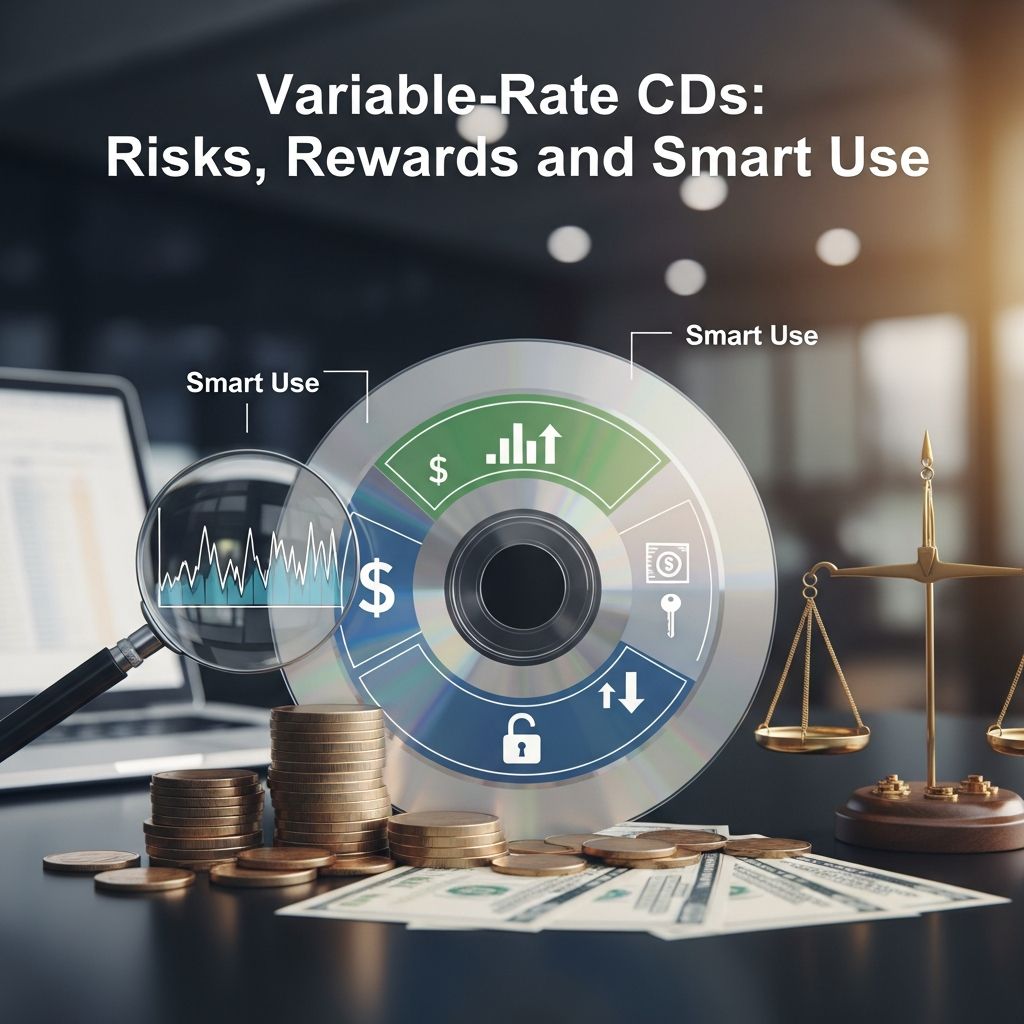
Variable-rate certificates of deposit (CDs) can look appealing when interest rates are moving, especially if you worry about locking into a fixed rate and missing out on future increases. However, these products come with specific caveats that can undermine your returns if you do not fully understand how they work.
This guide explains the key features of variable-rate CDs, the biggest risks and hidden trade-offs, how they compare with fixed-rate CDs and other savings vehicles, and how to decide whether they belong in your overall savings strategy.
What Is a Variable-Rate CD?
A variable-rate CD is a time deposit that holds your money for a set term but pays an interest rate that can change over that period. Unlike a traditional fixed-rate CD, which locks in an annual percentage yield (APY) for the entire term, a variable-rate CD’s interest rate is periodically adjusted based on a reference indicator or specific terms set by the bank.
How Variable-Rate CDs Differ from Fixed-Rate CDs
Both fixed and variable-rate CDs share some basic characteristics: they usually require leaving your money on deposit until maturity and they generally charge a penalty if you withdraw your funds early. The key difference is rate behavior over time.
| Feature | Fixed-Rate CD | Variable-Rate CD | |
|---|---|---|---|
| Interest rate | Stays the same for the entire term | Can move up or down during the term | |
| Predictability of returns | Very predictable; earnings known in advance | Uncertain; total interest depends on future rates | |
| Benefit when market rates rise | No benefit; you remain at the old rate | Potential benefit if the CD rate is allowed to adjust higher | |
| Benefit when market rates fall | Protected; your rate stays locked | At risk; your rate may drop over time | |
| Typical use | Income stability and certainty | Trying to gain from possible rate increases |
What Drives the Interest Rate on a Variable-Rate CD?
Banks often link variable CD rates to an external benchmark or internal pricing formula. Common influences include:
- Short-term market interest rates, such as rates on Treasury bills or interbank lending markets
- Prime rate, often used as a reference rate for consumer lending
- Inflation-linked measures or internal bank indices in some products
Some variable CDs specify a margin or spread over a benchmark rate, while others simply give the bank discretion to adjust the rate at set intervals. The details in the disclosure documents determine how much you might benefit—or suffer—from future rate changes.
Main Caveats of Variable-Rate CDs
Variable-rate CDs are often marketed as a way to benefit from rising interest rates, but they come with several important caveats that savers commonly overlook.
Caveat 1: Rising Rates Are Not Guaranteed
One of the biggest hazards is assuming that rates will rise during your CD term. Interest-rate cycles are influenced by inflation, economic growth, and central bank policy, and they do not always move in one direction for as long as consumers expect.
If you buy a variable-rate CD in a low-rate environment, hoping rates will climb significantly, you may face several outcomes:
- Rates rise, but more slowly than expected, giving you only modest gains over a comparable fixed-rate CD.
- Rates remain low for much of your term, leaving you with lackluster returns.
- Rates rise and then fall again, and your rate is cut just as you were starting to benefit.
Because these products lack certainty, you should treat potential rate increases as a possibility, not a guarantee.
Caveat 2: The Bank Controls When and How the Rate Changes
Even when the market rate moves in your favor, the benefit you receive depends heavily on the CD’s terms. Some variable-rate CDs:
- Adjust only at pre-set intervals (for example, quarterly or annually)
- Use a lagging benchmark, so your CD rate responds slowly to changes
- Include limits on increases or floors and caps that restrict movement
For example, a bank might tie your CD to a prime rate index but only update your rate twice per year. If market rates surge just after an adjustment date, you may have to wait months before your CD rate catches up—if it fully does at all.
Caveat 3: Rate Decreases Can Hurt More Than Increases Help
Volatility is a double-edged sword. While higher rates can boost your returns, rate cuts can quickly erode your yield—and there is no guarantee that upside and downside will balance out during your term.
Consider that:
- Fixed CDs protect you from rate cuts; variable CDs do not.
- A sharp decline in market rates early in your term can lock in low earnings for months or years.
- If you decide to exit after rates fall, early withdrawal penalties may wipe out much of the interest you earned.
In other words, you accept a meaningful downside in exchange for an uncertain upside.
Caveat 4: Lower Starting Rates and Fees for Rate Features
Variable-rate CDs sometimes feature additional options, such as a one-time bump-up that allows you to increase your rate during the term. In exchange, the bank may offer a lower initial rate than comparable fixed CDs or charge in other ways.
This creates a trade-off:
- If rates rise enough and you successfully bump your rate, you may come out ahead.
- If rates do not rise much—or if they fall—you may be stuck with a below-average return for the entire term.
Always compare the starting APY and total potential yield with plain fixed CDs before deciding that a special feature is worth the cost.
Caveat 5: Marketing Messages Can Be Misleading
Because variable-rate CDs sound flexible and responsive, they may be promoted as a simple way to “ride” interest-rate trends. The reality is more nuanced:
- Marketing materials may highlight best-case scenarios where rates climb steadily.
- They may not emphasize the risk of prolonged low or falling rates.
- Disclosures outlining how and when rates can change are often dense and easy to skim over.
To protect yourself, focus on the actual formula, adjustment schedule, and caps or floors specified in the account agreement, rather than hypothetical examples.
When Variable-Rate CDs Might Make Sense
Despite these caveats, variable-rate CDs can play a role in certain situations. The key is matching the product to realistic expectations about interest rates and your personal objectives.
Scenario 1: Short-to-Moderate Horizons with Rising-Rate Potential
Variable-rate CDs tend to make the most sense when:
- You expect rates to rise gradually rather than sharply and unpredictably.
- The CD has a transparent link to a benchmark and a fair adjustment schedule.
- You can tolerate some uncertainty in your total return.
If the starting rate is competitive and the bank’s terms allow your CD to respond reasonably quickly to market changes, you may benefit from a moderate rate uptrend.
Scenario 2: Complementing Fixed-Rate CDs in a Ladder
Instead of choosing all fixed or all variable-rate CDs, some savers combine them in a CD ladder. A ladder spreads maturity dates across multiple terms to reduce reinvestment risk.
You might, for example:
- Hold shorter-term variable CDs to potentially benefit from nearer-term rate moves.
- Lock a portion of your funds in longer-term fixed CDs for stability.
This blended approach can give you some protection if your expectations about the rate environment are wrong, since not all of your money depends on a single rate outcome.
Scenario 3: You Value FDIC Insurance and Safety but Want Some Upside
For risk-averse savers, the appeal of CDs is often the combination of principal protection and deposit insurance. In the United States, qualifying deposits at FDIC-insured banks are protected up to set limits, providing a high level of security for your cash.
Variable-rate CDs can preserve these safety features while adding the possibility of higher yields if rates move upward. However, that potential upside still has to be weighed against the loss of predictability.
When Variable-Rate CDs May Be a Poor Choice
In several common circumstances, a traditional fixed-rate CD or another savings vehicle may be more suitable than a variable-rate CD.
If You Need Certainty About Future Income
Retirees or anyone relying on predictable interest income often favor fixed-rate CDs precisely because the rate does not change. Variable-rate CDs can undermine budgeting efforts because:
- Monthly or quarterly interest payments may fluctuate.
- Rate cuts could reduce your income without warning.
- You may feel pressured to exit early and incur penalties if returns fall too low.
If You Do Not Plan to Hold to Maturity
Most CDs, fixed or variable, involve early withdrawal penalties if you redeem them before maturity. However, with variable-rate CDs there is a greater chance that unexpected rate movements will tempt you to exit:
- If rates spike and your CD does not keep up, you might want to withdraw and seek a better rate elsewhere.
- If rates plunge and your CD’s rate is cut, you may feel stuck earning less than you could in other deposits.
Because early withdrawals can offset or even negate your interest, variable-rate CDs are best suited for funds you can commit with high confidence for the full term.
If You Can Earn More with Flexible Accounts
In some rate environments, high-yield savings accounts or money market accounts may offer rates similar to or even higher than certain variable CDs, while remaining more liquid. If the starting APY on a variable CD is not clearly better than those alternatives, and the rate terms are complex or restrictive, tying up your money may not be justified.
How to Evaluate a Variable-Rate CD Offer
Before opening a variable-rate CD, it is critical to review the specific terms. Do not rely solely on the product name or marketing description.
Key Questions to Ask
- What is the starting APY? Compare it directly with competitive fixed-rate CDs and liquid accounts.
- How and when can the rate change? Look for the adjustment frequency and whether it is tied to a clear benchmark.
- Are there caps, floors, or limits? Understand the maximum and minimum possible rate over your term.
- Is there a bump-up or special feature? If so, what trade-offs are you accepting in exchange?
- What is the early withdrawal penalty? Be clear about how much interest you could lose if you might need the funds early.
Comparing Different CD Options
Use the following comparison framework when reviewing multiple offers:
| Criterion | Variable-Rate CD A | Fixed-Rate CD B | Online Savings Account |
|---|---|---|---|
| Starting APY | Higher / lower / similar? | Known for full term | Can change at any time |
| Rate certainty | Low | High | Low |
| Liquidity | Penalties for early withdrawal | Penalties for early withdrawal | Usually no penalty |
| Potential in rising-rate environment | Moderate to high, depending on terms | Low (rate locked) | Moderate; banks may raise or hold rates |
| FDIC/NCUA insurance eligibility | Yes (if issued by insured bank/credit union) | Yes | Yes |
Frequently Asked Questions (FAQs)
Q: Are variable-rate CDs safe?
A: In terms of principal safety, variable-rate CDs at FDIC-insured banks or NCUA-insured credit unions are generally as safe as fixed-rate CDs, up to the applicable insurance limits. The main risk relates to the variability of the interest you earn, not the safety of your insured deposit.
Q: Can I lose money on a variable-rate CD?
A: You are unlikely to lose principal if your deposit remains within insurance limits and you hold the CD to maturity. However, you can effectively “lose” potential earnings if rates fall or if you pay an early withdrawal penalty that offsets much of your interest.
Q: How often do variable CD rates change?
A: Adjustment frequency varies by product. Some CDs adjust monthly or quarterly, while others follow a different schedule or a specific benchmark formula. The account agreement will spell this out; always check it before opening the account.
Q: Are variable-rate CDs better than fixed-rate CDs?
A: Neither is inherently better. Variable-rate CDs may outperform fixed CDs in certain rising-rate environments, but they can underperform if rates are flat or fall. The right choice depends on your rate outlook, risk tolerance, and need for predictable income.
Q: Who should consider a variable-rate CD?
A: Variable-rate CDs may suit savers who want insured, relatively low-risk savings vehicles but are willing to accept uncertain yields in exchange for potential benefits when rates rise. They are less suitable for those with fixed income needs or a low tolerance for fluctuating returns.
References
- What Is a CD (Certificate of Deposit)? — Bankrate. 2024-02-01. https://www.bankrate.com/banking/cds/what-is-a-cd/
- What Is a Variable-Rate CD? — SoFi. 2023-08-16. https://www.sofi.com/learn/content/what-is-a-variable-rate-certificate-of-deposit/
- Variable-Rate Certificate of Deposit — Corporate Finance Institute. 2022-05-10. https://corporatefinanceinstitute.com/resources/wealth-management/variable-rate-certificate-of-deposit/
- Types of Certificates of Deposit Explained — Rising Bank. 2023-06-30. https://www.risingbank.com/types-of-certificates-of-deposit-explained/
- Variable Rate CD Product Information — United Security Bank. 2024-01-10. https://www.unitedsecuritybank.com/variable-rate-cd
Similar Articles








Read full bio of medha deb