Value Vs Growth Vs Index Investing: A Guide For 2025
Compare value, growth, and index investing strategies to find the right approach for your portfolio.
Understanding Investment Strategies: Value vs. Growth vs. Index Investing
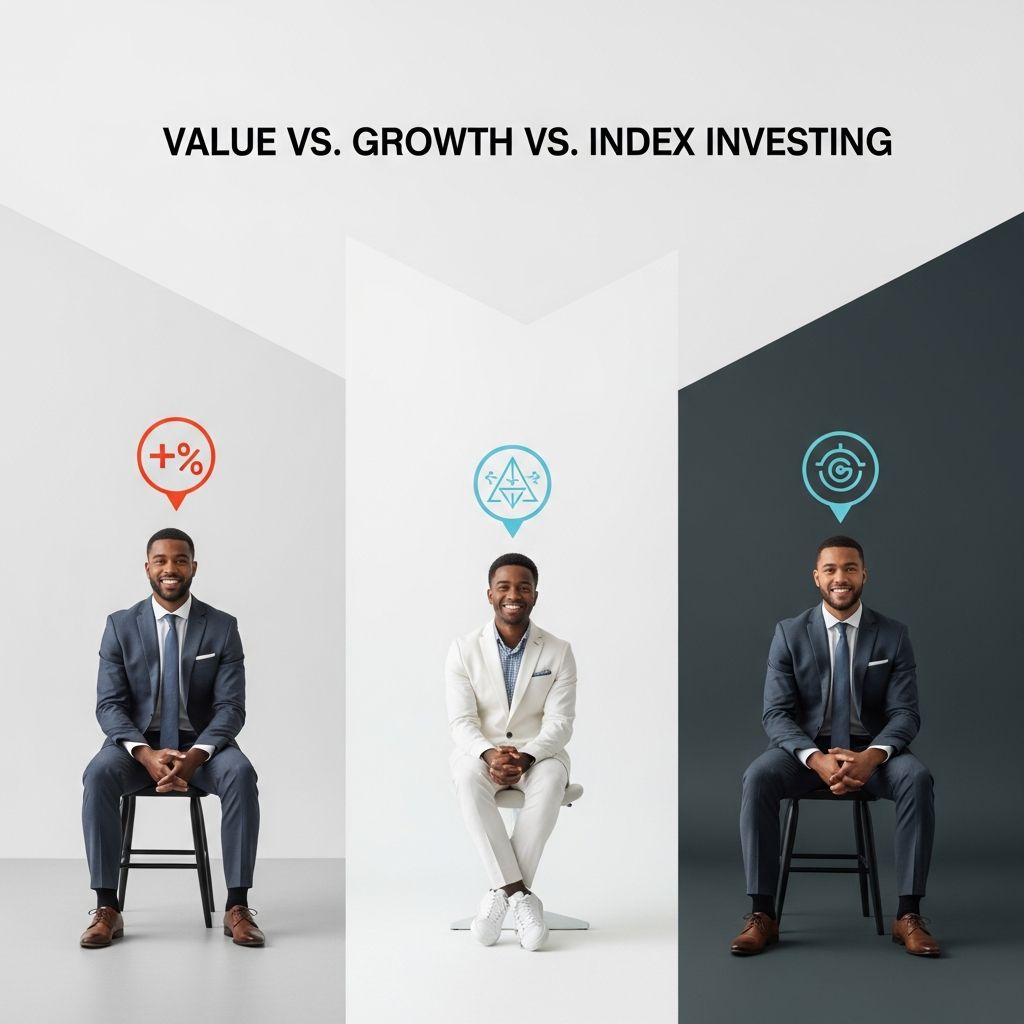
When it comes to building an investment portfolio, investors face several strategic choices about how to allocate their money. Three of the most popular investment approaches are value investing, growth investing, and index investing. Each strategy offers distinct advantages and disadvantages, and understanding the differences between them can help you make more informed decisions about your financial future.
The investment landscape is filled with different philosophies and methodologies, but these three approaches represent some of the most fundamental ways investors attempt to grow their wealth. Whether you are a beginner investor just starting out or an experienced portfolio manager looking to optimize your strategy, comparing these three approaches can provide valuable insights into which method might work best for your specific circumstances and investment goals.
What Is Value Investing?
Value investing is a strategy focused on finding companies whose stock prices are lower than their intrinsic or fundamental worth. Value investors look for what they consider “diamonds in the rough”—businesses trading at a discount to their true value. The fundamental premise behind value investing is that the market sometimes misprices stocks, and savvy investors can profit when the market eventually recognizes the company’s actual value and the stock price rises accordingly.
Characteristics of Value Stocks:
- Lower price-to-earnings (PE) ratios compared to the broader market
- Lower price-to-book ratios
- Higher dividend yields
- Often found in mature or established industries
- Companies that may be temporarily out of favor with investors
Value investors typically research companies thoroughly to identify those with strong fundamentals that the market has undervalued. They seek businesses with proven track records of generating profits, stable cash flows, and solid management teams. Because value stocks often pay dividends, investors benefit from income generation while waiting for the stock price to appreciate.
One of the primary advantages of value investing is the potential for lower risk. Value stocks have already demonstrated the ability to generate profits based on proven business models. Additionally, value stocks have more limited upside potential and, therefore, can be safer investments than growth stocks. The downside is that not all undervalued stocks will appreciate—investors may have correctly priced the stock already, meaning limited upside potential.
What Is Growth Investing?
Growth investing takes a different approach by focusing on companies expected to deliver better-than-average returns and expand earnings at a faster rate than the overall market. Growth investors are attracted to companies with strong competitive advantages, innovative business models, or those operating in rapidly expanding industries. Rather than looking backward at proven performance, growth investors look forward to future potential.
Characteristics of Growth Stocks:
- Higher price-to-earnings ratios relative to earnings or sales
- Lower or nonexistent dividend yields
- Companies operating in innovative or expanding industries
- Often include technology companies, biotech firms, and high-growth consumer brands
- Strong capital appreciation potential
Growth companies typically reinvest their earnings back into the business rather than paying dividends to shareholders. This allows them to fund research and development, expand operations, and pursue new market opportunities. Growth investors bet that these companies will continue to outperform and that stock prices will rise significantly as the companies reach their full potential.
The primary advantage of growth investing is the potential for substantial capital appreciation over time. However, this comes with increased risk. Growth stocks are expensive relative to their current earnings, meaning investors are paying a premium based on expectations of future performance. If those expectations don’t materialize, the stock price can decline sharply. Growth stocks also tend to experience higher volatility than value stocks.
Value vs. Growth: Key Differences
While both value and growth investors share the same ultimate goal—to buy low and sell high—they approach this objective from different angles. Understanding these differences is crucial for determining which strategy aligns with your investment philosophy and risk tolerance.
| Aspect | Value Stocks | Growth Stocks |
|---|---|---|
| Price Assessment | Currently undervalued | Currently overvalued |
| PE Ratio | Generally low | Above-average |
| Dividends | Generally high dividend yields | Low or no dividends |
| Risk Level | Lower risk, limited upside | Higher volatility, significant upside potential |
| Time Horizon | Patient, long-term investing | Long-term growth potential |
| Industry Focus | Mature, established industries | Innovative, expanding industries |
A stock that a value investor considers an attractive opportunity might be viewed as worthless by a growth investor, and vice versa. This fundamental philosophical difference explains why certain market conditions and economic cycles favor one approach over the other.
The Performance Cycles of Growth and Value
History demonstrates that the performance of growth stocks and value stocks has been cyclical. The stock market experiences periods where one approach dramatically outperforms the other. During the 1990s dot-com era, growth stocks significantly outperformed value stocks as investors became excited about technology companies. Growth stocks then performed extremely well for more than a decade afterward.
However, from 2001 to 2008, value stocks outperformed growth stocks as investors placed higher emphasis on fundamental valuations and lower forecasted growth values. Over the long term, research shows that value stocks have outperformed growth stocks by an average of 4.4% annually in the US since 1927. When value stocks do outperform, the average annual premium is nearly 15%.
Recently, growth stocks have experienced a strong performance run, but this may not continue indefinitely. Current valuations suggest potential opportunities ahead for value investors, as growth stocks trade at significantly higher price-to-earnings ratios compared to their historical averages.
What Is Index Investing?
Index investing represents a fundamentally different approach compared to value or growth strategies. Rather than attempting to identify undervalued or high-growth companies, index investors seek to replicate the performance of a market index by holding a diversified portfolio of securities that comprise that index. Common indices include the S&P 500, Russell 1000, Nasdaq-100, and many others.
Key Characteristics of Index Investing:
- Passive investment approach focused on matching market returns
- Low fees and expense ratios compared to actively managed funds
- Broad diversification across many companies and sectors
- Reduced need for constant monitoring and rebalancing
- Eliminates the challenge of stock picking
Index investing has gained tremendous popularity over the past two decades, driven by the recognition that most actively managed funds fail to consistently outperform their benchmarks after accounting for fees and expenses. By holding a diversified basket of stocks that mirrors a market index, investors can achieve market-level returns with minimal effort and cost.
Index Investing vs. Active Strategies
The main advantage of index investing is simplicity and cost-effectiveness. Index funds and exchange-traded funds (ETFs) typically charge significantly lower fees than actively managed value or growth funds. Over long periods, these lower fees can result in substantially higher after-tax returns for index investors compared to active managers.
Additionally, index investing provides automatic diversification. By holding hundreds or thousands of securities through a single fund, investors reduce the risk associated with individual stock selection. This approach works particularly well for investors who lack the time, expertise, or inclination to research individual companies.
However, index investing means accepting market returns rather than seeking to outperform the market. Index investors will never beat the market by definition, though they are also unlikely to underperform it significantly. For investors who believe they can identify undervalued stocks or high-growth opportunities, active value or growth investing strategies may seem more appealing.
Diversification Through Multiple Strategies
Many sophisticated investors recognize that these strategies need not be mutually exclusive. A well-constructed portfolio might include components of all three approaches. Some investors maintain a core index position providing broad market exposure while using value or growth strategies for satellite positions designed to enhance returns or provide specialized exposure to particular market segments.
The correlation between growth and value stocks is important for diversification purposes. Research shows that the correlation between growth and value equities is mostly positive, but dips around economic recessions. This means that while growth and value stocks typically move together, during periods of economic stress they can provide meaningful diversification benefits. Including both growth and value holdings in a portfolio can help reduce overall volatility and provide more consistent returns across different market environments.
Choosing the Right Strategy for Your Situation
Selecting between value, growth, and index investing depends on several personal factors including your investment experience, time availability, risk tolerance, time horizon, and financial goals.
Value investing may be appropriate if you:
- Have strong analytical skills and enjoy researching companies
- Have a long time horizon to allow for mean reversion
- Prefer lower volatility and income generation through dividends
- Believe markets frequently misprice securities
Growth investing may be appropriate if you:
- Have a long time horizon to weather volatility
- Can tolerate higher short-term price fluctuations
- Believe you can identify companies with sustainable competitive advantages
- Are comfortable with stocks that don’t pay dividends
Index investing may be appropriate if you:
- Prefer a passive, low-maintenance approach
- Want to minimize fees and taxes
- Don’t have time for company research
- Accept market returns as satisfactory
Market Cycles and Strategy Performance
The stock market experiences different cycles that favor either growth or value strategies at different times. During bull markets with strong economic growth, growth stocks often outperform. During economic slowdowns or periods of uncertainty, value stocks may perform better as investors seek stability and income.
Recent data shows that growth stocks have outperformed value stocks in five of seven time periods examined, with growth’s recent outperformance driven largely by sector allocation, particularly in technology and related high-growth sectors. However, valuations suggest potential opportunities ahead for value investors, as pure value indices maintain price-to-earnings ratios near their 15-year averages while pure growth indices trade significantly above historical averages.
Frequently Asked Questions About Investment Strategies
Q: Can I combine value, growth, and index investing in one portfolio?
A: Yes, many investors use a blended approach with a core index position supplemented by value or growth holdings. This combination can provide both broad market exposure and targeted opportunities for potential outperformance.
Q: Which strategy has historically performed better over long periods?
A: Over the long term since 1927, value stocks have outperformed growth stocks by approximately 4.4% annually on average. However, this varies by period, and growth has had extended periods of outperformance as well.
Q: What is the risk difference between these strategies?
A: Value stocks typically carry lower risk but limited upside potential. Growth stocks offer higher upside potential but with greater volatility. Index investing provides moderate risk through diversification.
Q: How do I know which strategy is right for me?
A: Consider your investment experience, time availability, risk tolerance, and financial goals. Beginners often start with index investing, while experienced investors may pursue value or growth strategies.
Q: Do growth stocks or value stocks pay dividends?
A: Value stocks typically offer higher dividend yields, while growth stocks generally pay low or no dividends as they reinvest earnings into business expansion.
Conclusion
Value investing, growth investing, and index investing each offer distinct approaches to building wealth through stock market participation. Value investing seeks underpriced opportunities with lower risk but requires research skills. Growth investing pursues companies with significant future potential, offering higher returns but with increased volatility. Index investing provides a passive, diversified approach with low costs and reliable market returns.
The best strategy depends on your individual circumstances, expertise, and investment philosophy. Many successful investors find that a combination of these approaches provides the optimal balance of opportunity, risk management, and return potential. Regardless of which strategy or combination you choose, maintaining a long-term perspective, staying disciplined through market cycles, and regularly reassessing your portfolio remains essential for investment success.
References
- Growth vs. Value Stocks – Updated Chart — Long Term Trends. 2025. https://www.longtermtrends.net/growth-stocks-vs-value-stocks/
- Growth vs. Value Stock Investing: Understanding the Differences — NerdWallet. 2025. https://www.nerdwallet.com/investing/learn/value-vs-growth-investing-styles
- Growth Vs. Value Investing — First Trust. 2025-09-16. https://www.ftportfolios.com/blogs/MarketBlog/2025/9/16/growth-vs.-value-investing
- Growth versus Value Investing — Fidelity. 2025. https://www.fidelity.com/learning-center/investment-products/mutual-funds/2-schools-growth-vs-value
- The Cyclical Nature of Growth vs. Value Investing — Hartford Funds. 2025-08-25. https://www.hartfordfunds.com/dam/en/docs/pub/whitepapers/CCWP105.pdf
- When It’s Value vs. Growth, History Is on Value’s Side — Dimensional. 2025. https://www.dimensional.com/ca-en/insights/when-its-value-versus-growth-history-is-on-values-side
Similar Articles








Read full bio of medha deb