Value at Risk (VaR): Definition, Methods, and Applications
Understanding VaR: A comprehensive guide to measuring portfolio risk and potential losses.

Value at Risk (VaR): Definition and Overview
Value at Risk, commonly abbreviated as VaR, is a statistical risk measurement technique used to quantify the level of financial risk within a firm or investment portfolio over a specific time frame. It represents the maximum amount of money an investor could lose on an investment with a given probability over a defined period, typically one day or ten days.
VaR has become an industry standard for measuring market risk exposure across financial institutions, from banks to hedge funds and pension funds. It provides portfolio managers and risk officers with a single, comprehensible metric that communicates potential losses in straightforward terms. Rather than presenting complex statistical analyses, VaR distills risk into a dollar amount that stakeholders can readily understand.
For example, if a portfolio has a one-day VaR of $1 million at a 95% confidence level, this means there is only a 5% chance that the portfolio could lose more than $1 million in a single day. This metric helps institutions set aside adequate capital reserves and make informed decisions about acceptable risk levels.
How Value at Risk Works
Value at Risk operates on the principle of measuring downside risk—the potential for losses rather than gains. The calculation involves three key components:
- Time Horizon: The period over which risk is measured, commonly one day for trading portfolios or ten days for longer-term holdings.
- Confidence Level: The probability that actual losses will not exceed the VaR estimate, typically set at 95% or 99%.
- Portfolio Composition: The specific assets and their weightings within the portfolio being analyzed.
The practical application of VaR involves examining historical price movements, current market conditions, and statistical correlations between assets. VaR calculations take into account the volatility of individual securities and the diversification benefits gained from holding multiple assets with different risk profiles.
Financial institutions use VaR to establish risk limits for traders and portfolio managers. If a trader’s portfolio VaR exceeds the established limit, it signals that the position carries too much risk and must be reduced or hedged. This disciplined approach helps prevent catastrophic losses and maintains organizational risk tolerance within acceptable parameters.
Methods for Calculating Value at Risk
There are three primary methodologies for calculating VaR, each with distinct advantages and limitations:
1. Historical Simulation Method
The historical simulation method assumes that past market behavior predicts future price movements. This approach involves analyzing actual historical returns of portfolio constituents over a specified period, typically one to five years of data.
- Organizes historical returns from worst to best performance
- Identifies the return at the specified confidence level cutoff
- Applies this historical return to the current portfolio value
- Does not assume any specific probability distribution
- Captures actual market events and extreme scenarios that occurred
The primary advantage of historical simulation is its simplicity and intuitiveness. It directly uses real market data without imposing assumptions about probability distributions. However, it assumes that past patterns will repeat, which may not hold during unprecedented market conditions.
2. Parametric Method (Variance-Covariance Method)
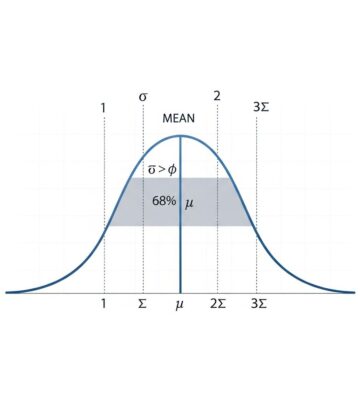
The parametric method, also called the variance-covariance approach, assumes that portfolio returns follow a normal distribution. This method uses mathematical models to estimate the mean return, standard deviation (volatility), and correlations between assets.
- Calculates the expected return and volatility of the portfolio
- Uses standard deviation multiplied by a confidence level factor
- Formula: VaR = Portfolio Value × Z-score × Standard Deviation
- Computationally efficient and quick to calculate
- Provides a closed-form solution without extensive simulations
This method is popular among financial institutions due to its computational efficiency and elegant mathematical framework. However, it assumes normal distribution of returns, which empirical evidence shows often underestimates the probability of extreme events, particularly during market crises when returns exhibit fat tails.
3. Monte Carlo Simulation Method
Monte Carlo simulation uses random sampling to generate thousands or millions of potential future price paths for portfolio assets. This method is the most flexible and can accommodate complex portfolios with non-linear instruments and multiple risk factors.
- Generates random price movements based on historical volatility and correlations
- Simulates portfolio performance across numerous scenarios
- Calculates the loss distribution from simulation results
- Extracts the VaR from the percentile of simulated losses
- Can model various distributions beyond normal distribution
While Monte Carlo simulation provides the most realistic risk assessment for complex portfolios, it requires significant computational resources and takes longer to execute compared to other methods. The accuracy depends heavily on the assumptions embedded in the model regarding volatility, correlations, and probability distributions.
VaR Confidence Levels and Time Horizons
The selection of confidence level and time horizon significantly impacts VaR calculations and their interpretation:
| Confidence Level | Interpretation | Common Use |
|---|---|---|
| 90% | 10% probability of exceeding loss | Aggressive portfolios |
| 95% | 5% probability of exceeding loss | Standard industry practice |
| 99% | 1% probability of exceeding loss | Conservative, regulatory requirement |
Time Horizons: A one-day VaR is appropriate for actively traded portfolios and daily risk management. A ten-day VaR aligns with regulatory requirements and longer-term holding periods. The longer the time horizon, the larger the potential VaR, as more time allows for greater price movements.
Applications of Value at Risk in Finance
VaR serves multiple critical functions within financial institutions and investment management:
- Risk Limit Setting: Establishing maximum acceptable VaR levels for traders and business units
- Capital Allocation: Determining how much capital to allocate to different trading desks and risk factors
- Regulatory Compliance: Meeting Basel III requirements and other regulatory capital standards
- Performance Attribution: Evaluating risk-adjusted returns by comparing profits to VaR-based risk exposure
- Portfolio Construction: Optimizing asset allocation to achieve target return levels at specified risk constraints
- Stress Testing: Complementing VaR with scenario analysis to assess performance during extreme market conditions
- Investor Communication: Conveying portfolio risk in understandable terms to stakeholders and clients
Limitations and Criticisms of VaR
While VaR is widely used, it has significant limitations that risk managers must understand:
Does Not Account for Tail Risk: VaR reveals the maximum loss at a given confidence level but provides no information about how much larger losses could be if the rare event beyond the confidence threshold occurs. For instance, a 95% VaR tells you about the worst 5% of scenarios but nothing about those extreme events.
Assumes Consistent Correlations: VaR typically assumes correlations between assets remain stable. During market stress events, however, correlations often increase dramatically or shift unexpectedly, meaning VaR underestimates risk when diversification benefits are needed most.
Sensitive to Methodology: Different VaR calculation methods can produce significantly different results for the same portfolio. The parametric method, for example, often underestimates VaR during periods of market turbulence.
Historical Limitations: Methods relying on historical data may not capture unprecedented risks. The 2008 financial crisis and COVID-19 pandemic demonstrated that markets can experience extreme movements well beyond historical precedent.
Not Additive Across Time: Due to changing market conditions and portfolio rebalancing, a ten-day VaR is not simply ten times the one-day VaR, making VaR comparisons across different time horizons problematic.
Fails to Indicate Magnitude of Losses Beyond VaR: VaR is a threshold measure; it does not indicate how severe losses could be beyond the calculated level, which can lull risk managers into complacency about extreme downside scenarios.
Value at Risk vs. Conditional Value at Risk (CVaR)
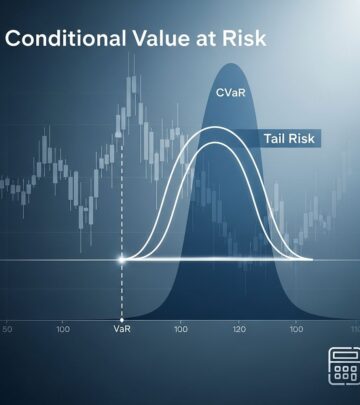
In response to VaR’s limitations, risk managers often use Conditional Value at Risk (CVaR), also known as Expected Shortfall. CVaR measures the expected loss given that losses exceed the VaR threshold.
For example, if a 95% VaR is $1 million, CVaR would calculate the average loss in the worst 5% of scenarios. If losses in those tail scenarios averaged $1.5 million, the CVaR would be $1.5 million. This metric provides crucial information about catastrophic risk that VaR overlooks.
Many sophisticated risk managers now use both VaR and CVaR together, with VaR serving as a daily monitoring metric and CVaR supplementing analysis with insight into tail risk exposure.
Frequently Asked Questions
Q: What does a VaR of $5 million at 95% confidence mean?
A: It means there is a 95% probability that the portfolio will not lose more than $5 million over the specified time period, and a 5% chance of losses exceeding $5 million.
Q: Why do banks use VaR for regulatory compliance?
A: Banks use VaR because regulatory bodies like the Basel Committee require it to calculate minimum capital reserves. It provides a standardized, comparable measure of risk across institutions.
Q: Which VaR calculation method is best?
A: No single method is universally superior. Historical simulation works well for standard portfolios with complete historical data. The parametric method is computationally efficient. Monte Carlo is most flexible for complex portfolios. Many institutions use multiple methods as cross-checks.
Q: Can VaR be negative?
A: VaR is typically expressed as a positive number representing potential loss. However, some contexts express it as negative to emphasize it represents downside risk.
Q: How often should VaR be calculated?
A: Most trading operations calculate one-day VaR daily at market close. Risk management frameworks often calculate VaR at multiple horizons and review it continuously during trading hours.
Q: Does VaR account for black swan events?
A: Traditional VaR models struggle with black swan events because they occur outside historical parameters. This is why stress testing and scenario analysis complement VaR to address tail risks.
References
- Basel Committee on Banking Supervision (BCBS). International Convergence of Capital Measurement and Capital Standards — Bank for International Settlements. 2010. https://www.bis.org/publ/bcbs128.htm
- Jorion, P. Value at Risk: The New Benchmark for Managing Financial Risk — McGraw-Hill, Third Edition. 2006.
- SEC. Risk Management Guidelines for Broker-Dealers — U.S. Securities and Exchange Commission. https://www.sec.gov/investor/pubs/riskmanagement.htm
- Dowd, K. Measuring Market Risk — John Wiley & Sons, Second Edition. 2007.
- Federal Reserve. Guidance on Model Risk Management — Board of Governors of the Federal Reserve System. 2011. https://www.federalreserve.gov/supervisionreg/srletters/sr1107.pdf
Similar Articles








Read full bio of medha deb