U.S. National Debt Clock: Definition and History
Understanding the National Debt Clock: From its 1989 inception to today's trillions.

The United States National Debt Clock stands as one of the most visible and tangible representations of America’s fiscal challenges. Installed prominently in New York City, this electronic billboard continuously displays the nation’s cumulative federal debt and calculates each American family’s proportional share. Unlike traditional clocks that measure time, the National Debt Clock measures dollars—specifically, the trillions of dollars the federal government owes to its creditors. Understanding what the debt clock represents and how it came to exist provides crucial insight into American fiscal policy and public awareness efforts surrounding government spending.
What Is the National Debt Clock?
The National Debt Clock is a billboard-sized, real-time display that shows the United States’ gross national debt and each American family’s share of that debt. Rather than counting seconds like a conventional timepiece, this specialized clock counts dollars accruing continuously due to ongoing government borrowing and interest accumulation. The display operates on an odometer-style mechanism, automatically updating throughout the day to reflect the estimated speed of debt growth. The numbers change so rapidly that observers can literally watch the debt increase in real time, with the display adjusting weekly according to the latest figures published by the United States Treasury.
The fundamental purpose of the National Debt Clock is to provide visual transparency regarding government borrowing. It transforms abstract economic statistics into an immediate, tangible reality that passersby can witness directly. The clock serves as a constant reminder of the nation’s fiscal obligations, making the invisible visible. Each increment on the display represents real financial obligations that the federal government must eventually address through taxation, spending adjustments, or additional borrowing.
How the Debt Accumulates
Understanding how the national debt grows requires examining the relationship between government revenues and expenditures. The national debt accumulates when the federal government spends more money than it receives from taxes and other revenue sources. This phenomenon, known as deficit spending, creates a shortfall that the government must finance through borrowing. Over many decades, these annual deficits compound, resulting in the astronomical total displayed on the National Debt Clock today.
Deficit spending has been a recurring feature of American fiscal policy, particularly during specific circumstances:
- Major military conflicts and defense buildups
- Economic recessions and financial crises
- Significant federal initiatives and social programs
- Emergency responses to national disasters or public health emergencies
When the government cannot balance its budget through revenues alone, it raises funds by issuing Treasury securities—bonds and bills that investors purchase. Foreign governments, domestic investors, the Federal Reserve, and financial institutions buy these securities, essentially lending money to the U.S. government in exchange for interest payments and eventual repayment. This borrowing mechanism allows the government to continue spending beyond its immediate revenues, but it creates obligations that accumulate over time with compound interest.
The Origin and Installation of the Clock
The story of the National Debt Clock begins with a concerned businessman named Seymour Durst, a prominent New York real estate developer. In the late 1980s, as the national debt approached and then exceeded $1 trillion, Durst became increasingly troubled by what he perceived as fiscal irresponsibility in government. He believed that American citizens were largely unaware of the magnitude of government debt and its implications for the nation’s future. This conviction motivated him to create a tangible, unavoidable reminder of the problem.
The first National Debt Clock was installed on February 20, 1989, on Sixth Avenue between 42nd and 43rd Streets in Manhattan, just one block from Times Square. At that time, the national debt stood at approximately $2.7 trillion. The original display measured 11 by 26 feet and was constructed at a cost of $100,000. The sophisticated electronic mechanism required 305 lightbulbs to operate, and maintenance costs amounted to $500 per month. Durst financed the entire project privately, viewing it as a civic duty to inform the public about government spending patterns.
Seymour Durst made an unequivocal statement about his intentions: the clock would “be up as long as the debt or the city lasts.” He further noted that “if it bothers people, then it’s working.” This declaration revealed Durst’s primary motivation—not merely to inform, but to provoke public consciousness and potentially inspire action toward fiscal responsibility. The clock’s location near Times Square ensured maximum visibility, with millions of tourists and New Yorkers encountering the display annually.
Evolution and Technical Challenges
The National Debt Clock’s journey has been marked by numerous technical challenges that reveal just how quickly American debt has grown. The original display operated for approximately nine years before encountering its first major problem. In 1998, shortly after the national debt surpassed $5.5 trillion, the clock malfunctioned. The cause was attributed to the numbers simply “being too high” for the original mechanical and electronic systems to handle. The Durst Organization responded by installing new computer technology inside the clock to manage the larger figures.
A remarkable and unusual period occurred in the early 2000s. Following budget surpluses during the late 1990s—a rare occurrence in modern American fiscal history—the national debt actually decreased temporarily. Consequently, the National Debt Clock ran backward between 1999 and 2000, displaying a declining debt figure. This reversal created confusion about the clock’s message and purpose. By May 2000, Douglas Durst, who had taken over operations from his father Seymour, announced plans to unplug the clock on what would have been Seymour’s 87th birthday, arguing that the clock had served its original purpose by raising awareness about rising debt.
The clock was indeed shut down in September 2000 and covered with a patriotic red-white-and-blue curtain, with the national debt fixed at approximately $5.7 trillion. However, this closure proved to be temporary. Less than two years later, in July 2002, the curtain was raised and the clock resumed operation as the debt resumed its upward trajectory, starting at $6.1 trillion.
The $10 Trillion Crisis and Major Upgrades
One of the most significant milestones in the National Debt Clock’s history occurred on September 30, 2008, during the financial crisis. On that date, the U.S. gross federal debt exceeded $10 trillion—a threshold the clock’s designers had never anticipated when creating the original display. The clock literally ran out of digits. With no space remaining to display a number beginning with “1” followed by zeros for the trillions place, the display innovation was to substitute the dollar sign ($) symbol with the digit “1,” thereby representing the debt had entered the ten-trillionth category.
This crisis prompted serious consideration of upgrading the National Debt Clock’s display capabilities. Plans emerged to add additional digits that would allow the clock to display debts up to $1 quadrillion—an amount once thought incomprehensibly large but now viewed as a prudent safety measure given the trajectory of American debt accumulation.
In 2004, before the $10 trillion crisis, the clock had already been relocated and upgraded. The new installation was positioned near 44th Street and Sixth Avenue and featured improved technology. The updated clock incorporated a brighter seven-segment LED display that allowed numbers to be read more easily and included bidirectional capability—the ability to run both forward and backward if necessary, unlike the original mechanism.
Current Location and Operations
As of 2017, the National Debt Clock was relocated once again, this time to the Bank of America Tower near its original Manhattan location. The Durst Organization has maintained responsibility for the clock’s operations and upkeep throughout its entire existence. In 2009, Jonathan “Jody” Durst, a cousin of Douglas, took over day-to-day operations as president of the organization managing the clock. He committed to maintaining the display for years to come, ensuring that Seymour Durst’s original vision continues to inform the public about government debt.
The mechanism that updates the National Debt Clock operates on a sophisticated but straightforward principle. The display is set to the estimated speed of debt growth based on Treasury Department data and automatically adjusts weekly according to the latest official figures published by the United States Treasury’s Bureau of the Fiscal Service. This regular calibration ensures that the numbers remain accurate and reflect current fiscal conditions.
Impact on Public Discourse
The National Debt Clock has transcended its role as a mere informational display to become a symbol in American political discourse. During the 2012 Republican National Convention, the Republican Party displayed similar debt-tracking mechanisms to underscore concerns about government spending under the Obama administration. The RNC displayed multiple debt clocks showing the accumulated debt increase since the convention’s opening, using the imagery to communicate concerns about “unprecedented fiscal recklessness” in government spending.
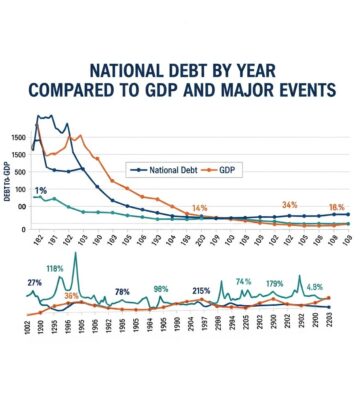
The clock has become particularly prominent during economic crises. When federal debt spiked to an all-time high of 132.8% of GDP in the second quarter of 2020 during the COVID-19 pandemic, media attention to the National Debt Clock intensified, as Americans grappled with massive government spending in response to the crisis.
Factors Contributing to Rising Debt
Several major historical factors have driven the dramatic increase in national debt that the clock displays:
- Reagan-Bush Years (1980s-early 1990s): Large deficits accumulated during defense spending increases and economic adjustments
- 2008 Financial Crisis: Government interventions and stimulus spending led to massive debt increases
- COVID-19 Pandemic (2020): Emergency federal spending pushed debt to historic levels relative to GDP
- Interest Rate Environment: Rising interest rates increase the cost of borrowing, requiring more government spending simply to service existing debt
Beyond these cyclical factors, structural issues contribute to ongoing deficits. When the Federal Reserve purchases government bonds to increase the money supply, this can contribute to inflation if money supply growth outpaces economic growth. The Federal government’s continued spending beyond revenues creates compounding interest obligations—the government must pay interest not just on the principal borrowed but on accumulated interest as well, creating an accelerating cycle.
Frequently Asked Questions
Q: Where is the National Debt Clock located?
A: As of 2017, the National Debt Clock is located at the Bank of America Tower in Manhattan, near its original location on Sixth Avenue. The clock is positioned to maximize visibility to pedestrians and tourists in one of New York City’s most visited areas.
Q: How often does the National Debt Clock update?
A: The clock operates continuously in real-time, displaying the estimated current debt amount. However, it is officially adjusted weekly based on the latest figures published by the United States Treasury Department to ensure accuracy.
Q: Why did the National Debt Clock run backward in 2000?
A: The debt ran backward because the federal government actually had budget surpluses in the late 1990s, causing the national debt to decrease temporarily. This was a rare occurrence in modern American history.
Q: What happened when the debt exceeded $10 trillion in 2008?
A: The original clock display ran out of digits. The Durst Organization modified the display by replacing the dollar sign with the digit “1” to represent the ten-trillionth place, allowing the clock to continue displaying the increasingly larger debt figures.
Q: Who currently maintains the National Debt Clock?
A: The Durst Organization, which includes family members of founder Seymour Durst, maintains and operates the National Debt Clock. Jonathan “Jody” Durst has overseen day-to-day operations since 2009.
Q: How much did it cost to build the original National Debt Clock?
A: The original 11-by-26-foot clock was constructed in 1989 at a cost of $100,000, with monthly maintenance costs of $500 to operate its 305 lightbulbs.
References
- National Debt Clock: Unraveling the Story Behind the Numbers — Metals Edge. 2025. https://metalsedge.com/us-national-debt-clock-explained/
- National Debt Clock — Wikipedia. 2025. https://en.wikipedia.org/wiki/National_Debt_Clock
- National Debt Clock — Atlas Obscura. 2025. https://www.atlasobscura.com/places/national-debt-clock
- Key Facts About the U.S. National Debt — Pew Research Center. August 12, 2025. https://www.pewresearch.org/short-reads/2025/08/12/key-facts-about-the-us-national-debt/
- What Is the National Debt Right Now? — Peterson Foundation. 2025. https://www.pgpf.org/national-debt-clock/
Similar Articles








Read full bio of Sneha Tete