America’s Declining Competitive Edge: Policy Challenges
Explore how policy shifts threaten America's economic dominance and innovation leadership.
America’s Losing Competitive Advantage: Understanding the Economic Threats
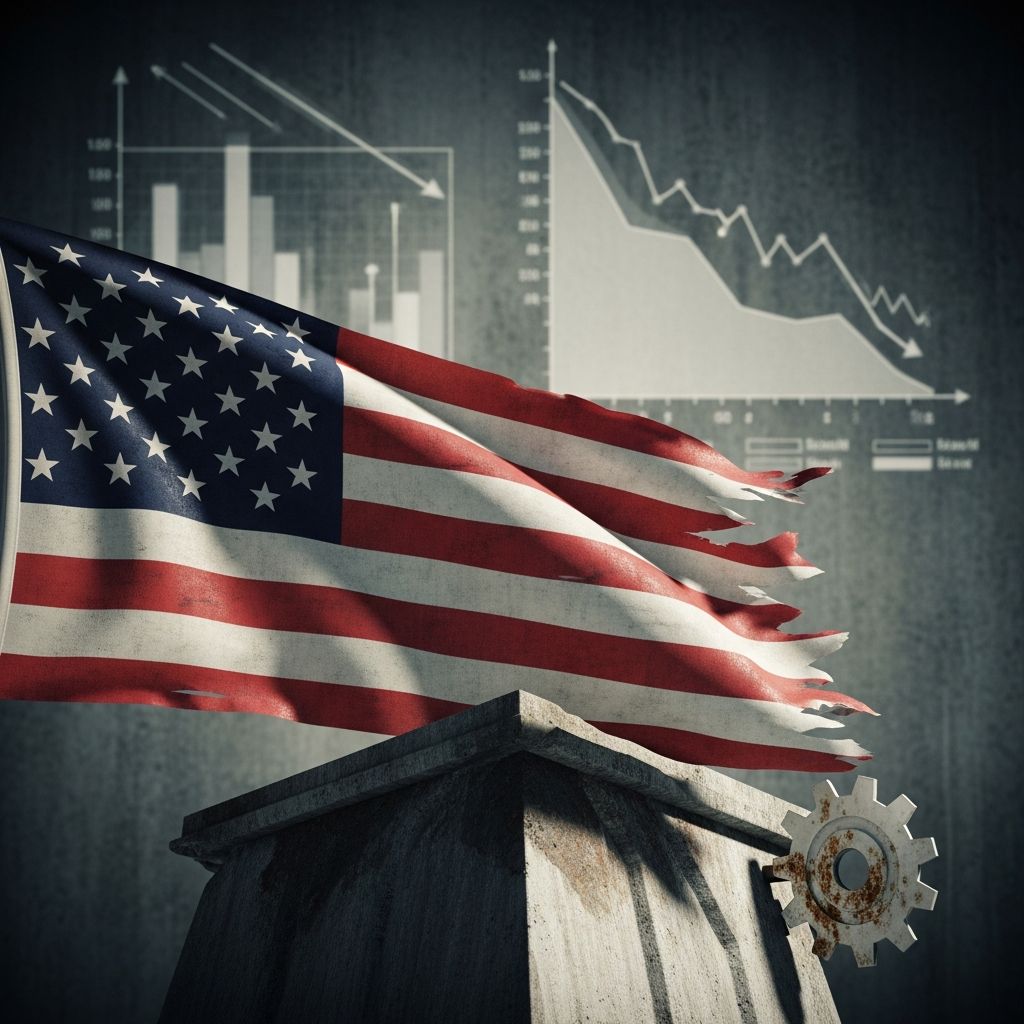
The United States has long maintained a position of economic preeminence on the global stage, built on decades of commitment to free markets, world-class research institutions, and an unparalleled ability to attract the world’s most talented minds. However, this extraordinary economic dominance now faces unprecedented challenges. Recent policy shifts have begun to systematically dismantle the very foundations that established American economic supremacy, creating a cascade of negative effects that threaten to fundamentally weaken the nation’s position in the global marketplace.
The Federal Reserve’s June 2025 economic forecast paints a sobering picture, anticipating decreased US economic growth throughout 2025 and 2026 compared to earlier projections. This shift reflects growing concerns about the sustainability of America’s competitive advantages and the long-term consequences of current policy trajectories.
The Three-Pronged Assault on American Competitiveness
America’s declining competitive advantage stems from three interconnected policy shifts that collectively undermine the nation’s economic leadership:
Trade Isolationism and Market Abandonment
The most visible threat to American competitiveness comes from a dramatic shift away from the international trading system that has defined American economic policy for generations. The United States has implemented tariff policies at levels not seen since the 1930s, with average effective tariff rates rising substantially above the 2024 baseline of 2.4%. These tariffs take multiple forms, including universal tariffs, sector-specific tariffs, country-specific tariffs, reciprocal tariffs, and special “Liberation Day” tariffs announced in April 2025.
This approach fundamentally contradicts basic economic principles about the benefits of free trade. Higher tariffs increase business uncertainty, which directly correlates with reduced business confidence and delayed or prevented investment in new projects. Consequently, firms face reduced capital availability for expansion and innovation, while those unable to pass increased costs to consumers may be driven from the market entirely. Additionally, tariff barriers shield domestic producers from the import competition necessary to maintain global competitiveness, leaving American exporters vulnerable to higher prices and reduced sales internationally.
Defunding Innovation and Research Infrastructure
Simultaneously, the current administration has implemented severe cuts to research budgets precisely when American innovation leadership is under its greatest threat. China has substantially increased its investment in research and development, implementing strategic initiatives like “Made in China 2025” and its “Dual Circulation Strategy” specifically designed to achieve technological leadership. By reducing funding for American research institutions at this critical juncture, the United States is essentially ceding technological ground to its primary global competitor.
The situation is further complicated by the revocation of thousands of international student visas with minimal explanation. The world’s most talented graduate students have historically been drawn to American universities, with approximately 71% of American temporary visa holders with science and engineering doctorates remaining in the United States after five years. However, the fear of additional visa cancellations and increased immigration enforcement has fundamentally altered the calculus for international students. The world’s brightest minds are now reconsidering whether to pursue advanced degrees in the United States, opting instead for countries offering stronger academic freedom, more robust research funding, and clearer protections for international scholars.
Immigration Restrictions and Workforce Contraction
The third pillar of American competitiveness—an abundant, skilled workforce—is being undermined through strict immigration policies that deport law-abiding immigrants and restrict visa programs. This approach creates a particularly acute problem because American birthrates have not kept pace with economic needs, leaving the nation dependent on immigration to maintain workforce growth. By implementing restrictive policies precisely when workforce expansion is most needed, current policy exacerbates labor shortages and reduces the flexibility of American employers to hire the specialized talent required for innovation and competitiveness.
Cascading Economic Consequences
These three policy shifts do not operate in isolation; they create a cascading series of negative economic effects that amplify each other:
Global Economic Slowdown
The World Bank’s June 2025 report “Global Economic Prospects” warns that the substantial rise in trade barriers and persistent policy uncertainty will cause global growth to slow to its lowest level since the 2008 Great Recession. The report notes that this outcome could worsen significantly if trade restrictions escalate further or policy uncertainty continues. This creates a vicious cycle: American isolationism reduces global growth, which in turn reduces demand for American exports, further damaging the American economy.
Historical Parallels and Lessons Ignored
The economic trajectory resulting from American withdrawal from the international trading system mirrors the experience of Brexit, the United Kingdom’s 2016 vote to withdraw from the European Union. As scholars Jonathan Haskel and Matthew Slaughter have documented, Britain’s experience demonstrates that uncertainty produces grinding stagnation in capital investment and research and development by private companies. This stagnation leads inevitably to plummeting productivity growth and stagnant real incomes. Rather than learning from this recent historical lesson, the United States appears to be repeating it through similar policy choices.
Inflation and Business Investment Decline
The Federal Reserve expects inflation to increase primarily due to rising prices resulting from tariff policies. Deloitte’s analysis of third-quarter 2025 economic data indicates that investment in structures declined 8.9% in the second quarter, with continued though more modest declines anticipated. Trade growth projections paint an equally bleak picture: exports are expected to grow just 0.6% in 2025 while imports rise 3.1%, with 2026 showing even more dramatic slowdowns.
The Alienation of Allies and Loss of Strategic Partnerships
Beyond immediate economic effects, current policy has created a strategic vulnerability by alienating America’s closest allies precisely when unified action is needed to address unfair Chinese trade practices and maintain Western technological supremacy. French President Emmanuel Macron has characterized Trump’s unpredictable tariff approach as a common threat to both Europe and Asia, and European and Asian nations are now actively seeking “a third way” and building alternative partnerships less dependent on American markets and goods.
This alienation has profound implications for American military exports, weapons systems that require ongoing technical support and spare parts, and the technological partnerships necessary to maintain American security advantages. As allies reduce their dependence on American markets, they simultaneously reduce their interest in purchasing American defense systems and technology, creating a downward spiral of reduced sales and reduced influence.
America’s Comparative Advantages Under Threat
The United States historically has enjoyed comparative advantages in several critical domains:
Higher Education and Research
The United States accounts for approximately one-third of the world’s top 100 universities, providing an unmatched research and education environment. This advantage is now under assault as international students choose alternative destinations and American research budgets are slashed.
Advanced Technology and Innovation
American technological dominance has rested on a large, highly skilled workforce in STEM fields capable of developing and implementing complex technologies. The combination of research funding cuts and immigration restrictions directly threatens this advantage by reducing both the institutional capacity for research and the human capital available to carry it out.
Military Technology and Defense Systems
American military superiority stems from advanced technology, robust logistical support, artificial intelligence capabilities, and a vast alliance network. This network is increasingly fragile as isolationist policies alienate traditional partners. Without allied cooperation, American military capabilities become correspondingly diminished.
Agricultural Production
American agricultural advantages, built on advanced technology and efficient production systems, are threatened by retaliatory tariffs that close export markets and reduce the return on agricultural investment.
The Path Forward: Strategic Recommendations
Reversing American economic decline requires fundamental policy reorientation across several dimensions:
Rebuilding International Partnerships
America must rebuild trust with allied nations and present a unified front against unfair Chinese practices. This requires abandoning the tariff-based approach that has alienated traditional partners and instead building coalitions based on shared economic and security interests.
Reinvesting in Research and Innovation
Reversing research budget cuts is essential to maintaining American technological leadership. Simultaneously, visa policies must be reformed to once again attract the world’s most talented students and researchers to American universities and research institutions.
Strategic Immigration Reform
Rather than implementing restrictive immigration policies that exacerbate labor shortages, the United States should pursue strategic immigration reform that allows employers to hire specialized talent while maintaining appropriate security screening.
Reducing Dependence on China Through Cooperation
Rather than attempting unilateral tariff solutions, America should cooperate with global partners to jointly increase output in goods and services that enhance national security, maintain technological supremacy, and ensure access to critical minerals.
The Stakes: Economic Future at a Critical Juncture
America stands at a critical juncture in its economic history. The policies outlined—trade isolationism, research funding cuts, immigration restrictions, and the alienation of allies—represent a fundamental departure from the strategies that built American economic supremacy. These are not merely policy disagreements; they are strategic blunders threatening to unravel decades of carefully constructed competitive advantages.
The evidence is clear and compelling: economic uncertainty has reached 40-year highs, America’s closest allies are seeking alternative partnerships, the innovation pipeline is being systematically strangled, and the workforce is shrinking precisely when expansion is most needed. Meanwhile, China continues to capitalize on American retreat from global leadership, positioning itself as the reliable partner to nations the United States is pushing away.
The window for course correction remains open, but it is narrowing. Policymakers must recognize that American economic dominance cannot be sustained through isolation and protectionism. Instead, it requires the recommitment to the principles of free markets, open trade, research investment, and immigration that built American prosperity in the first place.
Frequently Asked Questions
Q: What are America’s primary competitive advantages?
A: America’s primary competitive advantages include world-class universities and research institutions, advanced technology and innovation capabilities, a highly skilled STEM workforce, military superiority based on advanced technology and allied networks, and efficient agricultural production systems.
Q: How do current tariff policies affect American competitiveness?
A: Current tariff policies at 1930s levels increase business uncertainty, reduce investment, shield domestic producers from necessary competition, and make American exports more expensive and less competitive globally. They also trigger retaliatory tariffs from trading partners.
Q: Why are research budget cuts threatening American innovation?
A: Research budget cuts reduce institutional capacity for innovation precisely when China is dramatically increasing R&D investment. Combined with restrictions on international students and researchers, they accelerate a brain drain of talent to countries with stronger research funding and academic freedom.
Q: How does the US brain drain affect economic competitiveness?
A: International students and researchers have historically been attracted to American universities at high rates. Immigration restrictions and visa revocations are causing these talented individuals to choose alternative countries, reducing the skilled workforce available for American innovation and economic growth.
Q: What does the Brexit comparison reveal about current US policy?
A: Brexit demonstrates that trade isolationism and policy uncertainty produce grinding stagnation in business investment and R&D, leading to plummeting productivity growth and stagnant real incomes—exactly the outcomes America’s current policies are designed to produce.
Q: How are US allies responding to current policies?
A: American allies are actively seeking alternative partnerships and reducing dependence on US markets and goods. This alienation threatens both American export sales and the allied military and technological partnerships that underpin American security.
References
- Are America’s Competitive Advantages Being Decimated? — Fair Observer. 2025-06-15. https://www.fairobserver.com/economics/are-americas-competitive-advantages-being-decimated/
- America is losing its comparative advantage — Independent Australia. 2025. https://independentaustralia.net/politics/politics-display/america-is-losing-its-comparative-advantage,19781
- Vanishing Advantage: The U.S. Brain Drain Has Begun — The Century Foundation. 2025. https://tcf.org/content/commentary/vanishing-advantage-the-u-s-brain-drain-has-begun/
- United States Economic Forecast Q3 2025 — Deloitte. 2025. https://www.deloitte.com/us/en/insights/topics/economy/us-economic-forecast/united-states-outlook-analysis.html
- Monetary Policy: Beige Book (Branch) — Federal Reserve. 2025-11. https://www.federalreserve.gov/monetarypolicy/beigebook202511-summary.htm
- Why the US cannot afford to lose dollar dominance — Atlantic Council. 2025. https://www.atlanticcouncil.org/content-series/atlantic-council-strategy-paper-series/why-the-us-cannot-afford-to-lose-dollar-dominance/
Similar Articles








Read full bio of medha deb