U.S. Inflation Rate History by Year and Forecast
Track U.S. inflation trends from historical data through 2025 forecasts and understand economic implications.
Understanding U.S. Inflation Rate History and Future Forecasts
Inflation represents the rate at which the general level of prices for goods and services rises, eroding the purchasing power of money over time. The Consumer Price Index (CPI) serves as the primary measure of inflation in the United States, tracking changes in prices paid by consumers for a market basket of consumer goods and services. Understanding historical inflation trends and current forecasts is essential for investors, policymakers, and consumers alike to make informed financial decisions.
The inflation rate in the United States has experienced significant fluctuations throughout recent history, with particularly notable changes occurring in the early 2020s. As of September 2025, the annual inflation rate stands at 3.0%, reflecting a gradual moderation from the elevated levels experienced in 2022. This article examines the historical trajectory of U.S. inflation, analyzes current economic conditions, and explores forecasts for future inflation trends.
Historical Inflation Rates and Economic Context
The historical inflation rate data provides crucial insights into economic cycles and monetary policy effectiveness. Over the long term, inflation has averaged approximately 0.94% annually since 1635, though this figure masks significant period-to-period variations. More recently, the inflation landscape has been characterized by dramatic swings.
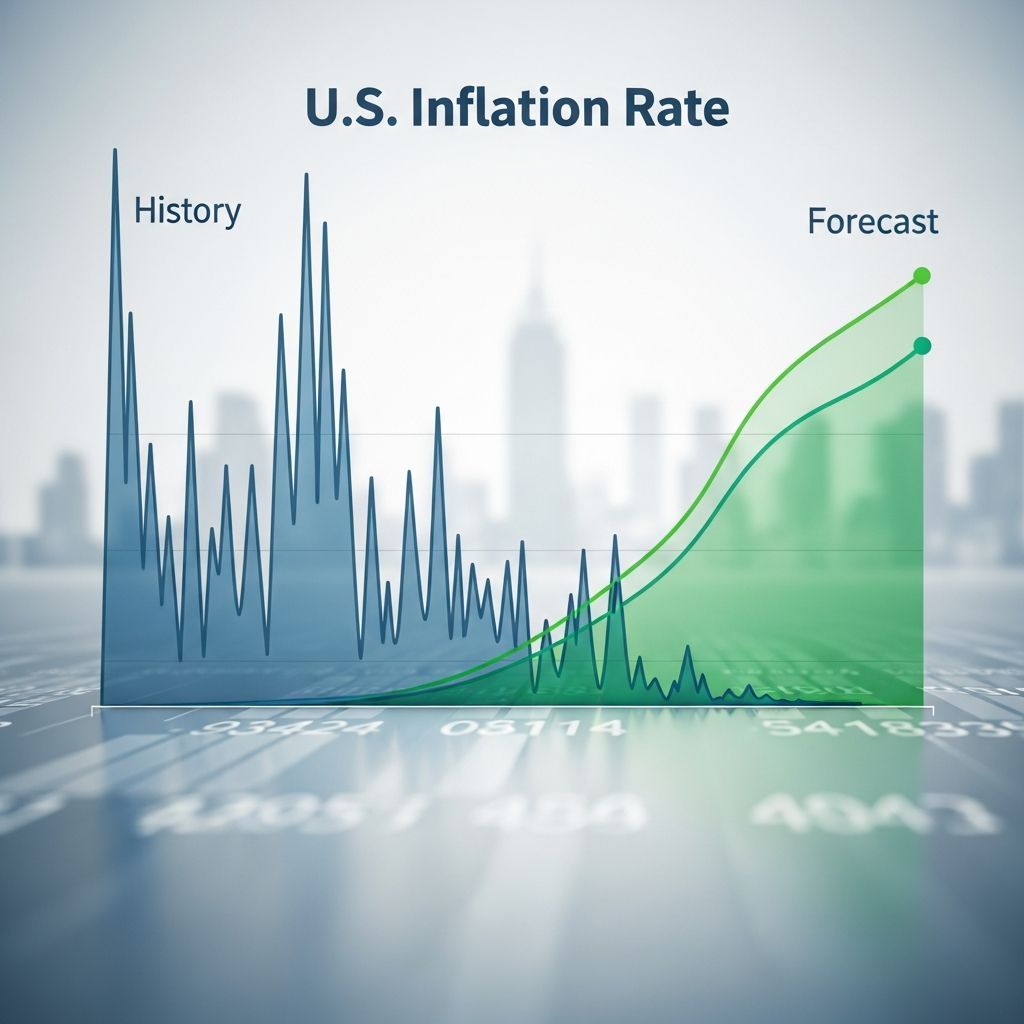
In 2022, the United States experienced a dramatic spike in inflation, reaching 8.0%, the highest level in four decades. This surge was driven by multiple factors including supply chain disruptions following the COVID-19 pandemic, unprecedented fiscal stimulus, energy price volatility, and accommodative monetary policy. The elevated inflation in 2022 represented a significant departure from the relatively stable inflation environment that had persisted for approximately two decades prior.
Following the 2022 peak, inflation began to moderate. In 2023, the annual inflation rate declined to 4.1%, reflecting the Federal Reserve’s aggressive interest rate increases and gradually improving supply chain conditions. This moderation continued into 2024, with inflation falling to 2.9%, approaching the Federal Reserve’s 2% long-term target.
Recent Inflation Trends in 2025
The year 2025 has continued the gradual disinflationary trend observed in late 2024. Current estimates place the inflation rate at approximately 2.92% for 2025, with some forecasts suggesting a slightly lower figure of 2.7%. As of September 2025, the 12-month inflation rate stood at 3.0%, indicating that while inflation remains modestly above the Federal Reserve’s 2% target, it has remained relatively stable.
Different measures of inflation provide varying perspectives on price pressures in the economy. The Consumer Price Index for Urban Wage Earners and Clerical Workers (CPI-W) increased 2.9% over the 12 months ending September 2025, while the Chained Consumer Price Index (C-CPI-U), which accounts for consumer substitution patterns, increased 2.9% over the same period.
Sector-Specific Inflation Trends
Inflation has not been uniform across economic sectors. In the past year, housing costs have emerged as a particular area of price pressure. Housing prices increased by 3.34% in the past year and have averaged 4.26% annual inflation since 1967. Other significant inflation drivers include:
– Other goods and services: Increased 3.03% in the past year, averaging 4.94% since first recorded- Medical care: Increased 2.51% in the past year, averaging 4.59% historically- Food and beverages: Increased 2.38% in the past year, averaging 3.97% historically- Shelter: Increased 3.6% over the last year, reflecting persistent housing cost pressures- Household furnishings and operations: Increased 4.1% over the last year- Used cars and trucks: Increased 5.1% over the last year
Impact on Purchasing Power
The cumulative effect of inflation over time has dramatically reduced the purchasing power of the U.S. dollar. A hypothetical $100 in 1635 would have the purchasing power equivalent of approximately $3,903.33 in 2025, reflecting a cumulative price change of 3,803.33%. This long-term erosion of purchasing power underscores the importance of understanding inflation’s historical trajectory.
In more recent terms, the 2025 inflation rate of 2.92% means that $100 today would have the equivalent purchasing power of approximately $97.10 one year from now, assuming the inflation rate holds at forecast levels. This ongoing erosion of purchasing power affects savings, investment returns, retirement planning, and real wage growth.
Inflation Rate Forecasts and Economic Outlook
Economic forecasters expect inflation to remain relatively moderate over the near to medium term. The Minneapolis Federal Reserve estimates the CPI will reach approximately 322.3 in 2025, implying an inflation rate of 2.7%. This forecast suggests that inflation will remain above the Federal Reserve’s 2% long-term target but continue its gradual moderation from the elevated levels seen in 2022-2023.
According to the International Monetary Fund, the U.S. Consumer Price Index is forecasted to grow from approximately 258.84 in 2020 to around 325.6 by 2027. This projection indicates expectations for continued moderate inflation over the medium term, with inflation gradually moving toward central bank targets.
The Federal Reserve’s monetary policy framework aims to achieve price stability with inflation averaging 2% over the long term. The recent moderation in inflation from 8.0% in 2022 to projected levels near 2.7-2.92% in 2025 suggests that policy tightening implemented by the Federal Reserve is having its intended effect, though full achievement of the 2% target may require additional time.
Monthly Inflation Trends
Monthly inflation data provides more granular insights into price pressures. On a seasonally adjusted basis, the Consumer Price Index increased 0.3% in September 2025, following a 0.4% increase in August. These month-to-month changes, while seemingly small, accumulate to generate the annual inflation rate.
The 12-month percentage change in the Consumer Price Index shows a relatively consistent trend throughout 2025. In January 2025, prices had increased by 3.0% compared to January 2024, and this rate has remained relatively stable throughout the year, hovering around 3.0%. This consistency suggests that inflation pressures have stabilized at levels moderately above the Federal Reserve’s target.
Factors Influencing Current and Future Inflation
Multiple factors will influence inflation trends going forward. Energy prices, which experienced significant volatility in recent years, continue to impact headline inflation. Labor market conditions, wage growth, and productivity trends will influence core inflation dynamics. Global supply chain conditions and international commodity prices also play important roles in determining U.S. inflation trajectories.
Additionally, Federal Reserve policy decisions regarding interest rates and monetary accommodation will continue to influence inflation through their effects on aggregate demand and financial conditions. The central bank’s communications regarding future policy paths also affect inflation expectations, which in turn influence actual inflation outcomes through wage-setting and pricing decisions.
Inflation Calculator and Personal Application
Various inflation calculators enable individuals to understand the impact of inflation on specific dollar amounts over time. Using official records published by the U.S. Department of Labor, these calculators allow users to determine what a given amount of money in one year would be equivalent to in another year, accounting for inflation. This tool proves useful for assessing historical wealth changes, understanding real returns on investments, and evaluating purchasing power changes over different time periods.
Frequently Asked Questions
Q: What is the current inflation rate for 2025?
A: As of September 2025, the annual inflation rate stands at approximately 3.0% on a 12-month basis, with forecasts suggesting the full-year 2025 inflation rate will reach approximately 2.7-2.92%. This represents a continued moderation from the 8.0% inflation rate experienced in 2022.
Q: How does the Consumer Price Index (CPI) measure inflation?
A: The CPI measures inflation by tracking changes in prices paid by consumers for a fixed market basket of goods and services. It compares the cost of this basket in different time periods to calculate the percentage change in prices, which represents the inflation rate. The Bureau of Labor Statistics publishes the CPI monthly based on data from urban consumers.
Q: What sectors have experienced the highest inflation in recent years?
A: Housing and shelter have experienced particularly elevated inflation, with housing costs increasing 3.34% in the past year and averaging 4.26% annually since 1967. Other sectors with significant inflation include used cars and trucks (5.1% increase), household furnishings and operations (4.1% increase), and medical care (3.3% increase).
Q: What is the Federal Reserve’s inflation target?
A: The Federal Reserve aims to achieve price stability with inflation averaging 2% over the long term. This target reflects a balance between the desire for stable prices and recognition that modest inflation supports economic growth and employment.
Q: How does inflation affect purchasing power?
A: Inflation erodes purchasing power by reducing what a given amount of money can buy. With 2025 inflation at approximately 2.92%, $100 today would have the purchasing power of roughly $97.10 one year from now. Over longer periods, this erosion compounds significantly, which is why long-term savers and retirees must consider inflation when planning finances.
Q: What caused the spike in inflation in 2022?
A: The 2022 inflation spike to 8.0% resulted from multiple factors including pandemic-related supply chain disruptions, fiscal stimulus increasing aggregate demand, energy price volatility following geopolitical events, and accommodative monetary policy that kept interest rates low for an extended period.
Q: How do forecasters predict future inflation rates?
A: Forecasters use economic models incorporating factors such as labor market conditions, wage growth, energy prices, Federal Reserve policy expectations, and global economic conditions. International organizations like the IMF and the Federal Reserve publish regular inflation forecasts based on these analytical frameworks.
Q: What is the difference between headline and core inflation?
A: Headline inflation includes all items in the Consumer Price Index, including volatile food and energy prices. Core inflation excludes these volatile categories to provide a clearer picture of underlying inflation trends. Both measures are important for understanding different aspects of price pressures in the economy.
Understanding Inflation’s Long-Term Impact
The historical perspective on inflation demonstrates the importance of understanding price trends for long-term financial planning. From 1635 to 2025, inflation has averaged 0.94% annually, yet specific periods have deviated dramatically from this long-term average. The recent experience of 8.0% inflation in 2022 followed by moderation to projected levels near 2.7% in 2025 illustrates how inflation can fluctuate significantly over relatively short timeframes.
For individuals and institutions, this understanding is crucial for making sound financial decisions regarding savings, investments, retirement planning, and debt management. Real returns on investments must account for inflation to accurately assess wealth accumulation. Similarly, wage growth expectations must consider inflation to evaluate real income growth.
Conclusion
The U.S. inflation rate has demonstrated significant variation throughout recent history, with the particularly notable spike in 2022 followed by substantial moderation in 2023-2025. Current 2025 inflation rates around 2.7-3.0% represent a substantial improvement from 2022 levels but remain modestly above the Federal Reserve’s 2% long-term target. Understanding these inflation trends, sector-specific price pressures, and economic forecasts is essential for navigating the financial landscape. As the economy continues to evolve, monitoring inflation data and forecasts will remain critical for individuals, businesses, and policymakers seeking to make informed decisions in an uncertain economic environment.
References
- U.S. Inflation Calculator: 1635-2025, Department of Labor Data — in2013dollars.com. Updated 2025. https://www.in2013dollars.com
- Monthly Inflation Rate U.S. 2025 — Statista. February 2025. https://www.statista.com/statistics/273418/unadjusted-monthly-inflation-rate-in-the-us/
- Consumer Price Index, 1913- — Federal Reserve Bank of Minneapolis. Updated 2025. https://www.minneapolisfed.org/about-us/monetary-policy/inflation-calculator/consumer-price-index-1913-
- Consumer Price Index – September 2025 — Bureau of Labor Statistics, U.S. Department of Labor. October 24, 2025. https://www.bls.gov/news.release/pdf/cpi.pdf
- Inflation, Consumer Prices for the United States — Federal Reserve Economic Data (FRED), Federal Reserve Bank of St. Louis. Updated April 16, 2025. https://fred.stlouisfed.org/series/FPCPITOTLZGUSA
Similar Articles








Read full bio of medha deb