Understanding U.S. Income Trends and Earnings Data
Explore comprehensive data on American wages, salaries, and income patterns across regions and demographics.

Income statistics provide essential insights into the economic landscape of the United States, helping individuals understand how their earnings compare to national standards and what factors influence wage levels across different regions and demographics. As the U.S. economy continues to evolve, comprehensive data on salaries, household income, and earning patterns becomes increasingly valuable for financial planning, career decisions, and understanding broader economic trends. This guide explores the current state of American earnings, regional variations, age-based income patterns, and what these figures mean for individuals and families navigating the modern financial landscape.
Current National Income Overview
The average salary in the United States stands at approximately $66,622, according to recent data from the Social Security Administration. This figure represents the mean income across all occupations and industries in the country. However, it’s important to distinguish between average and median earnings, as these metrics tell different stories about American income distribution.
The median household income in the U.S. is $80,734 during the 2020-2024 period, reflecting what the typical American household earns annually. Meanwhile, the median annual salary for individual workers is approximately $61,984, which better represents typical earnings by removing the influence of exceptionally high or low earners that can skew average figures.
On a monthly basis, the average American earns roughly $5,400 to $6,250 before taxes. This translates to a weekly wage of approximately $1,192 for full-time workers. After accounting for taxes and deductions, take-home pay varies significantly depending on state, filing status, and benefits enrolled in various programs.
Breaking Down Earnings by Age Groups
Income trajectories in America follow predictable patterns based on age and career progression. Understanding these patterns helps individuals set realistic financial goals and expectations at different life stages.
Young households under 25 years old bring in approximately $38,000 to $42,000 annually. This reflects early-career positions, part-time work, and individuals just entering the job market. By the time workers reach ages 25 to 34, median household income jumps substantially to around $62,000 to $66,000, signifying career establishment and increased earning potential.
Peak earning years typically occur during the 45 to 54 age bracket, when households can expect to earn approximately $95,000 annually. After this point, income gradually declines as individuals begin transitioning toward retirement. Those aged 55 to 64 see household income settle around $80,000 to $86,000, reflecting both career maturity and the beginning of workforce transitions.
The progression of income across age groups demonstrates the importance of career development and experience in earning potential. However, it’s crucial to note that these figures represent medians and vary significantly based on industry, education level, and geographic location.
Regional Income Variations and State Comparisons
Where Americans live significantly influences their earning potential and purchasing power. Salaries are closely tied to regional cost of living, with higher-paying states typically concentrated on the East and West Coasts.
The District of Columbia leads the nation with the highest single-person median household income at $75,814. Maryland follows closely with $52,519 for single-person households, while California rounds out the top tier at $50,251. Other high-income states include Colorado ($49,447), New Jersey ($48,523), and Washington ($48,386).
Southern states generally offer lower median household incomes compared to coastal regions. Texas reports a median income of $41,661 for single-person households, while Nevada stands at $42,034. States like Delaware ($42,168) and Illinois ($41,888) also fall in the lower-income bracket nationally.
It’s important to understand that higher nominal incomes in coastal states often reflect increased cost of living, particularly in housing markets. While someone earning $75,000 in Texas may have greater purchasing power than someone earning $95,000 in California, the absolute salary difference means different things depending on local economic conditions.
Multi-Person Household Income Comparisons
Income levels expand considerably when examining households with multiple earners or family members. The District of Columbia shows particularly dramatic increases, with two-person household median income reaching $147,683. For three-person households, that figure climbs to $183,198, and four-person households average $215,972.
In high-income states like New Jersey, two-person households report median income of $104,651, while four-person households reach $156,487. Even in lower-income states like Texas, two-person households earn $82,953 and four-person households reach $108,349.
Understanding Income Adequacy and Cost of Living
Determining what constitutes a comfortable income depends heavily on location, household size, and personal circumstances. Financial experts often use benchmarking frameworks to assess income adequacy relative to living expenses.
For a single adult, a comfortable annual salary typically falls between $60,000 and $90,000, depending on location. This range accounts for housing, food, transportation, healthcare, and discretionary spending using common budgeting frameworks. A dual-income household without children might comfortably manage on $100,000 to $130,000 combined annual income, while families with children require $120,000 or more in many metropolitan areas.
The threshold for what constitutes “middle class” income varies dramatically by state. Massachusetts has the highest threshold to break out of the middle class, with upper bounds of $209,656 per year. New Jersey ($208,588), Maryland ($205,810), Hawaii ($201,490), and California ($200,298) also show exceptionally high middle-class income ranges. Nationally, the lower bound for middle-class income is approximately $64,033, while the upper bound reaches $192,098.
Income Distribution and Inequality Patterns
American income is distributed unevenly across the population, with some earning considerably more than national averages. The distinction between average and median income becomes particularly important when examining this distribution.
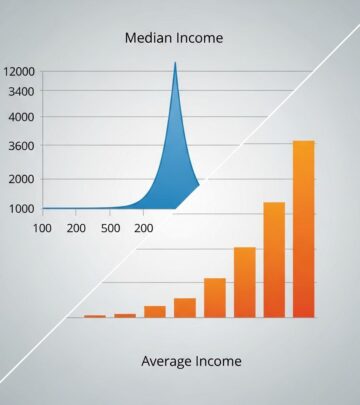
The average income of $66,622 exceeds the median of $61,984, indicating that high earners pull the average upward. This gap between average and median demonstrates that income distribution is skewed, with a smaller number of high earners significantly influencing the mean calculation.
Geographic and occupational factors create substantial income variations beyond the national average. Certain industries, professional positions, and regions offer substantially higher compensation packages than others. Professional services, technology, healthcare, and finance sectors typically offer above-average compensation, while retail, hospitality, and service industries tend toward below-average wages.
Factors Influencing Salary Levels
Multiple variables determine individual and household income levels. Understanding these factors helps explain why income varies so dramatically across the American workforce.
- Occupation and industry: Different professions command vastly different compensation levels based on education requirements, market demand, and revenue generation.
- Geographic location: Regional economies, cost of living, and local industry concentration significantly impact salary ranges.
- Education and credentials: Advanced degrees and professional certifications typically correlate with higher earning potential.
- Experience and tenure: Career progression and years in the workforce generally lead to increased compensation.
- Employer size and type: Large corporations and specialized firms often pay more than small businesses or nonprofit organizations.
- Negotiation skills: Individual salary negotiation can result in significant differences in compensation packages.
- Economic conditions: Regional economic health and industry growth affect available opportunities and salary competitiveness.
Income by Demographics and Background
Income statistics vary notably when examined through the lens of race and ethnicity. According to Census data, U.S. median household income was $80,734 during the 2020-2024 period, but this figure masks significant variations by racial and ethnic groups. These disparities reflect historical inequities, educational access differences, and ongoing systemic factors that influence earning opportunities.
Understanding these demographic variations in income is crucial for recognizing broader economic patterns and addressing disparities in earning potential and wealth accumulation across American communities.
Monthly and Weekly Income Breakdown
For budgeting and financial planning purposes, converting annual income to monthly or weekly figures proves helpful. The average American earning $66,622 annually receives approximately $5,552 per month before taxes. This breaks down further to roughly $1,280 per week for full-time workers.
The median monthly salary is lower, closer to $4,000 to $4,300, reflecting the distinction between mean and median earnings. Understanding these monthly figures helps individuals create realistic budgets and assess whether their income aligns with their financial obligations and lifestyle choices.
Income Adequacy for Different Household Compositions
| Household Type | Annual Income Range | Notes |
|---|---|---|
| Single Adult | $60,000 – $90,000 | Location-dependent; covers essentials plus modest discretionary spending |
| Dual Income, No Children | $100,000 – $130,000 | Combined household income; allows for savings and investment |
| Family with Children | $120,000+ | Varies significantly by location and childcare needs |
| Retired Individual | Varies based on savings and Social Security | Often lower than working-age adults |
Frequently Asked Questions About U.S. Income
What is the difference between average and median income?
Average income (mean) is calculated by adding all incomes and dividing by the number of people, making it vulnerable to inflation by extremely high earners. Median income represents the middle point where half earn more and half earn less, providing a more representative picture of typical earnings.
Why do some states have significantly higher average incomes than others?
State income variations reflect differences in cost of living, industry concentration, educational attainment, and regional economic development. Higher-income states often have more established professional services, technology, and finance sectors that command premium salaries.
How has American income changed in recent years?
According to the Social Security Administration, the national average wage index was $63,932.64 in 2023 and increased to $67,027.24 in 2024, reflecting ongoing wage growth, though this must be considered alongside inflation and cost-of-living increases.
What constitutes a living wage in the United States?
A living wage varies dramatically by location but generally refers to income sufficient to cover basic needs including housing, food, transportation, and healthcare. Using standard budgeting frameworks, $60,000 to $90,000 annually represents a reasonable starting point for a single adult in most U.S. locations.
How does education level impact earning potential?
Advanced education typically correlates with higher earning potential, though this varies by field and market conditions. Professional degrees, technical certifications, and advanced academic credentials generally lead to above-average compensation.
Planning Your Financial Future Based on Income Data
Understanding national income statistics provides valuable context for personal financial planning. Comparing your income to relevant benchmarks—whether by age, location, occupation, or household composition—helps identify whether you’re earning competitively and whether your income supports your financial goals.
Income data also informs important decisions about career development, geographic relocation, and financial goal-setting. If your income lags behind regional or occupational averages, this might signal opportunities for skill development, career advancement, or geographic repositioning. Conversely, if your income significantly exceeds averages, this suggests capacity for increased savings, investment, and wealth accumulation.
The relationship between income and cost of living remains central to financial wellbeing. Earning above-average income in a high-cost state may provide less financial flexibility than earning average income in a lower-cost area, underscoring the importance of considering both absolute and relative income figures in financial planning.
References
- Average Salary in the USA 2026: A Complete Breakdown — Visdum. 2026. https://www.visdum.com/blog/average-salary-in-the-us
- Median Household Income by State 2026 — World Population Review. 2026. https://worldpopulationreview.com/state-rankings/median-household-income-by-state
- Shocking 2026 Money Stats for the Typical American Household — YouTube. 2026. https://www.youtube.com/watch?v=WnRQCDBL_sA
- Average US Salary by State for 2026 — SoFi. 2026. https://www.sofi.com/learn/content/average-salary-in-us/
- What It Takes to Be Middle Class in America – 2026 Study — SmartAsset. 2026. https://smartasset.com/data-studies/middle-class-2026
- National Average Wage Index — Social Security Administration. 2024. https://www.ssa.gov/oact/cola/AWI.html
- How Income Varies by Race and Geography — U.S. Census Bureau. 2026. https://www.census.gov/library/stories/2026/01/household-income-by-race-and-state.html
Similar Articles








Read full bio of medha deb