U.S. GDP Growth: Understanding Economic Expansion
Explore U.S. GDP growth trends, components, and economic forecasts for 2025-2026.
Understanding U.S. GDP Growth
Gross Domestic Product (GDP) serves as the most comprehensive measure of a nation’s economic performance, representing the total value of goods and services produced within the United States during a specific period. GDP growth is a critical economic indicator that reflects the health and trajectory of the American economy, influencing employment levels, consumer confidence, investment decisions, and government policy. Understanding GDP growth patterns helps economists, policymakers, and investors assess economic conditions and make informed decisions about the future direction of the economy.
What Is GDP and Why It Matters
Gross Domestic Product measures the monetary value of all final goods and services produced by a country during a specific time period, typically expressed on a quarterly or annual basis. The U.S. Bureau of Economic Analysis (BEA) calculates GDP using three different approaches: the expenditure approach, the income approach, and the production approach. Most commonly, GDP is reported as an annualized growth rate, which expresses how quickly the economy is expanding or contracting when adjusted to an annual percentage.
GDP growth matters because it indicates whether the economy is expanding or contracting. A growing GDP typically signals a healthy economy with increasing business activity, rising employment, and improved consumer spending. Conversely, declining GDP can indicate economic weakness and potential recession. Policymakers monitor GDP closely to determine appropriate fiscal and monetary policies, while businesses and investors use GDP data to guide their strategic planning and investment decisions.
Recent U.S. GDP Performance
The U.S. economy has demonstrated resilience and strong performance in recent quarters. Real gross domestic product increased at an annual rate of 3.8 percent in the second quarter of 2025, according to the third estimate released by the U.S. Bureau of Economic Analysis. This represented a significant recovery from the first quarter of 2025, when real GDP decreased 0.6 percent. The 3.8 percent growth rate in Q2 2025 marked the strongest performance since Q3 2023, far exceeding earlier expectations.
The stronger-than-anticipated Q2 2025 figure primarily reflected an upward revision to consumer spending, which had been a significant driver of economic growth. Personal consumption expenditures (PCE) rose 2.5 percent, substantially higher than the 1.6 percent reported in the second estimate. This increase was led by stronger growth in services spending at 2.6 percent, while goods spending remained robust at 2.2 percent. The increase in real GDP in the second quarter also primarily reflected a decrease in imports, which are a subtraction in the calculation of GDP. These positive movements were partially offset by decreases in investment and exports.
Components of GDP Growth
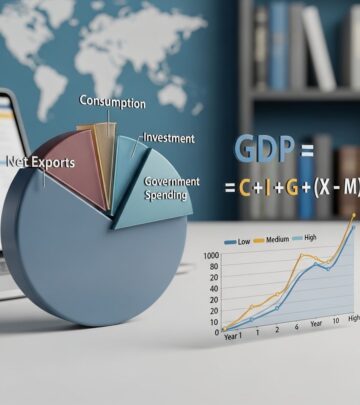
GDP growth is composed of several key components that contribute to overall economic expansion:
Consumer Spending
Consumer spending represents the largest component of GDP, typically accounting for approximately 70 percent of economic activity. Personal consumption expenditures include spending on durable goods (such as automobiles and appliances), nondurable goods (such as food and clothing), and services (such as healthcare and entertainment). The substantial upward revision to consumer spending in Q2 2025 demonstrated the continued strength of American consumer demand, reflecting confidence in employment prospects and financial stability among households.
Business Investment
Business investment encompasses spending by companies on capital equipment, structures, and intellectual property. Strong business investment indicates confidence in future economic prospects and typically supports long-term productivity growth. In Q2 2025, investment showed mixed signals with some revisions to earlier estimates, reflecting businesses’ cautious approach to capital expenditures amid changing economic conditions.
Government Spending
Government spending includes federal, state, and local government purchases of goods and services, as well as government investment in infrastructure and defense. Government spending contributes directly to GDP and can be used as a policy tool to stimulate or moderate economic activity. In Q2 2025, government spending remained relatively stable at approximately $3,993 billion.
Net Exports
Net exports represent the difference between exports and imports. A decrease in imports, as occurred in Q2 2025, provided a positive contribution to GDP growth. This primarily reflected a 30.3 percent plunge in imports following a 37.9 percent surge in Q1 2025, when businesses and consumers rushed to purchase goods ahead of anticipated tariff increases. Import and export dynamics remain sensitive to trade policies and global economic conditions.
Industry Contributions to GDP
Different sectors of the economy contribute varying amounts to overall GDP. The service sector represents the largest portion of the U.S. economy, contributing approximately $17.3 trillion in Q2 2025. Manufacturing contributed $2.4 trillion, while construction contributed $0.89 trillion. Transportation services added $0.74 trillion, and utilities contributed $0.34 trillion. Mining operations contributed $0.37 trillion to the overall economy. These diverse contributions demonstrate the complex, interconnected nature of the American economy across multiple sectors and industries.
Long-Term GDP Growth Trends
Historically, the U.S. GDP growth rate has averaged 3.2 percent from 1947 through 2025, reaching an all-time high of 34.9 percent in the third quarter of 2020 during the post-pandemic recovery period and a record low of negative 28 percent in the second quarter of 2020 during the initial pandemic shutdown. These extreme values reflect extraordinary circumstances rather than typical economic conditions.
Looking at more normalized periods, the average growth rate of real GDP from 2019 to 2024 was 2.4 percent, with real gross domestic income increasing at an average annual rate of 2.3 percent over the same period. The average of real GDP and real GDI over that five-year period was 2.4 percent, providing a balanced perspective on economic expansion when accounting for both production and income measures.
Future Economic Outlook
2025-2026 Growth Forecasts
Economic forecasters have provided their assessments of near-term GDP growth. S&P Global forecasts U.S. real GDP growth of 2 percent in both 2025 and 2026, modestly up from their September forecast and slightly above near-term potential growth. Trading Economics projects GDP growth of 2.1 percent by the end of the current quarter, with long-term projections suggesting the growth rate will trend around 2 percent in 2026.
Long-Term Growth Potential
Goldman Sachs Research expects the U.S. economy to have a potential growth rate of more than 2 percent over the next few years, with some additional acceleration anticipated in the coming decade. Their economists anticipate that artificial intelligence will increase labor productivity growth while workforce expansion slows. Goldman Sachs Research projects productivity growth across the U.S. economy to increase 1.7 percent through 2029 and 1.9 percent in the early 2030s.
Together with forecasts for labor force growth, these productivity estimates suggest that potential GDP growth will average about 2.1 percent in 2025-2029 before accelerating to 2.3 percent in the early 2030s as artificial intelligence boosts growth further. This projection reflects optimism about technological advancement’s ability to enhance economic productivity in the longer term.
Factors Supporting Recent Growth
Several factors have contributed to the recent strong GDP performance in 2025. Consumer confidence has remained relatively resilient despite concerns about inflation and interest rates. Employment levels have remained strong, supporting household income and spending capacity. Business activity has continued despite economic uncertainties, with companies maintaining capital investments in strategic areas. Additionally, the normalization of import levels after the surge in Q1 2025 provided a statistical boost to GDP calculations in Q2 2025.
Economic Challenges and Considerations
Despite recent strong performance, the U.S. economy faces several challenges. The GDP growth of 2 percent forecasted for 2025-2026 remains below the historical average of 3.2 percent, suggesting the economy is operating near its potential growth rate rather than expanding significantly above it. Labor force growth is expected to slow due to demographic trends, limiting the economy’s ability to expand through workforce expansion. Productivity growth, while expected to accelerate with AI adoption, remains a critical variable for long-term economic performance.
Key Economic Metrics at a Glance
| Metric | Value | Period |
|---|---|---|
| Real GDP Growth | 3.8% | Q2 2025 |
| Real GDP Growth | -0.6% | Q1 2025 |
| Personal Consumption Expenditures | 2.5% | Q2 2025 |
| Services Spending | 2.6% | Q2 2025 |
| Goods Spending | 2.2% | Q2 2025 |
| Forecasted Growth 2025-2026 | 2.0% | Annual |
| Potential Growth 2025-2029 | 2.1% | Average Annual |
| Projected Growth Early 2030s | 2.3% | Average Annual |
Frequently Asked Questions
Q: What exactly is included in GDP calculations?
A: GDP includes the monetary value of all final goods and services produced within U.S. borders during a specific period. This encompasses consumer spending, business investment, government spending, and net exports. It does not include intermediate goods (to avoid double-counting), used goods, or non-market activities like volunteer work or household production.
Q: How is GDP growth rate calculated?
A: The GDP growth rate is typically calculated as an annualized rate, meaning quarterly growth figures are multiplied by four to express them as annual rates. This allows for easier comparison across time periods. The growth rate is expressed as a percentage change from the previous period.
Q: What does a 3.8% GDP growth rate mean?
A: A 3.8% annualized GDP growth rate means that if the economy continued growing at the quarterly rate observed in Q2 2025, it would expand by 3.8% over the course of a full year. This represents strong economic expansion, particularly compared to the historical average of 3.2% and recent forecasts of 2% growth.
Q: Why is consumer spending so important to GDP?
A: Consumer spending represents approximately 70% of U.S. GDP, making it the largest component of economic activity. When consumers are confident and spending freely, it stimulates business activity, encourages hiring, and accelerates economic growth. Conversely, reduced consumer spending can slow economic expansion and potentially lead to recession.
Q: How does AI affect long-term GDP growth?
A: Artificial intelligence is expected to boost labor productivity, allowing workers to accomplish more in the same amount of time. This productivity enhancement could increase potential GDP growth from 2.1% during 2025-2029 to 2.3% in the early 2030s. However, AI adoption requires business investment and workforce adaptation to realize these benefits.
Q: What caused the Q1 2025 GDP contraction?
A: Real GDP decreased 0.6% in Q1 2025, representing a sharp reversal from Q2’s 3.8% growth. The contraction reflected various factors including adjustment periods following the previous year’s strong performance and potential shifts in business and consumer behavior in anticipation of policy changes.
Q: How reliable are GDP forecasts?
A: GDP forecasts provide valuable guidance but are subject to uncertainty. Economic forecasters use sophisticated models based on historical data, current trends, and leading indicators, but unexpected events can alter outcomes. Multiple estimates released by the BEA help refine understanding as more complete data becomes available.
References
- United States GDP Growth Rate — Trading Economics. 2025-09-25. https://tradingeconomics.com/united-states/gdp-growth
- What Is the US Economy’s Potential Growth Rate? — Goldman Sachs. 2025. https://www.goldmansachs.com/insights/articles/what-is-the-us-economys-potential-growth-rate
- Economic Outlook U.S. Q1 2026: Steady As She Goes — S&P Global. 2025. https://www.spglobal.com/ratings/en/regulatory/article/economic-outlook-us-q1-2026-steady-as-she-goes-but-on-a-narrow-path-s101658550
- Gross Domestic Product — U.S. Bureau of Economic Analysis (BEA). 2025. https://www.bea.gov/data/gdp/gross-domestic-product
- Gross Domestic Product, 2nd Quarter 2025 (Third Estimate) — U.S. Bureau of Economic Analysis (BEA). 2025. https://www.bea.gov/news/2025/gross-domestic-product-2nd-quarter-2025-third-estimate-gdp-industry-corporate-profits
- GDP Update — U.S. Congress Joint Economic Committee. 2025. https://www.jec.senate.gov/public/index.cfm/republicans/gdp-update
- Economy Statement for the Treasury Borrowing Advisory Committee — U.S. Department of the Treasury. 2025-09-30. https://home.treasury.gov/news/press-releases/sb0301
Similar Articles








Read full bio of medha deb