US GDP by Year: Historical Data and Trends
Track America's economic growth: Comprehensive US GDP data from 1960 to 2025.
Understanding US GDP: A Year-by-Year Analysis
The Gross Domestic Product (GDP) represents the total monetary value of all final goods and services produced within a country during a specific period. For the United States, GDP serves as the primary indicator of economic health and overall prosperity. Understanding how US GDP has evolved over the decades provides critical insights into economic cycles, policy impacts, and long-term growth trajectories.
The United States maintains the world’s largest economy by nominal GDP, representing approximately 27.49 percent of the global economy. This dominant position reflects the country’s advanced industrial base, technological innovation, and consumer-driven economic model. Examining US GDP year by year reveals not only periods of robust expansion but also significant contractions during recessions and financial crises.
Historical GDP Performance and Economic Milestones
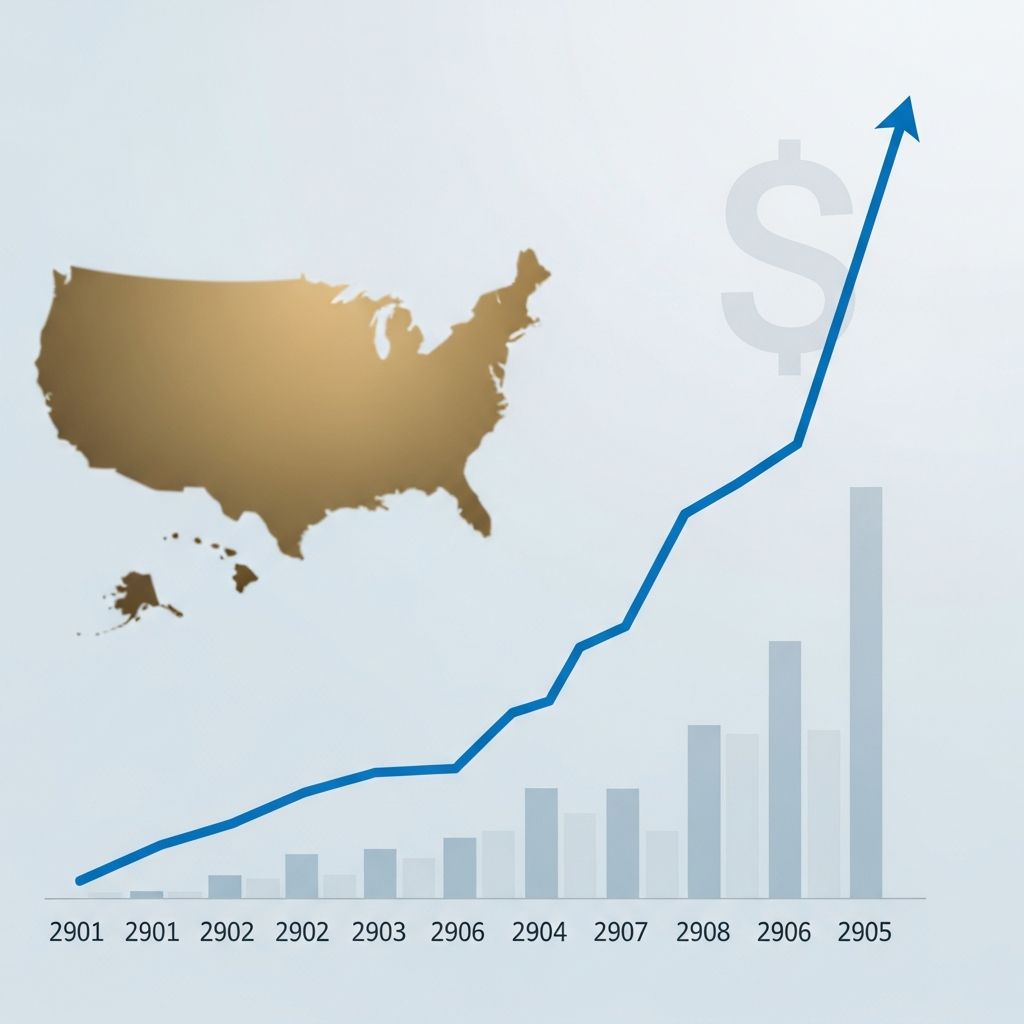
The evolution of US GDP demonstrates the remarkable growth of the American economy over six decades. In 1960, the US GDP stood at 542.39 billion dollars, establishing the baseline for measuring subsequent growth. By 2024, the nation’s GDP had surged to an all-time high of 29,184.89 billion dollars, reflecting an extraordinary expansion of over 5,200 percent.
Between 1960 and 2024, US GDP averaged 8,865.89 billion dollars, illustrating the steady upward trajectory despite periodic downturns. This averaging masks the dramatic acceleration in recent decades, particularly following the post-World War II economic boom. From 1946 to 1973, the US economy experienced robust growth, expanding at an average rate of 3.8 percent annually, while real median household income surged by 74 percent during this prosperous era.
Decades of Growth: Breaking Down Economic Performance
The 1960s and 1970s: Expansion and Inflation
The 1960s represented a period of sustained economic growth, though slower than the immediate post-war years. However, the 1970s brought significant challenges to the American economy. Following 1973, the nation experienced a period of stagflation—characterized by high inflation, elevated interest rates, and stubborn unemployment. This combination weakened confidence in traditional fiscal policy mechanisms and marked a turning point in US economic performance. Real GDP per capita growth slowed to 2.1 percent annually during the 1970s, compared to 3.0 percent in the 1960s.
The 1980s and 1990s: Recovery and Stability
The subsequent decades brought varying economic experiences. Real GDP per capita growth averaged 2.4 percent in the 1980s and 2.2 percent in the 1990s, reflecting moderate but steady expansion. These decades saw the emergence of new industries and the beginning of the technology revolution, which would reshape the American economy.
The 2000s: Slower Growth and Crisis
The 2000s presented a challenging period for economic expansion. US real GDP grew at an average rate of only 1.7 percent from 2000 to mid-2014, approximately half the historical average achieved through 2000. Real GDP per capita growth during this period reached just 0.7 percent annually, indicating that economic gains were not translating into meaningful improvements in per-capita income.
The Financial Crisis and Recovery Period
The 2008-2009 financial crisis represented one of the most severe economic contractions since the Great Depression. However, the recovery that followed demonstrated the resilience of the American economy. Real GDP regained its pre-crisis levels by 2011, household net worth recovered by the second quarter of 2012, and employment levels returned to pre-recession peaks by May 2014. By September 2015, the unemployment rate had normalized, and the US economy entered the second longest expansion on record in April 2018.
Recent GDP Performance: 2021-2024
Recent years have witnessed significant economic volatility and adaptation. In 2021, following pandemic-related disruptions, the US economy demonstrated remarkable resilience with robust growth. The subsequent years through 2024 have shown more moderate but consistent expansion.
| Year | Nominal GDP (Billions) | Real GDP (Billions) | GDP Growth Rate (%) | GDP Per Capita |
|---|---|---|---|---|
| 2021 | 23,725.6 | 23,725.6 | 5.3% | 71,365.3 |
| 2022 | 26,054.6 | 26,054.6 | 2.5% | 77,944.1 |
| 2023 | 27,811.5 | 27,811.5 | 2.9% | 82,523.2 |
| 2024 | 29,184.89 | 29,184.89 | 2.8% | 86,144.8 |
Components of US GDP
Understanding what comprises US GDP reveals the fundamental structure of the American economy. Approximately 70 percent of US GDP consists of personal consumption expenditures, reflecting the consumer-driven nature of the economy. Business investment accounts for approximately 18 percent of GDP, government spending represents about 17 percent (combining federal, state, and local expenditures but excluding transfer payments), while net exports contribute negatively at approximately negative 3 percent due to the persistent US trade deficit.
This composition highlights why consumer confidence and spending patterns significantly influence overall economic growth. When consumers reduce spending, the multiplier effect can substantially contract economic activity. Conversely, strong consumer demand can drive robust expansion across multiple sectors.
GDP Per Capita: Individual Prosperity Measures
While total GDP reflects the aggregate size of the economy, GDP per capita provides insight into average living standards and individual prosperity. In 2024, US GDP per capita reached 86,144.8 dollars, representing steady growth from prior years. The PPP-adjusted GDP per capita reached 75,491.61 dollars in the most recent measurement, which accounts for differences in purchasing power across countries.
Real GDP per capita, measured in constant 2009 dollars, was $52,444 in 2017 and has continued growing each year since 2010. This measure accounts for inflation, providing a clearer picture of genuine improvements in living standards over time.
Quarterly GDP Analysis and Recent Trends
Beyond annual figures, quarterly GDP data provides granular insights into economic momentum. Real gross domestic product increased at an annualized rate of 3.8 percent during the second quarter of 2025. This strong performance reflected decreased imports (which subtract from GDP calculations) and increased consumer spending, though partially offset by declines in investment and exports.
In the first quarter of 2025, real GDP had decreased 0.6 percent on an annualized basis, suggesting some volatility in economic performance. The subsequent rebound in Q2 indicates renewed economic momentum and consumer confidence.
GDP Forecasts and Future Projections
Looking forward, economic forecasts suggest continued but modest US GDP growth. US GDP is expected to reach approximately 29,652 billion dollars by the end of 2025, according to Trading Economics models and analyst expectations. Longer-term projections suggest GDP trending around 30,186 billion dollars in 2026 and 30,759 billion dollars in 2027.
These projections anticipate GDP per capita reaching approximately 89,598.8 dollars by 2025, with continued moderate expansion through 2027. However, these forecasts remain subject to various economic uncertainties, policy changes, and global conditions.
Factors Influencing US GDP Growth
Multiple factors determine the trajectory of US GDP. Technological innovation, particularly in digital and information technology sectors, continues driving productivity gains. Labor force participation and population demographics influence the economy’s growth potential. Monetary and fiscal policy decisions by the Federal Reserve and Congress significantly impact borrowing costs, investment, and consumer spending patterns.
International trade dynamics, commodity prices, and exchange rates also exert substantial influence on US GDP. Geopolitical events, supply chain disruptions, and natural disasters can temporarily constrain economic performance. The COVID-19 pandemic demonstrated how unexpected shocks can dramatically affect economic output, though also revealed the capacity for rapid adaptation and recovery.
Long-Term Economic Trends and Implications
The long-term trajectory of US GDP reveals an economy that, despite periodic setbacks, demonstrates persistent expansion and innovation. The transition from manufacturing-dominated to service and technology-oriented sectors has reshaped economic composition without significantly disrupting overall growth. The internet revolution and digital economy expansion have created new industries and productivity improvements difficult to fully capture in traditional GDP measurements.
However, challenges remain. Productivity growth rates have moderated compared to historical averages. Income inequality has increased, with GDP gains not uniformly distributed across the population. Infrastructure investment needs, climate-related economic transitions, and demographic aging present long-term challenges requiring policy attention.
Frequently Asked Questions About US GDP
Q: What is the difference between nominal and real GDP?
A: Nominal GDP measures the value of goods and services in current dollars, while real GDP adjusts for inflation using a base year’s prices. Real GDP provides a more accurate picture of actual economic growth by removing the distortions created by price changes.
Q: Why does the US have the world’s largest economy?
A: The US economy is the largest globally due to its advanced technological infrastructure, highly developed financial systems, abundant natural resources, large skilled workforce, strong entrepreneurial culture, and established institutions supporting business innovation and investment.
Q: How does consumer spending affect US GDP?
A: Since consumer spending represents approximately 70 percent of US GDP, changes in consumer confidence and spending patterns create significant multiplier effects throughout the economy. Increased spending stimulates business expansion and employment, while reduced spending can trigger economic contraction.
Q: What components contribute most to GDP growth?
A: Personal consumption expenditures (70 percent), business investment (18 percent), and government spending (17 percent) are the primary contributors to US GDP, though net exports provide a negative contribution due to the trade deficit.
Q: How frequently is US GDP data released?
A: The US Bureau of Economic Analysis releases quarterly GDP data approximately one month after quarter-end. Preliminary estimates are released first, followed by revised estimates as more complete data becomes available.
Q: What does GDP per capita tell us?
A: GDP per capita divides total GDP by the population, providing an average measure of economic output per person. It serves as a proxy for average living standards, though it doesn’t account for income distribution or non-monetary factors affecting quality of life.
References
- United States GDP — Trading Economics / World Bank. November 2025. https://tradingeconomics.com/united-states/gdp
- Economy of the United States — Wikipedia contributors (citing official US economic data). 2024. https://en.wikipedia.org/wiki/Economy_of_the_United_States
- Real Gross Domestic Product (GDPC1) — Federal Reserve Economic Data (FRED), St. Louis Fed. September 2025. https://fred.stlouisfed.org/series/GDPC1
- Gross Domestic Product — U.S. Bureau of Economic Analysis (BEA). 2025. https://www.bea.gov/data/gdp/gross-domestic-product
Similar Articles








Read full bio of Sneha Tete