U.S. Federal Budget Breakdown: Where Your Tax Dollars Go
Understanding how the federal government allocates $6.9 trillion in spending across major programs and departments.
Understanding the U.S. Federal Budget Breakdown
The U.S. federal budget represents how the government collects and spends taxpayer money to fund the nation’s operations, programs, and infrastructure. In fiscal year 2025, which ended on September 30, the federal government managed a budget totaling approximately $6.9 trillion in obligated spending, with a budget deficit of $1.8 trillion. Understanding this breakdown is crucial for citizens who want to comprehend how their tax dollars are allocated and what priorities the government emphasizes through its spending decisions.
The federal budget process involves multiple stages, including presidential proposals, congressional negotiations, and appropriations bills. For fiscal year 2025, the federal government operated under a full-year continuing resolution passed in March 2025, which extended the 2024 budget with limited changes. This continuing resolution approach has become increasingly common as lawmakers struggle to reach consensus on comprehensive budget proposals.
The Total Budget Overview
The federal budget is divided into several major categories that represent different types of government spending. The total obligated amount for fiscal year 2025 reached $10.3 trillion when including all obligations, though this differs from actual outlays (the cash spent). The actual outlays totaled approximately $6.975 billion according to Congressional Budget Office projections, representing a significant portion of the nation’s gross domestic product.
Federal spending increased substantially in the first half of 2025, with the government spending $3.6 trillion from January to June—up $142 billion compared to the same period in 2024. This increase reflects the automatic growth of major programs like Social Security and Medicare, which continue to consume larger portions of the federal budget annually.
Mandatory Spending: The Largest Budget Component
Mandatory spending comprises approximately 59 percent of total federal outlays and includes programs that are automatically funded by law unless Congress passes legislation to change them. These programs have grown significantly over the decades as demographics shift and benefit formulas increase with inflation and wage indices.
Social Security
Social Security represents one of the largest mandatory spending programs, providing retirement, disability, and survivor benefits to millions of Americans. The program automatically adjusts benefit amounts based on cost-of-living adjustments (COLAs), ensuring that benefits keep pace with inflation. As the aging population continues to grow, with more baby boomers reaching retirement age, Social Security spending continues to rise annually.
Medicare
Medicare, the federal health insurance program for seniors aged 65 and older, constitutes another massive mandatory spending component. The program includes hospitalization insurance (Part A), medical insurance (Part B), prescription drug coverage (Part D), and supplemental options. Recent policy changes have empowered Medicare to negotiate prescription drug prices, with the goal of reducing government spending and beneficiary costs. The government saved $160 billion through Medicare’s prescription drug price negotiation authority and aims to save an additional $200 billion by extending this negotiation authority to more drugs.
Medicaid
Medicaid provides health insurance to low-income individuals and families and is jointly funded by federal and state governments. While technically a mandatory program at the federal level, states have flexibility in determining eligibility and benefits within federal guidelines. Medicaid spending has grown substantially due to increased enrollment and rising healthcare costs.
Other Mandatory Programs
Additional mandatory spending includes programs such as unemployment insurance, veterans’ benefits, federal employee retirement programs, and various other entitlements. These programs have built-in eligibility criteria, and spending automatically adjusts based on the number of eligible beneficiaries and benefit formulas.
Discretionary Spending: Congress-Controlled Appropriations
Discretionary spending accounts for the remaining portion of the budget and requires Congress to pass annual appropriations bills to fund specific programs and departments. The Fiscal Responsibility Act of 2023 set spending caps for fiscal year 2025, allocating $895 billion for defense spending and $711 billion for non-defense discretionary spending, representing a 1% increase over fiscal year 2024.
Defense and Military Spending
Defense spending represents the largest discretionary budget category, funding the Department of Defense, military personnel, equipment, operations, and research. This funding supports active-duty and reserve military personnel, weapons development, maintenance of military installations, and ongoing military operations worldwide.
Non-Defense Discretionary Spending
Non-defense discretionary spending covers numerous federal agencies and programs, including education, transportation, environmental protection, scientific research, veterans’ services, and law enforcement. These programs compete for limited appropriations each fiscal year, making the allocation of these funds subject to annual political negotiations.
Federal Revenue Sources
To fund its operations, the federal government collects revenue through various sources. Individual income taxes represent the largest revenue source, followed by payroll taxes (Social Security and Medicare), corporate income taxes, and excise taxes. The budget for 2025 includes provisions to increase revenue through higher corporate tax rates and expanded enforcement efforts.
The administration has focused on closing tax loopholes and increasing enforcement against tax cheats. The budget included $200 billion in savings through enhanced IRS enforcement, a quadrupled surcharge on stock buybacks, and an increase in the corporate minimum tax rate to 21 percent. Additionally, a proposed minimum tax on billionaires would raise an estimated $500 billion for the federal government.
The Budget Deficit and National Debt
The difference between federal revenues and spending creates the budget deficit. In fiscal year 2025, the federal budget deficit totaled $1.8 trillion, representing a decrease of $41 billion (or 2 percent) from the previous year. While this represents a slight improvement, the deficit remains historically high and contributes to the nation’s growing national debt.
Lawmakers and budget experts have expressed concern about the unsustainable trajectory of federal spending. Despite focus on cost-cutting measures in Washington, spending continues to rise largely due to the automatic growth of programs like Social Security and Medicare. The Committee for a Responsible Federal Budget has emphasized that fixing the root causes of unsustainable spending will require bipartisan cooperation and candid discussions about the nation’s long-term fiscal health.
Budget Priorities and Investments
The 2025 federal budget emphasizes several key investment priorities. Infrastructure investments continue to expand, with over 46,000 new projects announced to rebuild roads, bridges, railroads, ports, airports, public transit, water systems, and high-speed internet. These infrastructure investments aim to modernize American infrastructure and support long-term economic growth.
The budget also prioritizes climate change investments, representing the most significant investment in fighting climate change in the nation’s history. Healthcare investments focus on expanding access and improving women’s health services. Education and childcare investments include universal free preschool for four-year-olds and childcare assistance for families earning no more than $10 per day.
Legislative Changes and Continuing Resolutions
The fiscal year 2025 budget process involved multiple legislative proposals and negotiations. Initially, a bipartisan continuing resolution extended government funding to March 14, 2025, with $110 billion in disaster relief and a one-year extension of the farm bill. Subsequent proposals included the American Relief Act of 2025, which suspended the debt ceiling and provided extensions for various healthcare programs.
The final full-year continuing resolution passed in March 2025 extended existing funding levels through September 30, 2025, with limited adjustments including defense spending increases and specific non-defense spending reductions. This continuing resolution approach avoids a government shutdown but limits the ability to implement comprehensive budget reforms or major spending changes during the fiscal year.
Understanding Budget Terminology
Outlays: Actual cash spent by the government during a specific period, measured in the Monthly Treasury Statement.
Obligations: Commitments to spend money, which may differ from actual outlays in the same fiscal year. The total obligated amount for FY 2025 was $10.3 trillion.
Continuing Resolution: A temporary appropriations bill that allows government agencies to continue operating at previous funding levels when a comprehensive budget has not been enacted.
Deficit: The annual difference between government revenues and spending; for FY 2025, this totaled $1.8 trillion.
Reconciliation: A legislative process that allows certain budget-related bills to pass the Senate with a simple majority, bypassing the normal filibuster process.
Comparative Budget Allocation Table
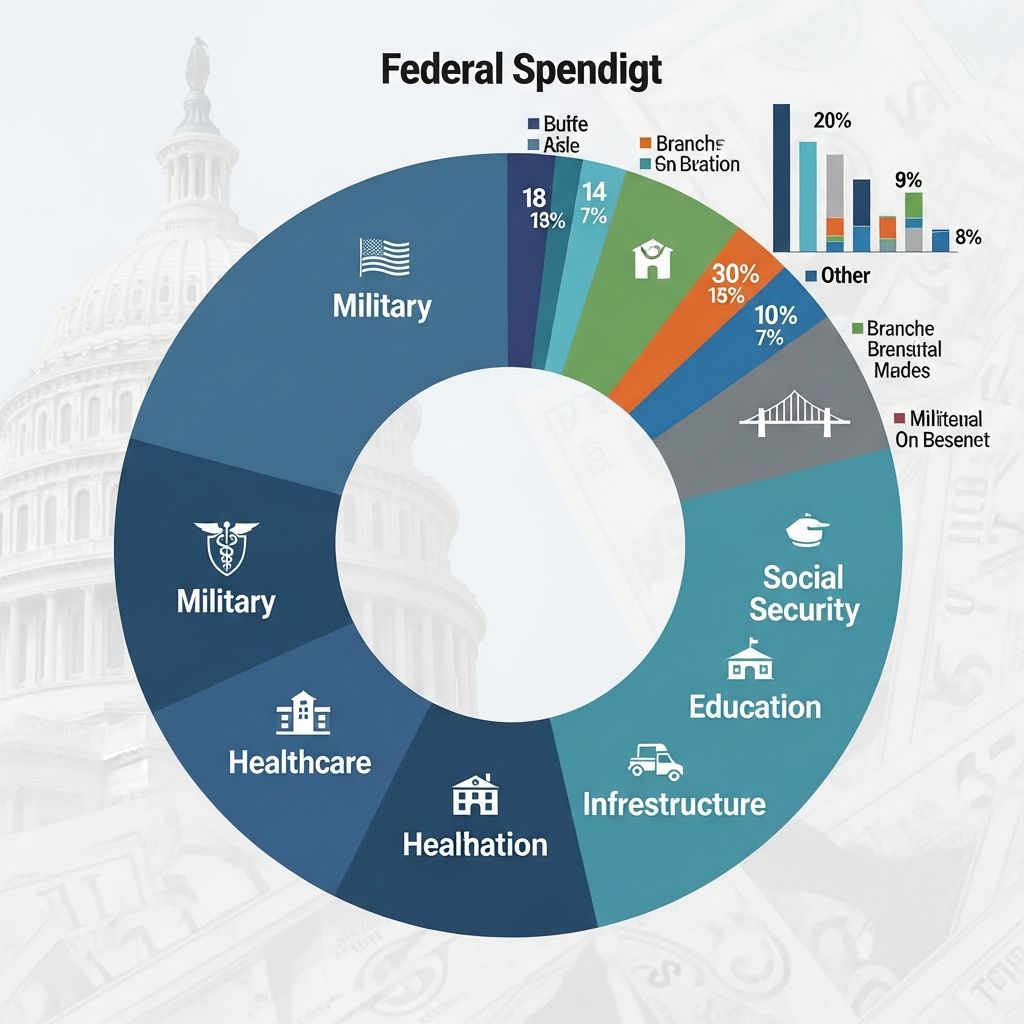
| Budget Category | Percentage of Total | Type | Key Components |
|---|---|---|---|
| Social Security | ~21% | Mandatory | Retirement, disability, survivor benefits |
| Medicare | ~16% | Mandatory | Senior healthcare, prescription drugs |
| Medicaid | ~10% | Mandatory | Low-income health insurance |
| Defense | ~13% | Discretionary | Military personnel, equipment, operations |
| Other Mandatory | ~12% | Mandatory | Veterans, unemployment, federal retirement |
| Non-Defense Discretionary | ~10% | Discretionary | Education, transportation, research, agencies |
| Interest on Debt | ~10% | Mandatory | Payments on national debt |
| Other | ~8% | Mixed | Various federal programs and services |
Frequently Asked Questions About the Federal Budget
Q: How much of the federal budget is spent on mandatory versus discretionary programs?
A: Mandatory spending comprises approximately 59 percent of total federal outlays, while discretionary spending accounts for the remaining portion. Within mandatory spending, the largest programs are Social Security, Medicare, and Medicaid, which together consume a substantial portion of the federal budget.
Q: What is a continuing resolution and why is it used?
A: A continuing resolution is a temporary appropriations bill that allows the federal government to continue operating at previous funding levels when Congress has not passed a comprehensive budget. For fiscal year 2025, a full-year continuing resolution was used to extend the 2024 budget through September 30, 2025, with limited changes.
Q: Why does the federal budget deficit keep growing?
A: The budget deficit grows when government spending exceeds revenues. Primary drivers include mandatory spending growth in programs like Social Security and Medicare due to demographic changes, as well as discretionary spending priorities established by Congress. While the FY 2025 deficit decreased slightly to $1.8 trillion, long-term unsustainable spending growth remains a concern.
Q: How does the government attempt to control spending?
A: The government employs various mechanisms to control spending, including spending caps established through legislation like the Fiscal Responsibility Act of 2023, budget reconciliation processes, and annual appropriations negotiations. However, mandatory spending programs grow automatically unless Congress passes legislation to change eligibility or benefit formulas.
Q: What recent changes have been made to Medicare and prescription drug pricing?
A: Medicare was given authority to negotiate prescription drug prices directly with pharmaceutical manufacturers, resulting in $160 billion in savings. The budget proposes extending this negotiation authority to additional drugs, with projected savings of another $200 billion.
Q: Where do individual income taxes fit into the federal budget?
A: Individual income taxes represent the largest source of federal revenue. The 2025 budget includes efforts to increase revenue through enhanced IRS enforcement, closing tax loopholes, and proposed new taxes on high-income earners and corporations.
Looking Forward: Budget Challenges and Solutions
The federal budget faces significant long-term challenges. With mandatory spending continuing to grow automatically and the aging population increasing beneficiaries for Social Security and Medicare, policymakers will need to make difficult decisions about future spending levels and tax revenues. Budget experts emphasize that addressing these challenges requires bipartisan cooperation and comprehensive reform rather than incremental adjustments.
The federal government’s commitment to controlling costs while maintaining essential services will require balancing competing priorities. Infrastructure investments, healthcare improvements, education expansion, and defense readiness all represent important national priorities that compete for limited resources within the annual budget process.
References
- Treasury Confirms Spending Up $142 Billion in 2025 — Committee for a Responsible Federal Budget. 2025-06-02. https://www.crfb.org/press-releases/treasury-confirms-spending-142-billion-2025
- 2025 United States Federal Budget — U.S. Congress Legislative Resource Center. 2025. https://en.wikipedia.org/wiki/2025_United_States_federal_budget
- Budget of the United States Government, Fiscal Year 2025 — The White House Office of Management and Budget. 2024-03. https://www.whitehouse.gov/wp-content/uploads/2024/03/budget_fy2025.pdf
- Monthly Budget Review: Summary for Fiscal Year 2025 — Congressional Budget Office. 2025. https://www.cbo.gov/publication/61307
- Government Spending Explorer | USAspending — USAspending.gov, U.S. Department of the Treasury. 2025. https://www.usaspending.gov/explorer/budget_function
- Overview of the FY2025 Federal Budget Projections — Congressional Research Service. 2025. https://www.congress.gov/crs-product/IN12477
- Budget FY 2025 – Historical Tables — Government Publishing Office. 2025. https://www.govinfo.gov/app/details/BUDGET-2025-TAB/context
Similar Articles








Read full bio of Sneha Tete