U.S. Deficit by Year: Historical Trends and Analysis
Understanding America's federal budget deficit: Historical data, trends, and economic impact analysis.

Understanding the U.S. Federal Budget Deficit
The federal budget deficit represents the annual shortfall between the U.S. government’s total spending and its total revenue collections. When the federal government spends more money than it collects in taxes and other revenues, that difference becomes the deficit for that fiscal year. The deficit is measured both in absolute dollar terms and as a percentage of gross domestic product (GDP), which provides context for the deficit’s size relative to the overall economy.
The U.S. fiscal year runs from October 1 through September 30, and deficit figures are typically released by the U.S. Department of the Treasury in October following the close of each fiscal year. Understanding the deficit by year provides valuable insights into government fiscal policy, economic conditions, and long-term financial sustainability.
FY 2025: Recent Deficit Data and Key Trends
In fiscal year 2025, the U.S. federal deficit totaled $1.78 trillion, representing a decrease of $50 billion or 2.8 percent compared to FY2024. This modest improvement came despite significant increases in federal spending, which rose 3.91 percent year-over-year. The FY 2025 deficit was driven by $7.0 trillion in total federal outlays against $5.2 trillion in net receipts.
As a percentage of GDP, the FY 2025 deficit represented 5.8 to 5.9 percent of the nation’s gross domestic product, down from 6.3 to 6.4 percent in FY2024. While still historically elevated, this decrease marked a slight improvement in the deficit’s relative burden on the economy.
Revenue and Spending Breakdown for FY 2025
Total federal revenue collections increased by $317 billion between FY 2024 and FY 2025, growing from $4.9 trillion to $5.2 trillion. Key contributors to this revenue growth included:
- Individual income tax revenue increased by $230 billion (9 percent), reaching $2.7 trillion
- Customs duties surged by $118 billion (153 percent) to $195 billion, driven by the Trump Administration’s tariff policies
- Excise tax revenue grew by $5 billion (4 percent) to $106 billion
- Federal Reserve remittances to the Treasury increased by $2 billion (75 percent) to $5 billion
However, corporate income tax revenue declined by $78 billion (15 percent), falling from $530 billion to $452 billion, due partly to provisions allowing larger tax deductions for business investments in 2025.
On the spending side, total federal spending increased by $275 billion, growing from $6.7 trillion to $7.0 trillion. Social Security spending alone increased by $120 billion (8 percent) to $1.6 trillion, driven by a 2.5-percent cost-of-living adjustment and increased beneficiary rolls.
Historical Context: Deficit Trends Over Time
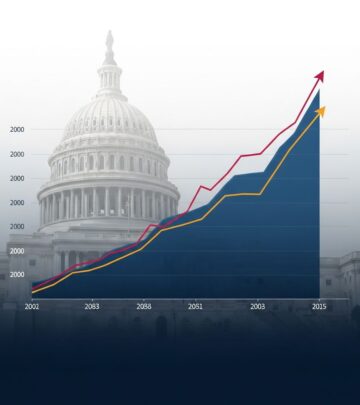
The FY 2024 and FY 2025 deficits of $1.8 trillion each represent some of the largest deficits in U.S. history outside of war, recession, or national emergency. These consecutive years of $1.8 trillion deficits underscore the persistent challenge of government spending exceeding revenues.
To understand the current deficit environment, it is important to recognize that deficit levels vary significantly based on economic conditions, policy decisions, and major events. During recessions, deficits typically expand as revenues decline and automatic spending programs increase. Conversely, during strong economic growth periods, deficits may narrow as tax revenues rise.
Deficit as a Percentage of GDP
When analyzing deficits relative to the size of the economy, the trend provides important context:
- FY 2024: 6.3 to 6.4 percent of GDP
- FY 2025: 5.8 to 5.9 percent of GDP
- 10-year projected average (2026-2035): 6.1 percent of GDP
This metric helps economists and policymakers understand whether deficits are growing or shrinking relative to economic output.
Interest Payments on the National Debt
One of the most concerning trends in recent years has been the rapid growth of interest payments on the national debt. In FY 2025, total interest on the debt reached a new record high of more than $1.2 trillion, representing an increase of $100 billion from FY2024. Net interest payments alone totaled almost $971 billion, making interest the fourth-largest federal expense behind Social Security, Income Security and Veterans Benefits, and Medicare—exceeding defense spending by approximately $100 billion.
The Committee for a Responsible Budget projects that by 2051, interest payments on the nation’s debt will become the largest expense in the U.S. budget, surpassing even Social Security. This trajectory reflects the compounding effect of rising debt levels combined with higher interest rates.
Federal Debt Held by the Public
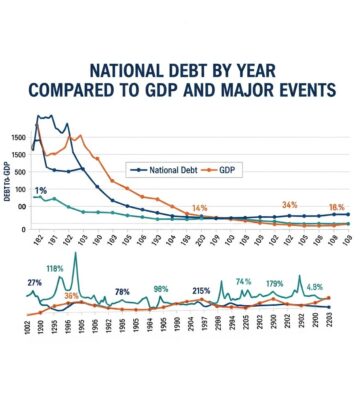
As deficits accumulate, the total federal debt held by the public continues to expand. In FY 2025, federal debt held by the public increased by $2.0 trillion, rising from $28.3 trillion at the end of FY 2024 to $30.3 trillion at the end of FY 2025. As a percentage of GDP, federal debt represented approximately 98 percent of gross domestic product.
This debt-to-GDP ratio is significant because it indicates that the nation’s outstanding debt is approaching the size of the entire annual economic output. Historically, debt-to-GDP ratios above 100 percent are considered unsustainable without significant policy changes.
Deficit Projections Through 2035
Looking forward, budget analysts project that deficits will remain elevated over the next decade. According to baseline projections, deficits will total $22.7 trillion over the FY 2026 through 2035 period, representing 6.1 percent of GDP. The projections show deficits rising from $1.7 trillion (5.6 percent of GDP) in 2025 to $2.6 trillion by 2035.
As a share of the economy, deficits are projected to rise from 5.6 percent of GDP in 2025 to 6.4 percent in 2028, dip to about 6.0 percent for several years, then climb to a high of 6.5 percent in 2033 before falling to 5.9 percent by 2035.
Impact of Recent Legislation and Policy
Recent legislative changes have significantly affected deficit projections. The “One Big Beautiful Bill” (OBBBA) as enacted is projected to add $4.6 trillion to deficits over the 2026-2035 period. However, tariffs enacted between January 6 and May 13 are projected to reduce deficits by $2.7 trillion over the same period, partially offsetting the deficit impact of the legislation.
Why the Deficit Matters
The federal deficit has important implications for the economy, inflation, interest rates, and long-term fiscal sustainability. When the government runs persistent deficits, it must borrow to finance the shortfall, which can affect market interest rates and crowd out private investment. Rising deficits also contribute to increased national debt, which grows with each year’s deficit.
The measurement of federal spending shows that in FY 2025, 25.33 percent of federal outlays were not paid for by revenues, meaning for every dollar the federal government received, it spent $1.34. This unsustainable spending-to-revenue ratio highlights the structural challenges facing the federal budget.
Revenue and Spending Components
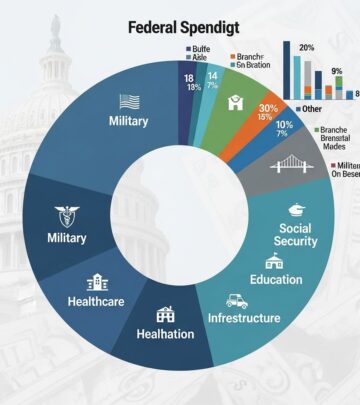
Understanding the deficit requires examining both its revenue and spending components. Revenue sources include individual income taxes, corporate income taxes, payroll taxes, excise taxes, customs duties, and various other sources. Spending comprises mandatory programs like Social Security and Medicare, discretionary spending on defense and domestic programs, and interest payments on the debt.
Changes in any of these components can affect the annual deficit. For example, the 153 percent surge in customs duties in FY 2025 represented record-setting tariff collections of $195 billion, which accounted for 3.7 percent of total receipts. Meanwhile, mandatory spending on Social Security and other entitlement programs continues to grow due to demographic factors and cost-of-living adjustments.
Comparison: FY 2025 vs. FY 2024
| Metric | FY 2025 | FY 2024 | Change |
|---|---|---|---|
| Total Deficit | $1.78 trillion | $1.83 trillion | -$50 billion |
| Deficit as % of GDP | 5.8-5.9% | 6.3-6.4% | -0.5 percentage points |
| Total Revenue | $5.2 trillion | $4.9 trillion | +$317 billion |
| Total Spending | $7.0 trillion | $6.7 trillion | +$275 billion |
| Individual Income Taxes | $2.7 trillion | $2.4 trillion | +$230 billion |
| Corporate Income Taxes | $452 billion | $530 billion | -$78 billion |
| Customs Duties | $195 billion | $77 billion | +$118 billion |
| Social Security Spending | $1.6 trillion | $1.5 trillion | +$120 billion |
| Interest on Debt | $1.2 trillion | $1.1 trillion | +$100 billion |
| Federal Debt Held by Public | $30.3 trillion | $28.3 trillion | +$2.0 trillion |
Frequently Asked Questions
Q: What is the difference between the budget deficit and the national debt?
A: The budget deficit is the annual shortfall between federal spending and revenue in a single fiscal year. The national debt is the cumulative total of all past deficits. Each year’s deficit adds to the national debt. For example, FY 2025’s $1.78 trillion deficit added to the existing $28.3 trillion debt, increasing it to $30.3 trillion.
Q: Why did the deficit decrease in FY 2025?
A: The FY 2025 deficit decreased by $50 billion (2.8 percent) compared to FY 2024 primarily due to record-setting tariff collections of $195 billion, increased income tax receipts of $230 billion, and modifications to the student loan program. Although spending also increased, revenue growth outpaced the spending increase, resulting in a smaller deficit.
Q: How does the U.S. deficit affect interest rates?
A: When the federal government runs large deficits, it must borrow significant amounts from the financial markets. This increased demand for borrowing can put upward pressure on interest rates, potentially making borrowing more expensive for businesses and consumers.
Q: Is the deficit expected to grow or shrink in the future?
A: According to baseline projections through 2035, deficits are expected to rise overall. While FY 2025 saw a slight improvement, deficits are projected to grow from $1.7 trillion in 2025 to $2.6 trillion by 2035, representing increases of 6.1 percent of GDP over the decade.
Q: What are customs duties and why did they increase so dramatically?
A: Customs duties are taxes on imported goods. In FY 2025, customs duties surged by 153 percent to $195 billion, driven by the Trump Administration’s tariff policies. This represents the largest single-year increase in tariff revenue in recent U.S. history.
Q: How much of federal spending goes toward interest payments?
A: In FY 2025, interest payments on the national debt totaled more than $1.2 trillion, making it the fourth-largest federal expense after Social Security, Income Security and Veterans Benefits, and Medicare. Interest spending exceeded defense spending by approximately $100 billion.
Q: When will interest payments become the largest federal expense?
A: According to the Committee for a Responsible Budget, interest payments are projected to become the largest expense in the U.S. budget by 2051, surpassing Social Security. This reflects the accelerating growth of interest costs as debt continues to accumulate.
Key Takeaways
The U.S. federal deficit remains a significant economic challenge despite a modest improvement in FY 2025. While the deficit decreased by $50 billion compared to FY 2024, driven primarily by record tariff collections and increased income tax revenue, the underlying structural imbalance between spending and revenues persists. With federal spending at $7.0 trillion against revenues of $5.2 trillion, the government continues spending $1.34 for every dollar it collects, an unsustainable trajectory.
Looking ahead, deficits are projected to increase over the next decade, reaching $2.6 trillion by 2035. The rapidly growing interest payments on the national debt—now exceeding $1.2 trillion annually—represent an accelerating burden on the federal budget. Without significant policy changes, interest payments will eventually crowd out other federal spending priorities, fundamentally altering the composition of the U.S. government budget.
References
- U.S. Deficit Decreases 2.8 Percent to $1.8 Trillion in FY2025, September Ends with $198 Billion Surplus — Joint Economic Committee, U.S. Senate. 2025. https://www.jec.senate.gov/public/index.cfm/republicans/2025/10/u-s-deficit-decreases-2-8-percent-to-1-8-trillion-in-fy2025-september-ends-with-198-billion-surplus
- U.S. Treasury: FY 2025 Deficit Totaled $1.8 Trillion — American Action Forum. 2025. https://www.americanactionforum.org/insight/u-s-treasury-fy-2025-deficit-totaled-1-8-trillion/
- Monthly Budget Review: Summary for Fiscal Year 2025 — Congressional Budget Office. 2025. https://www.cbo.gov/publication/61307
- An August 2025 Budget Baseline — Committee for a Responsible Budget. 2025. https://www.crfb.org/blogs/august-2025-budget-baseline
Similar Articles








Read full bio of Sneha Tete