Upside/Downside Ratio: Definition and Investment Analysis
Master the upside/downside ratio metric to evaluate investment performance against market benchmarks.
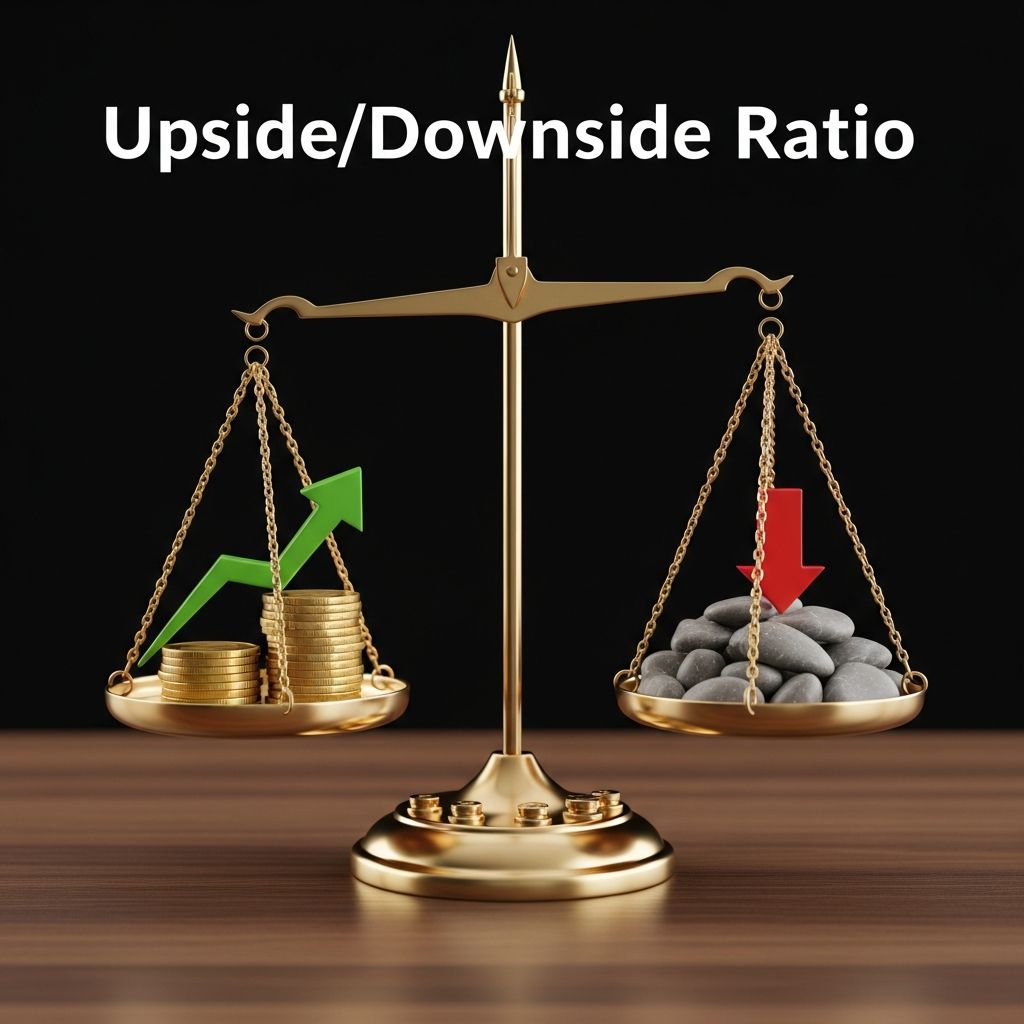
The upside/downside ratio, also known as the upside/downside capture ratio, represents a critical metric in investment analysis that measures how well an investment or fund performs relative to a benchmark index during periods of market strength and weakness. This ratio provides investors with valuable insights into whether a portfolio or investment strategy has captured market gains while simultaneously protecting against downside losses.
Understanding the Upside/Downside Capture Ratio
The upside/downside capture ratio fundamentally measures the degree to which a strategy has gained relative to an index during periods of market strength or lost relative to an index during periods of market weakness. It is expressed as two separate metrics: the upside capture ratio and the downside capture ratio.
The upside capture ratio indicates the percentage of an index’s positive returns that an investment has captured. For example, an upside capture ratio of 80% means that when the market rises by 10%, the investment rises by 8%. Conversely, the downside capture ratio reveals the percentage of an index’s negative returns that an investment has experienced. A downside capture ratio of 60% indicates that when the market falls by 10%, the investment falls by only 6%.
The Mathematical Foundation
Understanding how these ratios are calculated is essential for investors seeking to evaluate portfolio performance accurately. The calculations involve comparing the returns of an investment during up-market and down-market periods against a benchmark index.
To calculate the upside capture ratio, divide the investment’s return during up-market periods by the benchmark’s return during those same periods, then multiply by 100. Similarly, the downside capture ratio is calculated by dividing the investment’s return during down-market periods by the benchmark’s return during those periods, multiplied by 100.
Why the Upside/Downside Ratio Matters
The significance of the upside/downside ratio lies in its ability to reveal a fundamental aspect of investment strategy that traditional metrics often overlook: asymmetric risk management. While standard performance measures like total return or standard deviation provide useful information, they do not specifically address how an investment performs during market extremes.
Consider two funds with identical total returns over a five-year period. Without examining their upside/downside ratios, an investor might assume they are equally suitable investments. However, one fund might have captured 90% of market gains while experiencing only 50% of market losses, while the other captured 70% of gains but suffered 70% of losses. The upside/downside ratio reveals these critical differences in investment behavior.
The Power of Downside Capture in Portfolio Construction
Recent analysis demonstrates the transformative power of managing downside exposure in investment portfolios. An 80:60 strategy, which captures 80% of positive monthly returns while limiting exposure to 60% of negative monthly returns, provides compelling insights into why downside management matters for long-term investment success.
When applied to historical market data, this strategy demonstrates remarkable results. The proportion of negative months in market history, combined with the asymmetry between average up months and average down months, creates a mathematical advantage for strategies that limit downside participation. Historically, market indices experience approximately 58% positive months and 42% negative months, with average positive returns significantly larger than average negative returns.
Real-World Application: Historical Performance Analysis
When examining the Dow Jones index from 1900 to 2018, an 80:60 strategy produced annualized outperformance of 3.6% while simultaneously reducing annualized volatility from 18.1% to 12.8%. This represents a reduction of 5.3 percentage points in volatility while generating excess returns—a combination of improvements that most investors find highly desirable.
The effectiveness of such strategies varies across different market environments and time periods. Decades characterized by the greatest proportion of down months also coincided with the strategy’s greatest outperformance. Conversely, decades with the lowest volatility and lowest proportion of down months were periods when the downside-limiting strategy delivered smaller excess returns, as there were fewer opportunities to benefit from reduced downside participation.
Key Characteristics That Influence Upside/Downside Performance
Investment performance during market cycles is not random; specific characteristics of holdings significantly influence whether a portfolio captures upside or downside. Understanding these characteristics is crucial for investors constructing portfolios designed to optimize long-term outcomes through superior upside/downside capture.
Investment styles and company characteristics with strong downside protection characteristics include:
- High dividend yield stocks, which provide income regardless of market direction
- Larger capitalization companies, which typically demonstrate greater stability
- Low share issuance securities, indicating disciplined capital management
- Defensive sectors that maintain demand during economic downturns
- High-quality companies with strong competitive advantages
In contrast, characteristics associated with weaker downside protection include:
- Lower quality companies with vulnerable competitive positions
- Expensive securities trading at elevated valuations
- Cyclical companies sensitive to economic conditions
- Smaller capitalization companies with limited financial resources
- Growth stocks dependent on optimistic future expectations
Comparing Investments Using Upside/Downside Capture
The upside/downside ratio provides a superior framework for comparing investments from multiple perspectives. Rather than examining only total return or only volatility, investors can assess whether a fund manager has achieved returns through capturing market gains, through defensive positioning, or through some combination of both.
This distinction proves particularly important when evaluating actively managed funds against passive benchmarks. A fund with an upside capture ratio of 95% and a downside capture ratio of 75% tells a fundamentally different story than a fund with an upside capture ratio of 60% and a downside capture ratio of 40%, even if both have identical total returns over a specific period.
How Market Volatility Affects Upside/Downside Ratios
The effectiveness and importance of upside/downside capture ratios intensifies during periods of higher market volatility. During calm market periods with few significant corrections, the distinction between a strategy that limits downside and one that does not may seem insignificant. However, during volatile periods characterized by significant market declines, strategies that successfully limit downside exposure retain a higher base from which to capture positive returns during subsequent market recovery.
This compounding effect of maintaining a higher asset base after market declines means that over complete market cycles including both bull and bear markets, downside management becomes increasingly valuable. The mathematical advantage compounds through multiple market cycles, creating increasingly significant differences in long-term wealth accumulation.
Interpreting Upside/Downside Ratios
When evaluating upside/downside capture ratios, investors should consider what the ratios reveal about investment strategy and manager skill. A high upside capture ratio combined with a low downside capture ratio represents the ideal scenario, indicating that a manager successfully captures market gains while protecting against losses.
However, investors should also recognize that extremely high upside capture ratios, particularly those exceeding 100%, may indicate that the fund took on additional risk through leverage or concentrated positions. Similarly, very low downside capture ratios might result from defensive positioning that also limits upside potential.
Limitations and Considerations
While upside/downside capture ratios provide valuable insights, investors should recognize several limitations. These ratios depend on the choice of benchmark index, and selecting an inappropriate benchmark can distort the analysis. Additionally, historical capture ratios may not predict future performance, particularly if the investment strategy, management team, or market environment changes.
The length of the measurement period also influences the significance of the ratios. Shorter measurement periods may not capture a complete market cycle, potentially overestimating the benefits of downside management during bull market periods or overstating the value of market capturing during bear market periods.
Combining Upside/Downside Ratios with Other Metrics
The most sophisticated investment analysis combines upside/downside capture ratios with other performance measures. Standard deviation or volatility indicates overall portfolio fluctuation. The Sharpe ratio measures risk-adjusted returns. The Sortino ratio focuses specifically on downside volatility. Together, these metrics provide a comprehensive understanding of investment performance and risk characteristics.
By examining multiple metrics simultaneously, investors develop a more nuanced understanding of how investments achieve their returns and what risks they incur in the process.
Frequently Asked Questions
What is considered a good upside/downside capture ratio?
A strong upside/downside capture ratio typically features an upside capture ratio above 90% combined with a downside capture ratio below 70%. This indicates the investment captures most market gains while significantly limiting losses. However, “good” depends on investment objectives; some investors may prioritize downside protection more than others.
How does upside/downside capture differ from other performance metrics?
Unlike traditional metrics that measure overall performance or volatility, upside/downside capture specifically distinguishes how an investment performs during market strength versus weakness. This provides unique insights into whether a manager successfully balanced growth objectives with risk management.
Can upside/downside capture ratios predict future performance?
While historical capture ratios provide useful insights into past strategy effectiveness, they do not guarantee future performance. Changes in market conditions, management personnel, or investment strategy can alter future capture ratios significantly.
Why do some funds have upside capture ratios above 100%?
Upside capture ratios exceeding 100% indicate the fund outperformed the benchmark during positive market periods. This can result from manager skill, concentrated positions, or additional leverage, which may introduce additional risk.
How should investors use upside/downside ratios in portfolio construction?
Investors can use these ratios to select investments aligned with their risk tolerance and return objectives. Those prioritizing capital preservation may emphasize funds with strong downside capture ratios, while those accepting higher volatility might focus on upside capture ratios.
What time period should be used when analyzing capture ratios?
Using longer measurement periods, ideally covering multiple complete market cycles including both bull and bear markets, provides more reliable insights than shorter periods, which may not reflect comprehensive performance across different market environments.
References
- The Power of Less Downside: The 80:60 Case Study — State Street Global Advisors. 2019-04-30. https://www.ssga.com/library-content/pdfs/insights/the-power-of-less-downside-the-80-60-case-study.pdf
Similar Articles








Read full bio of Sneha Tete