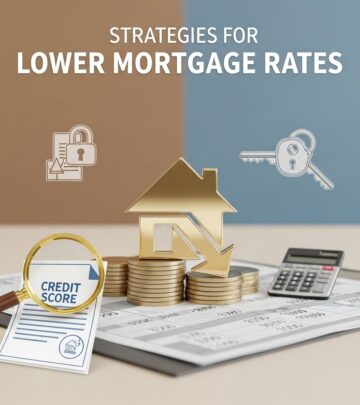
Mortgage Rates: 6 Expert Steps To Secure The Best Offers
Discover proven strategies to secure the lowest mortgage rates and save thousands on your home loan journey.

Unlocking the Best Mortgage Rates
Securing a favorable mortgage rate can dramatically reduce the total cost of homeownership over decades. Rates are shaped by a blend of personal financial profiles, economic conditions, and lender policies, making it essential for buyers to understand these dynamics. This guide explores the core elements driving mortgage rates and provides practical steps to position yourself for the most competitive offers.
Core Elements Shaping Your Mortgage Rate
Mortgage interest rates aren’t arbitrary; they stem from lender assessments of risk combined with broader market forces. Lenders evaluate borrower-specific traits alongside macroeconomic indicators to set personalized rates.
Your Credit Profile: The Primary Gatekeeper
A strong credit score signals reliability to lenders, directly correlating with lower rates. Borrowers with scores above 740 often qualify for prime rates, while those below 620 face higher premiums due to perceived risk. Credit reports from Experian, TransUnion, and Equifax factor in payment history, debt levels, and account age.
- Higher scores (760+) unlock the lowest rates on conventional loans.
- Scores of 620-739 qualify but at slightly elevated costs.
- Below 580 limits options to FHA loans with added insurance fees.
Improving your score involves timely payments, reducing credit utilization under 30%, and disputing inaccuracies—actions that can yield results in months.
Down Payment Size and Loan-to-Value Ratio
The portion of the home price you pay upfront influences lender risk exposure. A 20% down payment avoids private mortgage insurance (PMI) and typically secures better rates, as it lowers the loan-to-value (LTV) ratio—the loan amount divided by appraised value.
| LTV Ratio | Typical Rate Impact | PMI Required? |
|---|---|---|
| <80% | Lowest rates | No |
| 80-90% | Moderate increase | Possible |
| 90-97% | Higher rates | Yes |
Larger down payments reduce LTV, signaling commitment and minimizing default risk, which translates to rate savings. For example, on a $400,000 home, 20% down ($80,000) versus 5% ($20,000) can shave 0.5% off your rate.
Debt-to-Income Ratio: Balancing Your Financial Load
Lenders calculate your debt-to-income (DTI) ratio by dividing monthly debt payments (including the new mortgage) by gross income. Ideal DTIs under 36% qualify for top rates; exceeding 43% raises flags and rates.
- Front-end DTI: Housing costs alone (under 28%).
- Back-end DTI: All debts (under 36% preferred).
Pay down debts or boost income to improve DTI before applying, as this directly enhances rate eligibility.
Market Forces and Economic Influences
Beyond personal factors, rates mirror national trends. The 10-year Treasury yield serves as a benchmark, with lenders adding a spread for profit and risk. Mortgage-backed securities (MBS) prices also play a role, as they determine how lenders fund loans.
Federal Reserve and Inflation Dynamics
Fed policies on federal funds rates indirectly sway mortgage rates via bond markets. Rising inflation prompts rate hikes to curb spending, pushing mortgage costs up. Conversely, economic slowdowns lower yields and rates.
Global events, oil prices, and employment data further amplify volatility. Buyers should monitor these via reliable economic calendars.
Location, Property Type, and Occupancy Status
Rates vary by property use: primary residences get the best terms due to lower risk, while investment properties command premiums. Non-single-family homes like condos or multi-units often incur higher rates owing to resale challenges. Local competition among lenders can compress margins, benefiting shoppers in high-density markets.
Loan Features That Affect Rate Offers
Not all mortgages are equal; term length, rate type, and size influence pricing.
- Term Length: 15-year loans carry lower rates than 30-year but higher monthly payments.
- Fixed vs. Adjustable: Fixed rates provide stability; ARMs start lower but risk future hikes.
- Loan Size: Jumbo loans (over conforming limits) face higher rates due to secondary market constraints.
Strategic Steps to Secure Optimal Rates
Proactive preparation trumps passive waiting. Here’s a roadmap:
- Enhance Credit: Review reports 6 months pre-application; aim for 740+.
- Save Aggressively: Target 20% down to dodge PMI and boost LTV.
- Optimize DTI: Consolidate debts; document stable income.
- Shop Multiple Lenders: Compare at least three quotes; rates differ by 0.25-0.5%.
- Leverage Relationships: Existing bank customers may access discounts.
- Time Your Lock: Lock rates when trends dip; 30-60 day periods are standard.
Pre-approval strengthens offers and reveals personalized rates early.
Comparing Lenders: What to Evaluate
Beyond advertised rates, scrutinize fees, service, and flexibility.
| Factor | Why It Matters | Ideal Benchmark |
|---|---|---|
| APR | Includes fees for true cost | Lowest overall |
| Closing Costs | Upfront expenses | <2-5% of loan |
| Lock Period | Rate protection duration | 45-60 days |
| Customer Reviews | Service quality | 4.5+ stars |
Use tools like rate tables from CFPB for apples-to-apples comparisons.
Frequently Asked Questions
How much does a 0.25% rate difference cost over 30 years?
On a $300,000 loan, it adds about $50,000 in interest.
Can I re-lock if rates drop after initial lock?
Many lenders allow free float-down options; confirm upfront.
What’s the impact of buying points?
Paying upfront fees (points) buys down the rate; ideal for long-term stays.
Do ARMs ever make sense?
Yes, for short holds (5-7 years) when initial rates beat fixed.
How often do rates change daily?
Multiple times, tied to bond market shifts.
Long-Term Rate Management Tips
Post-closing, refinance when rates fall 0.5-1% to capture savings, factoring closing costs. Maintain credit health to access future equity products at favorable terms. Economic shifts like Fed cuts often create windows—stay informed via primary sources.
By mastering these factors, buyers transform rate hunting from gamble to strategy, potentially saving tens of thousands. Start with credit review and lender outreach today.
References
- Seven factors that determine your mortgage interest rate — Consumer Financial Protection Bureau. 2023-05-10. https://www.consumerfinance.gov/about-us/blog/7-factors-determine-your-mortgage-interest-rate/
- 11 Factors That Help Determine Your Mortgage Interest Rate — Experian. 2024-08-15. https://www.experian.com/blogs/ask-experian/how-are-mortgage-rates-determined/
- What Factors Determine And Move Mortgage Rates? — Bankrate. 2025-01-22. https://www.bankrate.com/mortgages/how-interest-rates-are-set/
- What factors Influence Mortgage Rates? — First Federal Bank. 2024-11-05. https://www.bankfirstfed.com/connect/news/detail.html?title=mortgage-guide-rates
- What Affects Mortgage Rates: Key Factors and Determinants — Chase. 2025-02-01. https://www.chase.com/personal/mortgage/education/buying-a-home/what-affects-mortgage-rates
- What Determines the Rate on a 30-Year Mortgage? — Fannie Mae. 2023-09-12. https://www.fanniemae.com/research-and-insights/publications/housing-insights/rate-30-year-mortgage
Similar Articles








Read full bio of Sneha Tete