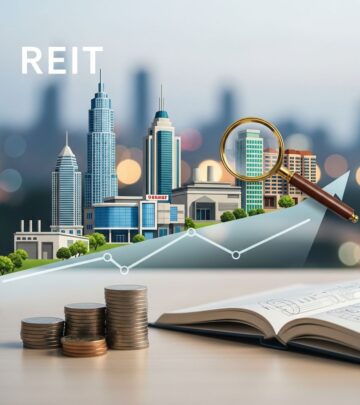
Unlocking REITs: Real Estate Trusts Explained
Discover how Real Estate Investment Trusts provide accessible entry to property markets with high dividends and diversification benefits for everyday investors.

Real Estate Investment Trusts, commonly known as REITs, represent a powerful vehicle for investors seeking exposure to real estate markets without the complexities of direct property ownership. These entities own, operate, or finance income-generating properties, distributing a significant portion of earnings to shareholders as dividends.
Core Definition and Legal Framework
A REIT qualifies as a corporation, trust, or association under U.S. federal tax law, specifically outlined in the Internal Revenue Code sections 856 through 859. To earn this designation, it must adhere to strict criteria, including management by trustees or directors, transferable shares, and ownership by at least 100 persons.
The structure ensures centralized control while allowing broad investor participation. Trustees hold legal title to assets and exercise authority over management and dispositions, subject to certain limitations. This setup mirrors a domestic corporation for tax purposes but grants special treatment if requirements are met.
- Managed by trustees or directors with exclusive ongoing authority.
- Beneficial ownership via transferable shares or certificates.
- Excludes financial institutions or insurance companies.
- Avoids personal holding company status.
Strict Qualification Requirements
Qualifying as a REIT demands compliance with income, asset, and distribution tests. At least 75% of total assets must consist of real estate, cash, or government securities, with no more than 25% in taxable subsidiaries. Gross income must derive at least 75% from rents, mortgages, or related sources, and 95% from passive or specified active sources.
Critically, REITs must distribute at least 90% of taxable income annually to shareholders, minimizing corporate-level taxation. Failure to meet the 5/50 rule—where no five individuals hold more than 50% of shares in the latter half of the tax year—disqualifies the entity.
| Requirement Category | Key Thresholds |
|---|---|
| Asset Test | 75% in real estate/cash; ≤25% in subsidiaries |
| Income Test | 75% real estate-related; 95% passive/total |
| Distribution | ≥90% of taxable income |
| Ownership | ≥100 persons; 5/50 rule compliance |
Primary Categories of REITs
REITs segment into equity and mortgage varieties, each targeting distinct real estate facets. Equity REITs acquire and manage physical properties like offices, apartments, retail centers, warehouses, hotels, and healthcare facilities, generating revenue primarily through rents.
Mortgage REITs (mREITs), conversely, provide financing via loans or mortgage-backed securities, earning from interest payments. Hybrid REITs blend both approaches, balancing property ownership with debt investments.
- Equity REITs: Direct property operators (e.g., malls, data centers).
- Mortgage REITs: Focus on loans and interest income.
- Hybrids: Combine ownership and financing.
Tax Advantages Driving Appeal
The hallmark of REITs lies in their tax efficiency. By distributing 90%+ of income, they avoid double taxation at the corporate level—income passes directly to shareholders, taxed at individual rates. This structure, modeled after mutual funds, democratizes real estate investing.
Dividends often qualify for favorable treatments, such as the 20% deduction under Section 199A for non-corporate taxpayers, enhancing after-tax yields. Investors benefit from liquidity via exchange-traded shares, unlike illiquid direct real estate.
Historical Evolution and Market Presence
Enacted in 1960, REIT legislation aimed to broaden real estate access amid post-war property booms. Today, public REITs trade on major exchanges, with non-traded and private variants offering alternative liquidity profiles. The sector spans commercial forests, studios, hospitals, and urban housing, bridging institutional capital to development.
Globally, similar structures exist, often with localized rules like minimum asset allocations or holding periods, but U.S. REITs set the benchmark for transparency and scale.
Key Benefits for Portfolio Builders
REITs deliver compelling advantages:
- Income Generation: High dividend yields, often exceeding bonds or equities, from rental streams.
- Diversification: Low correlation to stocks/bonds, stabilizing portfolios.
- Liquidity: Traded like stocks, enabling quick entry/exit.
- Professional Management: Expert operations without tenant hassles.
- Inflation Hedge: Rents and values rise with prices.
Historically, REITs have matched stock returns with superior income, per industry data.
Navigating Potential Drawbacks
Despite strengths, risks persist. Market sensitivity to interest rates can depress values when rates rise, as borrowing costs climb and yields compete with bonds. Dividend fluctuations tie to occupancy and economic cycles.
Leverage amplifies volatility, particularly for mREITs exposed to credit spreads. Regulatory changes or failure to qualify could trigger full corporate taxation. Illiquidity in non-public REITs poses redemption challenges.
| Pros | Cons |
|---|---|
| High yields & dividends | Interest rate sensitivity |
| Easy diversification | Economic cycle vulnerability |
| Tax-efficient pass-through | Leverage risks |
Investment Strategies and Selection
Approach REITs via individual stocks, ETFs, or mutual funds for broad exposure. Prioritize funds with low expenses and strong track records. Analyze metrics like funds from operations (FFO), a key profitability gauge adjusting for depreciation.
Diversify across sectors—office, residential, industrial—to mitigate sector-specific downturns. Monitor debt levels, occupancy rates, and dividend coverage. Long-term holders benefit from compounding reinvested dividends.
- Review FFO growth and payout ratios.
- Assess portfolio quality and geographic spread.
- Balance equity vs. mortgage exposure.
Comparing REITs to Traditional Real Estate
Unlike direct ownership, REITs eliminate maintenance, vacancies, and financing burdens. No need for large capital outlays—shares start at affordable prices. However, investors forfeit control over assets and face market pricing inefficiencies.
REITs excel in scalability and transparency, with SEC filings detailing holdings, unlike opaque private deals.
Future Trends Shaping REITs
Emerging sectors like data centers, cell towers, and renewable energy properties fuel growth. E-commerce drives industrial/logistics demand, while remote work reshapes offices. Sustainability mandates push green retrofits, influencing valuations.
Technological integration, such as proptech for efficiency, enhances margins. As populations urbanize, residential and healthcare REITs gain traction.
Frequently Asked Questions
What minimum distribution do REITs require?
REITs must pay out at least 90% of taxable income as dividends to maintain tax status.
Can anyone invest in REITs?
Yes, via publicly traded shares on stock exchanges, accessible through brokerage accounts.
How do interest rates affect REIT performance?
Rising rates often pressure prices due to higher borrowing costs and dividend competition.
Are REIT dividends taxable?
Yes, as ordinary income primarily, though portions may qualify for capital gains or return-of-capital treatments.
What sectors do REITs cover?
Office, retail, residential, industrial, healthcare, hospitality, and specialized like timber or infrastructure.
References
- 26 CFR § 1.856-1 – Definition of real estate investment trust — U.S. Government Publishing Office. N/A. https://www.law.cornell.edu/cfr/text/26/1.856-1
- Real estate investment trust — Wikipedia (informed by IRC sources). 2026. https://en.wikipedia.org/wiki/Real_estate_investment_trust
- What’s a REIT (Real Estate Investment Trust)? — National Association of Real Estate Investment Trusts (NAREIT). 2026. https://www.reit.com/what-reit
- Real Estate Investment Trusts (REITs) — Charles Schwab. 2026. https://www.schwab.com/stocks/understand-stocks/reits
- ABCs of REITs — RSM US LLP. 2026. https://rsmus.com/insights/industries/real-estate/abcs-of-reits.html
Similar Articles








Read full bio of medha deb