Unlocking the Hidden Gem of Retirement Savings
Discover why only a fraction of Americans tap into this powerful tax-advantaged account that could transform your golden years.

In the landscape of retirement planning, numerous options exist, yet one stands out for its unique tax benefits and flexibility: the Roth IRA. Despite its advantages, adoption remains low, with estimates suggesting only about 17% of Americans actively use it. This account allows contributions with after-tax dollars, enabling tax-free growth and qualified withdrawals in retirement, making it a cornerstone for building substantial wealth over decades.
Why the Roth IRA Deserves Your Attention
The Roth IRA distinguishes itself from traditional retirement vehicles by shifting the tax burden upfront. Contributors pay taxes on money entering the account, but all subsequent earnings—from dividends to capital gains—compound without tax liability. Upon reaching age 59½ and meeting the five-year holding period, withdrawals are entirely tax-free. This structure proves especially valuable in lower tax brackets today or if future rates rise.
Unlike employer-sponsored plans tied to job changes, Roth IRAs offer portability. Individuals control investments, selecting from stocks, bonds, ETFs, or mutual funds at brokerages like Fidelity or Vanguard. Contribution limits for 2026 stand at $7,000 annually for those under 50, with a $1,000 catch-up for ages 50 and older, totaling $8,000.
Eligibility Rules and Income Thresholds
Not everyone qualifies for direct Roth IRA contributions due to income limits set by the IRS. For 2026, full contributions are available to single filers with modified adjusted gross income (MAGI) below $153,000, phasing out up to $168,000. Married couples filing jointly can contribute fully if MAGI is under $242,000, with phase-out through $252,000.
- Single filers: Full contribution if MAGI < $153,000; partial $153,000–$168,000; none above $168,000.
- Married filing jointly: Full if MAGI < $242,000; partial $242,000–$252,000; none above $252,000.
- Key note: These limits adjust annually for inflation, so check IRS updates.
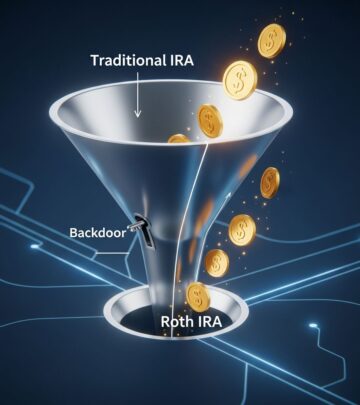
High earners exceeding these thresholds can employ a backdoor Roth IRA strategy: contribute to a traditional IRA (non-deductible if income is high), then convert to Roth. This maneuver bypasses direct limits but requires careful tax planning to avoid unexpected liabilities.
Roth IRA vs. Traditional IRA: A Side-by-Side Comparison
Choosing between Roth and traditional IRAs hinges on current versus future tax situations. Traditional IRAs offer upfront deductions, taxing withdrawals later, while Roth IRAs tax now for tax-free later.
| Feature | Roth IRA | Traditional IRA |
|---|---|---|
| Contributions | After-tax (no deduction) | Pre-tax (deductible, subject to limits) |
| Growth | Tax-free | Tax-deferred |
| Withdrawals | Tax-free if qualified | Taxed as income |
| RMDs | None during lifetime | Required at age 73 |
| 2026 Limit | $7,000 ($8,000 if 50+) | Same |
Roth IRAs shine for those expecting higher taxes in retirement or wanting to leave tax-free inheritances, as beneficiaries avoid income taxes on distributions.
Integrating Roth IRAs with Workplace Plans
Many overlook Roth IRAs because of 401(k)s, yet they complement each other. You can contribute to both if eligible. For 2026, 401(k) limits rise to $24,500 under 50, $32,500 over 50, with super catch-ups up to $35,750 for ages 60-63. Starting 2026, catch-ups for high earners ($150,000+ prior wages) must go to Roth-designated balances.
Roth 401(k)s mirror Roth IRA benefits but feature higher limits and potential employer matches (on pre-tax portions). Rolling over a 401(k) to a Roth IRA upon job change preserves tax advantages while gaining investment flexibility.
Strategic Tips to Maximize Your Roth IRA
To leverage this account fully:
- Start early: Time in the market beats timing the market; even modest contributions compound massively over 30+ years.
- Diversify investments: Allocate across low-cost index funds for broad exposure.
- Use for conversions: Gradually convert traditional IRA/401(k) funds to Roth during low-income years.
- Emergency access: Contributions (not earnings) withdraw penalty-free anytime; earnings penalty-free after five years and age 59½.
- Spousal contributions: Non-working spouses can contribute via spousal IRA if the working spouse has earned income.
Consider asset location: place tax-inefficient investments (e.g., bonds) in tax-advantaged accounts like Roth for optimal after-tax returns.
Common Myths Debunked
Several misconceptions deter adoption:
- Myth: Too late if over 50. Catch-up contributions and rollovers make it viable at any age.
- Myth: No tax break now. Future tax-free status often outweighs immediate deductions, especially with rising brackets.
- Myth: Only for the wealthy. Low minimums at most brokers make it accessible.
Low utilization—around 17%—stems from unawareness or preference for immediate tax relief, but long-term math favors Roth for many.
2026 Updates and Future-Proofing Your Plan
SECURE 2.0 Act provisions enhance Roth appeal. Mandatory Roth catch-ups for high earners and rising limits reflect policy shifts toward post-tax savings. State-mandated plans and AI-driven advice tools further democratize access.
Monitor inflation-adjusted limits; SIMPLE IRAs rise to $17,000 in 2026. Pair Roth with HSAs for triple tax-free growth if eligible.
Frequently Asked Questions (FAQs)
What is the Roth IRA contribution deadline?
April 15 of the following year, or tax filing deadline.
Can I have both Roth and traditional IRAs?
Yes, but total contributions across both cannot exceed annual limits.
What happens if I exceed income limits?
Recharacterize as traditional or use backdoor strategy.
Are Roth IRAs protected from creditors?
Generally yes, under federal bankruptcy law; state laws vary.
Can I roll a traditional 401(k) into a Roth IRA?
Yes, but pay taxes on the converted amount.
Building a Robust Retirement Portfolio
A well-rounded strategy layers Roth IRAs with 401(k)s, HSAs, and taxable accounts. Aim for 15-20% savings rate, adjusting for age and goals. Tools like retirement calculators from Fidelity help project outcomes.
For self-employed, consider SEP or Solo 401(k)s with Roth options, offering higher limits up to 25% of compensation.
In summary, the Roth IRA’s tax-free promise positions it as an essential tool. With low adoption rates, those who embrace it gain a competitive edge toward financial independence.
References
- 9 Best Retirement Plans In 2026 — Bankrate. 2026. https://www.bankrate.com/retirement/best-retirement-plans/
- 9 types of retirement accounts — Fidelity Investments. 2026. https://www.fidelity.com/learning-center/smart-money/retirement-accounts
- 3 Big Changes for Retirement Planning in 2026 — Morningstar. 2026. https://www.morningstar.com/retirement/3-big-changes-retirement-planning-2026
- RETIREMENT PLANS COMPARISON CHART 2026 — Stifel. 2026. https://www.stifel.com/newsletters/adgraphics/pdf/rp/Retirement-Plans-Comparison-Chart.pdf
- New 2026 IRS Retirement Plan Contribution Limits — White Coat Investor. 2026. https://www.whitecoatinvestor.com/retirement-plan-contribution-limits/
Similar Articles








Read full bio of medha deb