Credit Scoring: 5 Key Factors That Shape Your Score
Discover how credit scoring models work, from FICO to VantageScore, and learn the key factors that shape your financial future.

Credit scoring represents a cornerstone of modern financial decision-making, providing lenders with a numerical snapshot of an individual’s borrowing reliability. These scores, typically ranging from 300 to 850, predict the likelihood of timely repayments, influencing everything from loan approvals to interest rates.
The Foundations of Credit Scoring Systems
Credit scores emerge from sophisticated statistical models developed by companies like FICO and VantageScore. These models analyze data from credit reports compiled by major bureaus: Equifax, Experian, and TransUnion. The process involves assigning weights to various financial behaviors, resulting in a score that quantifies risk.
Unlike subjective assessments, credit scoring relies on objective data points such as payment timeliness and debt levels. This standardization, pioneered by FICO in 1989, ensures consistency across lenders.
Major Credit Scoring Models Explained
Several models dominate the landscape, each with unique methodologies.
FICO: The Industry Standard
The FICO Score, used by 90% of top lenders, ranges from 300 to 850. Scores below 600 signal high risk, while those above 740 indicate excellent creditworthiness. Recent iterations like FICO 9 (2014) and FICO 10 (2021) refine calculations: FICO 9 reduces penalties for paid medical collections and incorporates rental payments, adapting to contemporary financial realities.
FICO offers variants, including base scores for general use and industry-specific ones like Auto Score (250-900 range) tailored for vehicle financing.
VantageScore: A Collaborative Alternative
Launched in 2006 by the three major bureaus, VantageScore provides competition to FICO. It emphasizes payment history (40% weight) and credit mix (21%), evaluating on-time payments across diverse accounts like mortgages and credit cards.
VantageScore scores also span 300-850 but may score more individuals due to its inclusive data approach, such as considering banking history.
Core Factors Driving Your Credit Score
Both models weigh similar elements, though percentages differ slightly. Here’s a breakdown:
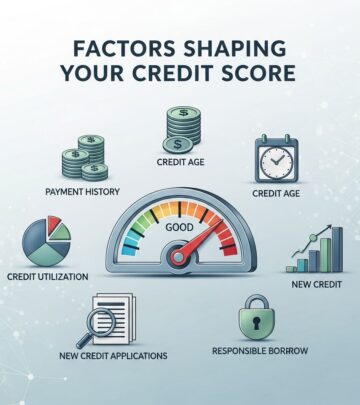
- Payment History (35-40%): The most critical factor, tracking on-time payments, delinquencies, bankruptcies, and collections. Recent late payments hurt more than older ones.
- Credit Utilization (20-30%): Ratio of balances to limits. Keeping it under 30% boosts scores.
- Length of Credit History (15-21%): Older accounts demonstrate stability.
- Credit Mix (10%): Variety of accounts (e.g., installment vs. revolving).
- New Credit (10%): Frequent inquiries or new accounts can signal risk.
| Factor | FICO Weight | VantageScore Weight | Impact Example |
|---|---|---|---|
| Payment History | 35% | 40% | Late payment drops score 60-110 points |
| Amounts Owed | 30% | 20% | High utilization lowers score significantly |
| Length of History | 15% | 21% | Longer history stabilizes score |
| Credit Mix | 10% | 11% | Diverse accounts improve mix |
| New Credit | 10% | 5% | Multiple inquiries penalize |
This table illustrates approximate weights; actual calculations are proprietary and dynamic.
Why Multiple Scores Exist
You don’t have a single score—variations arise from different bureaus’ data, model versions, and lender choices. For instance, Equifax might report a FICO 8 score, while Experian provides VantageScore 4. Lenders select based on needs, like auto-specific scores for car loans.
Discrepancies occur because bureaus maintain separate reports, and timing affects data freshness. A single event, like a late payment, impacts scores variably based on your overall profile.
Interpreting Score Ranges
- Exceptional (800-850): Best rates, highest approvals.
- Very Good (740-799): Strong position.
- Good (670-739): Competitive terms.
- Fair (580-669): Higher rates possible.
- Poor (<580): Limited options, high costs.
Strategies to Elevate Your Score
Improving credit takes time but yields rewards.
- Pay bills promptly—automate payments.
- Reduce balances to lower utilization.
- Limit new applications.
- Retain old accounts.
- Dispute errors via AnnualCreditReport.com.
Avoid closing old cards, as it shortens history and raises utilization.
Industry-Specific and Judgmental Models
Beyond general scores, specialized models exist for mortgages, autos, etc., tweaking factors like rental history or job stability. Judgmental models incorporate subjective elements like employment duration, used less today due to bias risks.
Common Myths Debunked
- Myth: Income affects scores. Fact: Scores focus on credit behavior, not earnings.
- Myth: One late payment ruins you forever. Fact: Impact fades over time; recent behavior matters more.
- Myth: More cards always help. Fact: Depends on management.
Frequently Asked Questions
How often do scores update?
Scores refresh with report changes, often monthly, but can shift daily with new data.
Free score access?
Yes, via bureaus, banks, or Credit Karma (VantageScore).
Does checking my score hurt it?
Soft inquiries don’t; hard ones from applications do temporarily.
Medical debt impact?
Lessened in newer models if paid.
Authorized user benefits?
Can help if primary user has strong history, but risks exist.
Navigating Scores for Financial Success
Understanding credit scoring empowers better decisions. Monitor reports annually, aim for low utilization, and build positive history. Higher scores unlock lower rates—e.g., a 760 score might save thousands on a mortgage versus 660.
In today’s economy, with FICO 10T gaining traction for mortgages, staying informed is key.
References
- Credit Scoring Models: FICO, VantageScore & More — Debt.org. 2023. https://www.debt.org/credit/report/scoring-models/
- How Are Credit Scores Calculated? — Equifax. 2024-01-15. https://www.equifax.com/personal/education/credit/score/articles/-/learn/how-is-credit-score-calculated/
- Credit Scores — Federal Trade Commission (FTC.gov). 2023-05-10. https://consumer.ftc.gov/credit-scores
- What Is a Good Credit Score? — Experian. 2024-02-01. https://www.experian.com/blogs/ask-experian/credit-education/score-basics/what-is-a-good-credit-score/
- Understanding Credit Scores — Wells Fargo. 2023-11-20. https://www.wellsfargo.com/goals-credit/smarter-credit/credit-101/why-so-many-credit-scores/
- Understand your credit score — Consumer Financial Protection Bureau (consumerfinance.gov). 2024. https://www.consumerfinance.gov/consumer-tools/credit-reports-and-scores/understand-your-credit-score/
- Credit Scores — Federal Housing Finance Agency (FHFA.gov). 2025-01-01. https://www.fhfa.gov/policy/credit-scores
Similar Articles








Read full bio of medha deb