Compound Interest: 6 Strategies To Maximize Growth
Discover how compound interest supercharges your savings and investments, turning small contributions into substantial wealth over time.

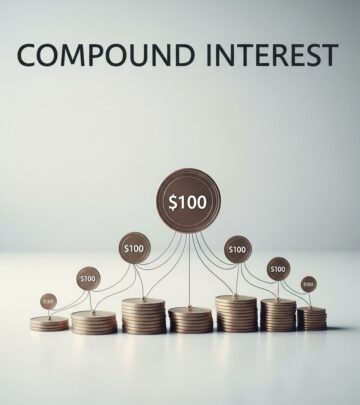
Compound interest represents one of the most potent forces in personal finance, enabling money to multiply exponentially over time by earning returns on both the initial investment and the accumulated earnings. Unlike simple interest, which only applies to the principal, this mechanism creates a snowball effect that can dramatically boost wealth accumulation.
The Fundamentals of Interest Growth
At its core, compound interest builds on itself. When you deposit funds into an account or investment vehicle offering this feature, the interest generated gets added to the principal at regular intervals. Subsequent calculations then apply to this larger base, accelerating growth. This process contrasts sharply with simple interest, where returns remain linear and limited to the original sum.
- Principal: The initial amount invested or deposited.
- Interest rate: The percentage yield applied periodically.
- Compounding frequency: How often interest is calculated and added, such as daily, monthly, or annually.
- Time horizon: The duration over which growth occurs, magnifying the effect.
This interplay of factors underscores why patience and consistency prove essential for harnessing its full potential.
Mathematical Foundation
The standard formula for calculating the future value under compound interest is A = P(1 + r/n)^(nt), where A denotes the final amount, P the principal, r the annual interest rate (as a decimal), n the compounding periods per year, and t the time in years. The interest earned equals A minus P.
For instance, consider a $10,000 deposit at 5% annual interest compounded monthly over 10 years. Here, n=12, r=0.05, t=10. Plugging in yields A ≈ $16,453, generating about $6,453 in interest.
| Year | Balance at Year-End (Monthly Compounding) | Simple Interest Alternative |
|---|---|---|
| 1 | $10,512 | $10,500 |
| 5 | $12,834 | $12,500 |
| 10 | $16,453 | $15,000 |
This table illustrates the divergence: compounding monthly outpaces annual simple interest significantly.
Compounding Frequency Matters
The more frequently interest compounds, the greater the effective yield. Daily or continuous compounding edges out annual applications due to more opportunities for reinvestment. Financial products often disclose the Annual Percentage Yield (APY), which accounts for this frequency, providing a standardized comparison metric.
- Annual compounding: Interest added once yearly.
- Quarterly: Four times per year.
- Monthly: Twelve intervals, common in savings accounts.
- Daily: 365 periods, maximizing growth in high-yield options.
For a 5% nominal rate, APY rises from 5.00% (annual) to about 5.12% (daily), compounding the advantage over extended periods.
Real-Life Applications in Savings
Savings accounts, certificates of deposit (CDs), and money market funds typically offer compound interest. A high-yield savings account at 4% compounded daily on $5,000 grows to roughly $5,408 after one year. Over a decade, it reaches about $7,401, versus $6,500 under simple interest.
Term deposits or CDs lock funds for set periods, often compounding daily for superior returns. Banks and credit unions provide these, with rates varying by institution and economic conditions.
Investment Vehicles Amplifying the Effect
Beyond basic savings, investments like bonds, dividend-reinvesting stocks, and retirement accounts (e.g., 401(k)s, IRAs) leverage compounding. Corporate or government bonds pay semi-annually, with interest reinvested to compound. Dividend reinvestment plans (DRIPs) automatically purchase additional shares using payouts, fueling ongoing growth.
Stock market indices historically average 7-10% annual returns compounded over decades, transforming modest contributions into retirement nest eggs.
The Double-Edged Sword: Borrowing Costs
While beneficial for savers, compound interest burdens borrowers. Credit card debt or loans accrue interest on principal plus prior interest, escalating balances rapidly if unpaid. A $5,000 credit card balance at 20% APR compounded daily balloons to over $12,200 in five years without payments.
Prioritizing high-interest debt repayment harnesses the inverse power, freeing resources for positive compounding.
Timing: The Eighth Wonder
Starting early unlocks exponential advantages. Compare two scenarios at 7% compounded daily: $10,000 annually for 10 years (then stops) yields $1.39 million after 40 years; $2,500 annually for 40 years reaches $612,116. The former benefits from 30 extra compounding years.
Another example: $1,000 invested at age 20 at 7% grows to $149,018 by age 70. Starting at 30 yields $55,993; at 40, just $26,573. Time proves irreplaceable.
| Starting Age | Years to 70 | Final Value ($1,000 initial, 7% compounded) |
|---|---|---|
| 20 | 50 | $149,018 |
| 30 | 40 | $55,993 |
| 40 | 30 | $26,573 |
| 50 | 20 | $10,677 |
Strategies to Maximize Gains
To optimize compound interest:
- Begin immediately: Even small amounts compound powerfully.
- Contribute regularly: Dollar-cost averaging smooths volatility.
- Select high-APY options: Compare across banks and products.
- Reinvest earnings: Avoid withdrawals to sustain growth.
- Minimize fees: They erode compounding benefits.
- Diversify: Balance savings with growth-oriented investments.
Automate contributions to retirement plans for tax-deferred compounding.
Common Pitfalls to Avoid
Many underestimate compounding’s pace or withdraw prematurely, stunting growth. Inflation can erode real returns, so aim for rates exceeding it (e.g., 3% inflation requires 5-7% nominal). Emotional decisions during market dips disrupt long-term strategies.
Frequently Asked Questions
What is the difference between compound and simple interest?
Simple interest applies only to the principal; compound interest includes prior earnings, leading to faster growth.
How does compounding frequency impact returns?
More frequent compounding increases effective yield by applying interest to a larger base sooner.
Can compound interest work against me?
Yes, on debts like credit cards, where unpaid interest compounds, inflating balances quickly.
Is compound interest guaranteed?
In FDIC-insured savings or CDs, yes up to limits; investments carry market risk but historically reward compounding.
How can I calculate it myself?
Use A = P(1 + r/n)^(nt) or online calculators for precision.
Building a Compounding Habit
Integrate compounding into daily finances by setting up high-yield accounts, maxing employer matches, and reviewing APYs annually. Track progress with spreadsheets modeling scenarios. Over decades, disciplined application turns ordinary savings into financial independence.
Population growth models, bacterial proliferation, and asset depreciation also follow similar exponential patterns, highlighting compounding’s ubiquity in nature and economics.
References
- Compound interest – Wikipedia — Wikipedia. 2023-10-01. https://en.wikipedia.org/wiki/Compound_interest
- Compound Interest Calculator — BYJU’S. 2024-01-15. https://byjus.com/maths/compound-interest/
- What Is Compound Interest & How Is It Calculated? — PNC Insights. 2023-11-20. https://www.pnc.com/insights/personal-finance/save/what-is-compound-interest.html
- Compound Interest: What It Is, How it Works, and Examples — Western & Southern. 2024-02-10. https://www.westernsouthern.com/investments/how-does-compound-interest-work
- Compound interest — Moneysmart.gov.au (Australian Government). 2023-05-12. https://moneysmart.gov.au/saving/compound-interest
- What Is Compound Interest? — Bankrate. 2024-03-05. https://www.bankrate.com/banking/what-is-compound-interest/
Similar Articles








Read full bio of medha deb