University of Wisconsin-Madison: Premier Public Research Institution
Explore UW-Madison: A top-ranked public research university in Wisconsin with world-class academics and innovation.
University of Wisconsin-Madison: Excellence in Public Education
The University of Wisconsin-Madison stands as one of America’s premier public research institutions, serving as the flagship campus of the University of Wisconsin System. Founded in 1848 as Wisconsin achieved statehood, UW-Madison has evolved into a world-class educational powerhouse recognized for its commitment to academic excellence, groundbreaking research, and the Wisconsin Idea—a guiding principle emphasizing public service at regional, local, and global levels. With over 50,000 students from all 50 states and more than 130 countries, the university creates a vibrant, diverse community dedicated to solving real-world problems through innovative scholarship and engaged learning.
Overview and Institution Profile
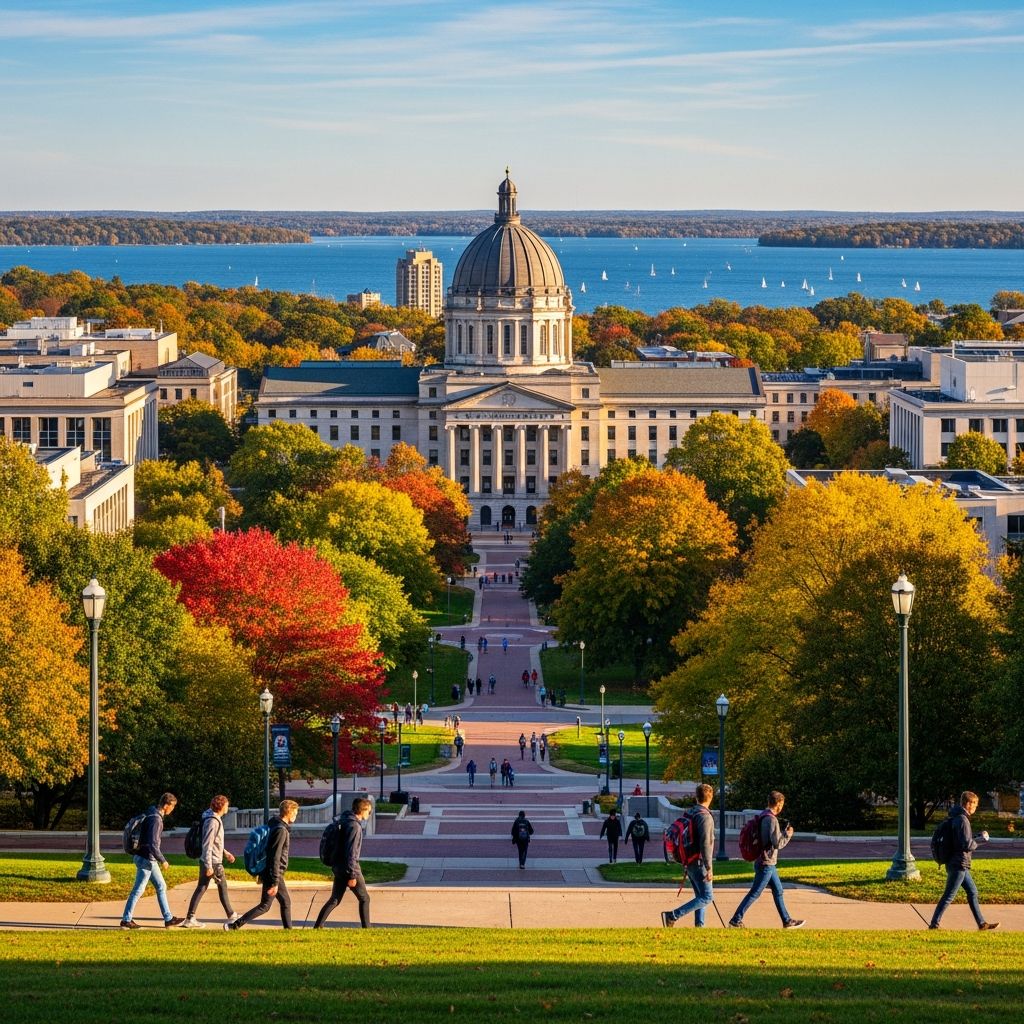
UW-Madison operates as a public land-grant research university with an impressive scope and reach. The institution is organized into 13 schools and colleges, providing comprehensive educational opportunities across numerous disciplines. Located in Madison, Wisconsin, the main campus spans 939 acres of scenic beauty situated on the Madison Isthmus between Lake Mendota and Lake Monona. This strategic location provides students with access to vibrant urban amenities, outdoor recreational opportunities, and a thriving intellectual community. The entire campus system, including research stations throughout Wisconsin, encompasses over 10,600 acres.
As a major research institution, UW-Madison ranks 6th nationally in research expenditures, demonstrating its commitment to advancing knowledge across multiple fields. The university’s budget for 2024-25 totals $4.95 billion, enabling substantial investment in academic programs, research initiatives, and student support services.
Academic Structure and Programs
The academic framework at UW-Madison reflects comprehensive offerings designed to meet diverse educational goals and career aspirations. The university provides 136 undergraduate majors, 148 master’s degree programs, and 120 doctoral programs, ensuring students can pursue specialized paths in their fields of interest. The College of Letters and Science, the largest undergraduate college, enrolls approximately half the undergraduate student body and comprises 38 departments along with five professional schools.
UW-Madison’s professional schools and colleges include:
– College of Letters and Science- School of Business- School of Engineering- School of Nursing- School of Medicine and Public Health- School of Law- School of Education- School of Pharmacy- School of Veterinary Medicine- School of Environmental Studies- Graduate School- School of Public Affairs- School of Library and Information Studies
The Poets & Quants rankings recognize the Wisconsin School of Business undergraduate program as 22nd nationally and top 10 among public universities, demonstrating the quality of business education offered at UW-Madison.
Student Enrollment and Demographics
UW-Madison serves a substantial student population reflecting remarkable geographic and cultural diversity. In Fall 2025, the university enrolled 51,822 total students, including 37,198 undergraduates, 10,069 graduate students, 2,560 professional students, and 1,995 special students. The faculty and staff complement comprises 27,293 professionals dedicated to supporting student success and advancing institutional missions.
The international student population at UW-Madison demonstrates the institution’s global reach and appeal. With approximately 7,000 international students from over 130 countries, UW-Madison ranks among the top 25 U.S. universities with the largest international student enrollment. This cultural diversity enriches the campus environment and advances collaborative research and learning opportunities.
Admissions and New Student Data
UW-Madison maintains selective admissions standards reflecting its competitive position among leading public universities. For Fall 2025 admissions, the university received 73,912 applications from prospective students. Of these applications, 30,167 students received admission offers, while 8,495 students ultimately enrolled, representing a total of 9,180 bachelor’s degrees awarded for the 2024-25 academic year.
University Rankings and Recognition
UW-Madison’s academic standing is affirmed through numerous prestigious rankings and recognitions from leading organizations. The university holds distinctive positions in national and international rankings:
| Ranking Organization | Ranking/Recognition | Category |
|---|---|---|
| Washington Monthly (2024) | #1 | National Public University |
| U.S. News & World Report (2025) | 13th (Public), 39th (Overall) | National Universities |
| Times Higher Education (2025) | 22nd (National), 38th (World) | World Reputation Rankings |
| Academic Ranking of World Universities (2024) | 23rd (National), 36th (World) | Global University Rankings |
| Center for World University Rankings (2024) | 20th (National), 28th (World) | Global Performance |
| Forbes Magazine | 16th | Public College Rankings |
These rankings reflect UW-Madison’s commitment to academic excellence, research innovation, and student success across multiple dimensions of institutional performance.
Academic Excellence and Research Achievements
Academic excellence remains central to UW-Madison’s institutional mission, attracting faculty and students dedicated to intellectual advancement and discovery. The university maintains a distinguished history of scientific and medical breakthroughs, including pioneering work in stem cell research, bone marrow transplantation, and wildlife management. These achievements underscore UW-Madison’s commitment to addressing pressing challenges through rigorous scholarly investigation and innovation.
The Carnegie Foundation classifies UW-Madison’s undergraduate program as “arts and science plus professions” with high graduate coexistence, indicating the integration of liberal arts education with professional preparation. This approach develops well-rounded graduates equipped for diverse career paths and lifelong learning.
Campus Life and Community
Madison provides an ideal environment for student development and personal growth beyond the classroom. The city is known as a ‘green’ city with extensive opportunities for outdoor recreation, including skiing, fishing, boating, and various athletic pursuits. State Street and Capitol Square offer vibrant cultural experiences, featuring restaurants, coffee shops, music venues, and boutiques that create a dynamic social atmosphere.
The main campus contains four National Historic Landmarks and is situated approximately 1 mile west of the Wisconsin State Capitol, connected by State Street. This proximity to civic and cultural institutions enriches student experiences and provides networking opportunities with community leaders and organizations.
The Wisconsin Idea: Public Service Commitment
The Wisconsin Idea represents UW-Madison’s foundational principle emphasizing public service at regional, local, and global levels. This guiding philosophy shapes how students, faculty, and staff approach their work, encouraging engagement with community challenges and commitment to improving society. Through research, teaching, and service, UW-Madison extends knowledge and expertise to support public welfare and democratic values.
Distinctive Features and Strengths
UW-Madison distinguishes itself through several key attributes that attract motivated students seeking comprehensive educational experiences:
– Great reputation and recognition among peers and employers globally- Huge variety of programs with over 321 undergraduate majors available- World-class research opportunities enabling undergraduate and graduate students to engage in cutting-edge investigations- Diverse student body with representation from all 50 states and over 130 countries- Strong alumni network comprising 502,324 living alumni worldwide- Commitment to public service through the Wisconsin Idea framework- Outstanding facilities including modern laboratories, libraries, and recreational centers
Degrees Conferred and Educational Outcomes
UW-Madison awards degrees across multiple levels, reflecting the breadth of educational opportunities provided to students. In 2024-25, the university conferred 9,180 bachelor’s degrees, 2,954 master’s and specialist degrees, and 1,599 doctorates. These figures demonstrate the institution’s capacity to prepare students for diverse professional and academic pursuits.
Recognition and Hospital Excellence
Beyond academic rankings, UW-Madison operates the best hospitals in Wisconsin, ranking #1 for 2025-26. The UW Health system provides exemplary patient care, advances medical knowledge through research, and trains the next generation of healthcare professionals, contributing significantly to regional health and wellbeing.
Institutional Leadership
UW-Madison operates under the leadership of Chancellor Jennifer L. Mnookin, who directs the institution’s strategic vision and operational excellence. The chancellor’s office oversees 13 schools and colleges, coordinates research initiatives, and ensures alignment with the university’s public service mission.
Frequently Asked Questions
Q: When was UW-Madison founded?
A: UW-Madison was founded in 1848 when Wisconsin achieved statehood, with the first class meeting in February 1849.
Q: How many students attend UW-Madison?
A: As of Fall 2025, UW-Madison enrolled 51,822 total students, including 37,198 undergraduates and 10,069 graduate students, with approximately 7,000 international students from over 130 countries.
Q: What is the Wisconsin Idea?
A: The Wisconsin Idea is UW-Madison’s guiding principle emphasizing public service at regional, local, and global levels, shaping how the university approaches education, research, and community engagement.
Q: How many schools and colleges does UW-Madison have?
A: UW-Madison is organized into 13 schools and colleges offering comprehensive academic programs across diverse disciplines.
Q: What are UW-Madison’s top rankings?
A: UW-Madison ranks #1 as a National Public University (Washington Monthly, 2024), 13th among public universities (U.S. News & World Report, 2025), and 39th overall among national universities.
Q: What research opportunities are available at UW-Madison?
A: UW-Madison ranks 6th nationally in research expenditures and offers extensive opportunities for undergraduate and graduate students to engage in pioneering research across multiple disciplines, from stem cell biology to environmental studies.
Q: How selective is UW-Madison in admissions?
A: UW-Madison received 73,912 applications for Fall 2025, admitted 30,167 students, and enrolled 8,495 new freshmen, reflecting competitive selectivity among leading public universities.
Q: What makes Madison an ideal college town?
A: Madison is known as a ‘green’ city offering abundant outdoor recreation, vibrant cultural attractions, renowned restaurants and venues, and proximity to natural lakes—all contributing to an exceptional college experience.
References
- University of Wisconsin–Madison — Wikipedia. Accessed November 2025. https://en.wikipedia.org/wiki/University_of_Wisconsin–Madison
- Facts — University of Wisconsin–Madison Official Website. Last updated November 5, 2025. https://www.wisc.edu/about/facts/
- UW-Madison — Go Wisconsin. Accessed November 2025. https://go.wisconsin.edu/campus-profiles/university-of-wisconsin-madison/
- About the University of Wisconsin-Madison — VISP (Visiting International Student Program). Accessed November 2025. https://visp.wisc.edu/uw-life/
- About UW–Madison — University of Wisconsin–Madison Official Website. Accessed November 2025. https://www.wisc.edu/about/
- University of Wisconsin-Madison | World University Rankings | THE — Times Higher Education. Accessed November 2025. https://www.timeshighereducation.com/world-university-rankings/university-wisconsin-madison
Similar Articles








Read full bio of medha deb