University of San Francisco: Premier Jesuit Education
Discover USF's excellence in diversity, academics, and social impact in San Francisco.

University of San Francisco: A Premier Jesuit Institution
The University of San Francisco stands as a distinguished private Jesuit university located in the heart of San Francisco, California. Founded in 1855, USF has evolved into a comprehensive institution serving nearly 9,000 students across undergraduate and graduate programs. With its commitment to academic excellence, diversity, and social responsibility, USF ranks among the nation’s leading universities, offering over 150 educational pathways across its main campus and five satellite locations throughout California.
USF’s strategic location in San Francisco provides students with unparalleled access to internships, research opportunities, and real-world learning experiences. The university combines rigorous academics with a values-driven education rooted in Jesuit traditions, emphasizing the development of critical thinkers who are prepared to serve the common good.
Academic Excellence and Rankings
The University of San Francisco has demonstrated significant upward momentum in recent academic rankings, reflecting the institution’s commitment to educational quality. In the U.S. News & World Report 2025 rankings, USF achieved notable recognition across multiple categories. The university ranks No. 109 among national universities, placing it in the top 25 percent of all institutions nationwide—a six-position improvement from the previous year. Additionally, USF earned a position of No. 88 for Best Value Schools and No. 159 in the Best College for Veterans category, demonstrating its commitment to accessibility and veteran support.
On College Factual’s 2025 Best Colleges list, USF is ranked #152 out of 2,152 schools in the nation for overall quality, placing it in the top 10% of all schools. This represents a meaningful improvement from the previous year’s #164 ranking, showcasing the institution’s sustained commitment to excellence.
Standout Program Rankings
Certain academic programs at USF have garnered particular recognition for their quality and impact. In undergraduate nursing, USF ranks exceptionally high at No. 19 out of 686 programs nationwide—positioning it in the top 3 percent of nursing programs across the United States and representing a remarkable leap of 48 spots. This dramatic improvement underscores the university’s investment in health professions education.
The School of Management continues to earn strong accolades, with USF ranking No. 114 for undergraduate business programs, placing it in the top 25 percent nationally and rising 21 spots from previous rankings. Additionally, USF has established itself in emerging disciplines, ranking 18th in entrepreneurship and 26th in marketing among national universities.
Campus Diversity: A National Leader
One of USF’s most distinctive achievements is its recognition as the nation’s leader in campus diversity. In the U.S. News & World Report 2025 rankings, USF earned the No. 1 ranking for campus ethnic diversity, tied with prestigious institutions including Stanford University, Johns Hopkins University, and Andrews University. This recognition reflects the university’s deliberate commitment to creating an inclusive learning environment where students from diverse backgrounds collaborate and learn together.
The university’s student body demonstrates significant racial and ethnic diversity, with Asian students comprising 26% of the undergraduate population, White students 24%, Hispanic students 21%, foreign nationals 12%, and Black students 6%. Additionally, 27% of the undergraduate student body qualifies as low-income, while 73% come from affluent backgrounds, creating economic diversity that enriches the educational experience.
USF’s commitment to diversity extends beyond recruitment. The institution actively fosters a campus culture where students from different backgrounds engage meaningfully, exchange ideas, and develop cross-cultural competencies essential for success in an increasingly global society. This diversity-focused approach aligns with USF’s Jesuit mission to educate leaders committed to justice and social change.
Social Mobility and Student Success
Beyond academic rankings, USF has earned recognition for its role in advancing social mobility. The university ranks No. 59 for social mobility among national universities, placing it in the top 15 percent—a significant 11-position improvement from previous years. This achievement demonstrates USF’s effectiveness in helping students from disadvantaged backgrounds achieve upward economic mobility through quality education.
The institution’s commitment to student success is further evidenced by strong retention and graduation metrics. The freshman retention rate at USF stands at 81%, significantly higher than the national average of 68%, indicating that most first-year, full-time students find sufficient value in their experience to continue their studies. The on-time graduation rate for first-time, full-time students pursuing bachelor’s degrees is 63%, substantially exceeding the national average of 33.3%.
Academic Structure and Program Offerings
USF’s academic organization comprises one college and four professional schools, offering 59 major programs across diverse disciplines. This structure allows for both breadth of knowledge and specialized expertise.
Schools and Colleges
College of Arts and Sciences — Provides foundational education in humanities, social sciences, natural sciences, and mathematics, supporting USF’s liberal arts tradition.
School of Education — Prepares educators and administrators committed to social justice and equity in educational settings.
School of Law — Offers legal education grounded in social responsibility and service to underserved communities.
School of Management — Develops business leaders equipped with ethical frameworks and global perspectives.
School of Nursing and Health Professions — Ranks among the nation’s top nursing programs, preparing healthcare professionals committed to serving diverse populations.
Campus Locations and Accessibility
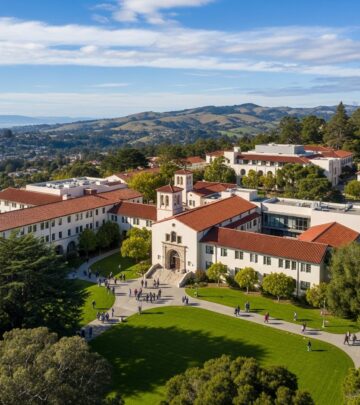
While USF’s 55-acre main campus in the Golden Gate area serves as the institution’s heart, the university extends access through multiple satellite locations across California. The main campus, known as “The Hilltop,” is divided into Lone Mountain and lower campus sections, positioned within a single block of each other north and south of Turk Street respectively.
The Downtown San Francisco Campus, established in 2012 at the historic Folger Coffee Company Building (101 Howard Street), offers 15 graduate programs in the School of Management and College of Arts and Sciences. This location provides graduate students with direct access to San Francisco’s business and professional communities.
USF’s Orange County Campus, founded in 1983, offers specialized graduate programs including the Master of Science in Sport Management, Master of Science in Nursing, and Master of Public Health in Applied Epidemiology and Population Health Methods. The Sacramento Campus, established in 1975, provides the Bachelor of Science in Nursing, Master in Counseling with emphasis in Marriage and Family Therapy, and Masters in Teaching with Teaching Credential. Additionally, USF offers programs through partnerships at San Jose City College and Santa Rosa Junior College, expanding educational access throughout California.
Admissions and Student Profile
USF maintains selective admissions standards while promoting accessibility. In 2025, the university accepted 50.1% of undergraduate applicants, with competition among applicants ranging from moderate to more intense. The average high school GPA for enrolled students was 3.61, reflecting the institution’s commitment to admitting academically prepared students.
The total enrollment for 2024 reached 8,913 students across all levels, with approximately 81% of first-year students returning for their sophomore year—a clear indicator of student satisfaction and engagement.
Sustainability and Campus Culture
USF demonstrates commitment to environmental responsibility as a recognized Green College by Princeton Review 2025. Notably, 70% of USF students, faculty, and staff employ sustainable transportation methods, walking, biking, carpooling, or utilizing public transit to reach campus. This sustainable approach reflects the university’s commitment to environmental stewardship and aligns with San Francisco’s broader sustainability goals.
The campus culture emphasizes collaboration, innovation, and social consciousness. Students engage in meaningful research with faculty members, participate in community service initiatives, and develop the critical thinking, communication, and problem-solving skills essential for contemporary careers.
Teaching Philosophy and Learning Environment
A distinguishing feature of USF’s educational model is its emphasis on small classes and accessible faculty. The university maintains a student-to-faculty ratio that enables meaningful interactions between professors and students, ensuring that educators know student names and individual learning needs. This approach contrasts with large lecture hall formats common at many universities, allowing for personalized attention and mentorship.
Faculty members bring substantial expertise to their disciplines while maintaining a commitment to holistic student development—addressing intellectual, physical, and spiritual dimensions of the educational experience. This Jesuit-informed approach emphasizes developing leaders committed to social justice and serving the common good.
Career Preparation and Employment Outcomes
USF’s education deliberately prepares students for career success and meaningful employment. The university emphasizes developing skills that employers consistently seek: critical thinking, creative problem-solving, effective communication, and collaborative capabilities. These competencies, combined with discipline-specific knowledge, position USF graduates competitively in the job market.
The San Francisco location provides distinct advantages for career development. Students access internships with Fortune 500 companies, innovative startups, nonprofit organizations, and government agencies. This proximity to major employers, research institutions, and industry leaders transforms the city itself into an extended classroom where theoretical learning connects to practical application.
Frequently Asked Questions
What makes USF’s campus diversity significant?
USF is ranked No. 1 nationally for campus ethnic diversity, tied with Stanford, Johns Hopkins, and Andrews universities. This recognition reflects intentional institutional efforts to recruit and support students from diverse racial, ethnic, and socioeconomic backgrounds, creating an enriching environment where cross-cultural learning occurs naturally.
How strong is USF’s nursing program?
USF’s nursing program ranks No. 19 nationally among 686 programs, placing it in the top 3 percent. This exceptional ranking represents a 48-position leap in recent years, reflecting significant investment in faculty, facilities, and clinical partnerships.
What is the freshman retention rate at USF?
USF’s freshman retention rate is 81%, significantly exceeding the national average of 68%. This high retention demonstrates strong student satisfaction and successful academic and social integration.
Does USF offer undergraduate research opportunities?
Yes, USF encourages undergraduates to engage in world-changing research alongside faculty members and classmates. This hands-on research experience develops practical skills and fosters meaningful connections between students and mentors.
How accessible is USF’s location for internships and jobs?
USF’s San Francisco location provides direct access to countless internship, research, and employment opportunities with major corporations, startups, nonprofits, and government agencies. This geographic advantage enables students to build professional networks and gain practical experience while studying.
What is USF’s commitment to social mobility?
USF ranks No. 59 nationally for social mobility, in the top 15 percent. The university actively recruits low-income students (27% of undergraduate population) and provides support services ensuring they successfully complete their degrees and achieve upward economic mobility.
How many majors does USF offer?
USF offers 59 major programs across its college and four schools, with additional certificates and advanced degrees. Students can pursue over 150 educational pathways, ensuring diverse academic interests find suitable programs.
References
- University of San Francisco Overview – College Factual’s 2025 Best Colleges Rankings — College Factual. 2025. https://www.collegefactual.com/colleges/university-of-san-francisco/
- University of San Francisco — Wikipedia. 2025. https://en.wikipedia.org/wiki/University_of_San_Francisco
- University of San Francisco Official Website — University of San Francisco. 2025. https://www.usfca.edu
- USF Shines in U.S. News Rankings — University of San Francisco. 2025. https://www.usfca.edu/news/usf-shines-2025-rankings
- Fast Facts – University of San Francisco — University of San Francisco. 2025. https://www.usfca.edu/who-we-are/fast-facts
Similar Articles








Read full bio of Sneha Tete