Unemployment Rate Formula: How It’s Calculated
Master the unemployment rate formula and understand how economists measure job market health.

Understanding the Unemployment Rate Formula
The unemployment rate is one of the most widely tracked economic indicators, serving as a barometer for the health of the job market and the broader economy. Unlike many complex economic metrics, the unemployment rate formula itself is straightforward and easy to understand. At its core, the unemployment rate represents the percentage of people in the labor force who are actively seeking employment but currently without a job. Understanding how this formula works is essential for investors, job seekers, policymakers, and anyone interested in economic trends.
The basic unemployment rate formula divides the number of unemployed individuals by the total size of the labor force, then multiplies the result by 100 to express it as a percentage. This simple calculation, however, is built on carefully defined categories and rigorous data collection methods that the Bureau of Labor Statistics (BLS) maintains to ensure accuracy and consistency across time and geographic regions.
The Basic Unemployment Rate Formula
The official unemployment rate, known as the U-3 rate, follows this straightforward mathematical formula:
Unemployment Rate = (Number of Unemployed ÷ Total Labor Force) × 100
While this formula appears simple, each component requires precise definition and measurement. The numerator represents people without work who have actively searched for employment during the past four weeks. The denominator includes all employed workers plus all unemployed individuals who are actively seeking work. This distinction is crucial because it excludes discouraged workers who have stopped looking for jobs, retirees, students not seeking employment, and others outside the formal labor force.
For example, if there are 7.7 million unemployed people and the total labor force consists of 159.2 million people, the calculation would be: (7.7 ÷ 159.2) × 100 = 4.8 percent. This straightforward computation masks the complex process of defining who counts as unemployed and what constitutes the labor force.
Defining Key Components
Who Counts as Unemployed?
Not everyone without a job is counted as unemployed in the official statistics. According to the BLS definition, unemployed individuals must meet specific criteria: they must be without a job, have actively looked for work in the past four weeks, and be currently available to work. This active job search requirement is essential to the definition and excludes millions of people who might be economically disadvantaged but are not actively seeking employment.
Active job search includes activities such as:
- Submitting job applications to employers
- Attending job interviews
- Registering with employment agencies or job placement services
- Responding to job advertisements
- Networking with industry contacts
- Attending job fairs or career development workshops
The BLS also includes people who are temporarily laid off and waiting to be recalled to their jobs, even if they haven’t actively searched during the reference period. This provision recognizes that some unemployment is temporary and brief.
Understanding the Labor Force
The labor force consists of all people aged 16 and older who are either employed or actively seeking employment. Notably, the labor force excludes several large population groups: children under 16, retirees, full-time students not seeking work, individuals with disabilities who aren’t working or seeking work, stay-at-home parents, and people who have become so discouraged they’ve stopped looking for employment entirely.
The labor force can be calculated using this formula:
Labor Force = Number of Employed + Number of Unemployed
This definition is important because it means the unemployment rate reflects only the percentage of active job seekers who are without work, not the percentage of the entire population. Understanding this distinction prevents misinterpretation of unemployment statistics and helps explain why unemployment rates might not seem to align with perceptions about the job market.
Step-by-Step Calculation Process
Step 1: Determine the Number of Unemployed Persons
The BLS collects unemployment data through the Current Population Survey (CPS), a monthly survey of approximately 60,000 households. Survey respondents are asked detailed questions about their employment status, job search activities, and reasons for unemployment during the reference week, typically the week containing the 12th of the month.
Based on these survey responses, the BLS estimates the total number of unemployed persons in the civilian labor force. This data is then weighted to represent the entire population and adjusted using statistical models to improve accuracy.
Step 2: Calculate the Total Labor Force
The total labor force is derived by adding all employed persons to all unemployed persons. Employed individuals include anyone who worked for at least one hour for pay or profit during the reference week, as well as those who did at least 15 hours of unpaid work in a family-operated business. The labor force also includes people temporarily absent from their jobs due to illness, vacation, or industrial disputes.
Step 3: Divide Unemployed by Labor Force
Once both figures are established, the number of unemployed is divided by the total labor force. Using our earlier example: 7.7 million ÷ 159.2 million = 0.0484
Step 4: Multiply by 100 to Express as a Percentage
The final step converts the decimal to a percentage: 0.0484 × 100 = 4.8 percent. This percentage represents the official U-3 unemployment rate reported in headlines and policy discussions.
Calculating Related Labor Market Statistics
Labor Force Participation Rate
While not technically unemployment, the labor force participation rate provides important context for unemployment figures. This rate measures what percentage of the working-age population (16 and older) is either employed or actively seeking employment.
Labor Force Participation Rate = (Labor Force ÷ Working-Age Population) × 100
For example, if the labor force is 159.1 million and the working-age population is 253.5 million, the participation rate would be: (159.1 ÷ 253.5) × 100 = 62.8 percent. In the United States, this rate typically ranges from 66 to 68 percent, though it has declined over recent decades due to demographic shifts and changing labor market dynamics.
Employment-to-Population Ratio
Another useful statistic is the employment-to-population ratio, which shows what percentage of the working-age population is employed. This metric can sometimes provide a clearer picture of the job market than the unemployment rate alone, as it captures both unemployment and labor force participation changes.
Understanding Different Unemployment Measures
While the U-3 rate is the official and most commonly cited unemployment measure, the BLS also calculates five additional unemployment rates (U-1 through U-6) that provide different perspectives on joblessness.
| Measure | Description |
|---|---|
| U-1 | Percentage of labor force unemployed for 15 weeks or longer |
| U-2 | Percentage of labor force who are job losers or people whose temporary jobs ended |
| U-3 | Official unemployment rate (total unemployed as percent of labor force) |
| U-4 | U-3 plus discouraged workers as percent of labor force plus discouraged workers |
| U-5 | U-4 plus marginally attached workers |
| U-6 | U-5 plus part-time workers seeking full-time employment (broadest measure) |
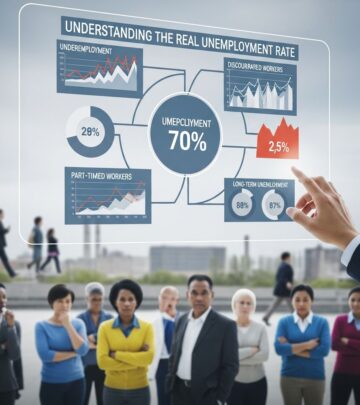
The U-6 rate, often called the “real unemployment rate,” provides a more comprehensive view of joblessness by including marginally attached workers and involuntary part-time employees. During economic downturns, the U-6 rate can be significantly higher than the official U-3 rate. For instance, in March 2020, the U-3 rate was 4.4 percent while the U-6 rate was 8.7 percent.
Data Collection and Methodology
The BLS uses two primary data sources to calculate unemployment rates: the Current Population Survey (CPS) for national and state estimates, and state Unemployment Insurance (UI) system data for substate area estimates. The CPS is a monthly survey conducted by the Census Bureau on behalf of the BLS, interviewing household members about their employment status.
For state-level estimates, the BLS employs a “signal-plus-noise” time series regression model that combines CPS data with UI claims data to produce more reliable estimates while ensuring that state figures aggregate to national totals. For counties and cities with populations exceeding 25,000, the BLS develops separate estimates using local employment data adjusted for population changes and migration patterns.
Why the Unemployment Rate Matters
The unemployment rate is far more than just a statistical abstraction. It serves as a crucial indicator of economic health and guides policy decisions affecting millions of people. A low unemployment rate generally suggests a strong economy where most workers can find jobs, while a high rate indicates economic weakness and job scarcity. Policymakers use unemployment data to make decisions about interest rates, government spending, and other economic policies.
The unemployment rate also reveals important demographic patterns. The BLS calculates unemployment rates broken down by state, industry, urban versus rural areas, gender, age, race or ethnicity, and educational attainment. These breakdowns show that unemployment is not evenly distributed across the population, with some groups consistently experiencing higher unemployment rates than others.
Limitations of the Unemployment Rate
While useful, the unemployment rate has important limitations. It excludes discouraged workers who have stopped searching for jobs, underemployed workers seeking full-time positions, and people working part-time involuntarily. The rate also cannot capture the quality of jobs created or destroyed, wage trends, or involuntary part-time employment. Additionally, the unemployment rate does not reflect the duration of unemployment or workers’ prospects for reemployment.
These limitations explain why economists and analysts often examine multiple labor market indicators alongside the official unemployment rate to develop a complete understanding of employment conditions.
Frequently Asked Questions
Q: How often is the unemployment rate calculated and released?
A: The unemployment rate is calculated monthly based on data from the Current Population Survey. The BLS releases unemployment figures on the first Friday of each month for the preceding month’s data.
Q: What is considered active job search for unemployment purposes?
A: Active job search includes submitting applications, attending interviews, contacting employers, registering with employment agencies, and responding to job advertisements. Passive activities like reading job listings do not count as active search.
Q: Why isn’t everyone without a job counted as unemployed?
A: The official definition requires active job seeking within the past four weeks. This excludes retirees, students, stay-at-home parents, discouraged workers, and others not actively seeking employment to provide a more meaningful measure of labor market slack.
Q: How does the U-6 unemployment rate differ from the official U-3 rate?
A: The U-6 rate includes marginally attached workers (those not currently seeking work but interested in employment) and involuntary part-time workers seeking full-time positions. This broader measure often reveals higher unemployment than the official U-3 rate.
Q: Can the unemployment rate be zero?
A: Practically, no. Even in the strongest economies, some unemployment exists due to frictional unemployment—the natural transition period when workers change jobs. This is why economists often refer to a “natural rate” of unemployment around 3-4 percent.
References
- Calculating the Unemployment Rate — Lumen Learning Macroeconomics. Accessed November 2025. https://courses.lumenlearning.com/wm-macroeconomics/chapter/calculating-the-unemployment-rate/
- How is the U.S. Unemployment Rate Calculated? — Britannica. Accessed November 2025. https://www.britannica.com/story/how-is-the-us-unemployment-rate-calculated
- Unemployment Rate Methodology — Ohio Labor Market Information. Accessed November 2025. https://ohiolmi.com/_docs/LAUS/UR_Methodology.pdf
- Unemployment: Its Measurement and Types — Reserve Bank of Australia Education. Accessed November 2025. https://www.rba.gov.au/education/resources/explainers/unemployment-its-measurement-and-types.html
- Understanding How the Feds Calculate the Unemployment Rate and What It Means — Conduit Street, Maryland Counties. 2023. https://conduitstreet.mdcounties.org/2023/06/07/understanding-how-the-feds-calculate-the-unemployment-rate-and-what-it-means/
- How the Government Measures Unemployment — Bureau of Labor Statistics. Accessed November 2025. https://www.bls.gov/cps/cps_htgm.htm
Similar Articles








Read full bio of medha deb