Unemployment Rate: Definition, Calculation & Impact
Understanding unemployment rate: How it's calculated, its significance, and economic implications.
What Is the Unemployment Rate?
The unemployment rate represents the percentage of the total labor force that is currently unemployed but actively seeking employment. It serves as a critical economic indicator used by policymakers, investors, and economists to gauge the health of an economy. A higher unemployment rate typically signals economic weakness, while a lower rate suggests a stronger economy with more job opportunities available.
The unemployment rate is calculated by dividing the number of unemployed individuals by the total labor force and multiplying by 100. The labor force includes all people aged 16 and older who are either employed or actively seeking work. Those not actively seeking employment, such as students, retirees, or stay-at-home parents, are not included in the labor force calculation.
Understanding the Unemployment Rate
The unemployment rate is one of the most widely followed economic statistics, released monthly by government statistical agencies. It provides insight into the labor market’s current state and helps economists predict future economic trends. When unemployment is rising, it may indicate a recession or economic downturn. Conversely, a falling unemployment rate suggests improving economic conditions and job creation.
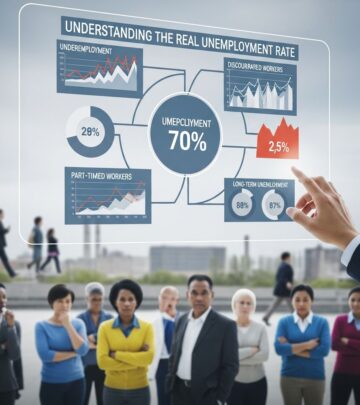
However, the unemployment rate has limitations as a comprehensive measure of economic health. It does not capture underemployment, where individuals work part-time or in positions below their skill level. Additionally, it excludes discouraged workers who have stopped searching for employment, potentially understating true joblessness in the economy.
How the Unemployment Rate Is Calculated
Government statistical agencies conduct regular surveys to collect employment data. In the United States, the Bureau of Labor Statistics (BLS) conducts the Current Population Survey (CPS) monthly, surveying approximately 60,000 households. Respondents are asked about their employment status, hours worked, and job-seeking activities.
The calculation involves the following steps:
- Identifying the total number of unemployed individuals actively seeking work
- Determining the total labor force size
- Dividing unemployed individuals by the total labor force
- Multiplying the result by 100 to express as a percentage
For example, if an economy has 160 million people in the labor force and 8 million are unemployed, the unemployment rate would be calculated as (8 million ÷ 160 million) × 100 = 5%. This means 5% of the labor force is without employment but actively searching for jobs.
Types of Unemployment
Economists recognize several distinct types of unemployment, each with different causes and implications for the economy:
Frictional Unemployment
Frictional unemployment occurs when individuals are between jobs or entering the workforce for the first time. This type of unemployment is natural and temporary, typically lasting from a few weeks to a few months. It reflects the time needed for job seekers to find suitable positions and for employers to fill vacancies. Even in a healthy economy, some frictional unemployment always exists.
Structural Unemployment
Structural unemployment results from a mismatch between available jobs and workers’ skills or geographic location. When industries decline or shift, workers may lack the necessary qualifications for new opportunities. Technological advancement can also create structural unemployment when automation replaces workers. This type of unemployment is more persistent and typically requires retraining or relocation to resolve.
Cyclical Unemployment
Cyclical unemployment is directly linked to economic cycles. During recessions, businesses reduce operations and lay off workers, increasing cyclical unemployment. As the economy recovers and expands, companies rehire workers, reducing cyclical unemployment. This type is most closely associated with overall economic health.
Seasonal Unemployment
Seasonal unemployment occurs in industries with predictable fluctuations in labor demand throughout the year. Agriculture, retail, and tourism are examples of seasonally dependent industries. Workers may experience regular periods of unemployment during off-seasons, though they typically return to employment during peak seasons.
Unemployment Rate Vs. Labor Force Participation Rate
While related, the unemployment rate and labor force participation rate measure different aspects of the labor market:
- Unemployment Rate: Percentage of the labor force that is currently unemployed and actively seeking work
- Labor Force Participation Rate: Percentage of the working-age population (aged 16 and older) that is either employed or actively seeking employment
The labor force participation rate can decline even when unemployment falls if fewer people are actively seeking work. This can occur when discouraged workers exit the labor force or when demographic shifts reduce the working-age population. Both metrics together provide a more complete picture of labor market conditions.
Components of the Official Unemployment Rate
The official unemployment rate, also known as U-3 unemployment, includes only those individuals actively searching for employment in the past four weeks. It excludes:
- Discouraged workers who have stopped looking for jobs
- Part-time workers seeking full-time positions
- Workers who are underemployed in positions below their skill level
- Those not in the labor force by choice
Due to these exclusions, the official unemployment rate may underestimate the true extent of joblessness. The U-6 unemployment rate, also called the underemployment rate, provides a broader measure by including discouraged workers and the underemployed.
Why the Unemployment Rate Matters
The unemployment rate serves multiple important functions in economic analysis:
Economic Health Indicator
A rising unemployment rate signals economic troubles, while a declining rate suggests recovery. The unemployment rate helps policymakers, business leaders, and investors make informed decisions about future economic direction.
Monetary Policy Tool
Central banks, like the Federal Reserve, monitor unemployment closely when setting interest rates and implementing monetary policy. High unemployment may prompt lower interest rates to stimulate borrowing and job creation.
Fiscal Policy Driver
Government spending decisions often hinge on unemployment levels. Rising unemployment may trigger increased government spending on social programs or tax cuts to stimulate economic activity.
Market Impact
Stock markets often react significantly to unemployment reports. Unexpected changes in the unemployment rate can influence investor sentiment and capital allocation decisions.
Limitations of the Unemployment Rate
Despite its widespread use, the unemployment rate has several important limitations:
- Excludes Discouraged Workers: People who have stopped searching for employment due to repeated rejection are not counted as unemployed
- Ignores Underemployment: Part-time workers seeking full-time work are counted as employed, potentially masking economic weakness
- Geographic Variation: National rates may not reflect regional unemployment disparities and local labor market conditions
- Demographic Differences: Unemployment rates vary significantly across age, education level, and ethnic groups
- Measurement Challenges: Survey-based calculations may contain sampling errors or reporting issues
Unemployment Rate by Demographics
Unemployment rates vary considerably across different population segments. Younger workers typically experience higher unemployment rates than older workers, as they have less experience and face more job transitions. Educational attainment significantly influences unemployment, with college-educated workers generally experiencing lower rates than those with high school diplomas or less.
Racial and ethnic minorities often face higher unemployment rates due to systemic barriers, discrimination, and unequal access to education and networking opportunities. These demographic disparities highlight that broad unemployment statistics mask important differences in labor market opportunities across different groups.
Historical Unemployment Trends
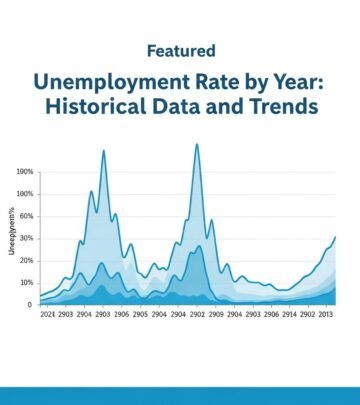
Unemployment rates fluctuate with economic cycles. During the Great Recession of 2007-2009, the U.S. unemployment rate peaked at approximately 10%. Following the COVID-19 pandemic in 2020, unemployment surged dramatically before gradually declining. Long-term trends show that developed economies typically maintain unemployment rates between 3% and 6% during normal economic conditions.
Frequently Asked Questions
Q: What is considered a good unemployment rate?
A: Most economists consider an unemployment rate between 3.5% and 5% to be healthy for a developed economy. Rates below 3.5% may indicate tight labor markets and potential inflation, while rates above 6% suggest economic weakness or recession.
Q: How often is the unemployment rate released?
A: The unemployment rate is typically released monthly by government statistical agencies, usually on the first Friday of each month in the United States. This monthly reporting allows for consistent tracking of labor market trends.
Q: Can the unemployment rate go below 0%?
A: No, the unemployment rate cannot be negative. The lowest possible rate is 0%, which would mean everyone in the labor force is employed. In practice, some frictional unemployment always exists.
Q: What factors cause the unemployment rate to rise?
A: Economic recessions, technological disruption, industry decline, policy changes, and global economic shocks can all cause unemployment to rise. When businesses reduce operations or close, workers lose jobs and unemployment increases.
Q: How does unemployment affect the economy?
A: High unemployment reduces consumer spending, lowers tax revenue, increases government spending on social programs, and can create social and health problems. It also represents lost economic productivity and potential output.
Q: Is the U-3 rate the only unemployment measure?
A: No. While U-3 is the official unemployment rate, the Bureau of Labor Statistics publishes six different unemployment measures (U-1 through U-6), each capturing different aspects of joblessness and underemployment.
References
- Labor Force Statistics from the Current Population Survey — U.S. Bureau of Labor Statistics. 2025. https://www.bls.gov/cps/
- Employment Situation News Release — U.S. Bureau of Labor Statistics. 2025. https://www.bls.gov/news.release/empsit.htm
- Concepts and Definitions for Employment Statistics — U.S. Bureau of Labor Statistics. 2024. https://www.bls.gov/bls/glossary.htm
- Understanding the Employment Cost Index — Federal Reserve Board. 2024. https://www.federalreserve.gov/
- International Labour Statistics — International Labour Organization. 2024. https://ilostat.ilo.org/
Similar Articles








Read full bio of Sneha Tete