Unearned Revenue: Definition, Examples & Accounting
Master unearned revenue accounting: Learn how to record prepaid payments and manage deferred revenue liabilities.
What Is Unearned Revenue?
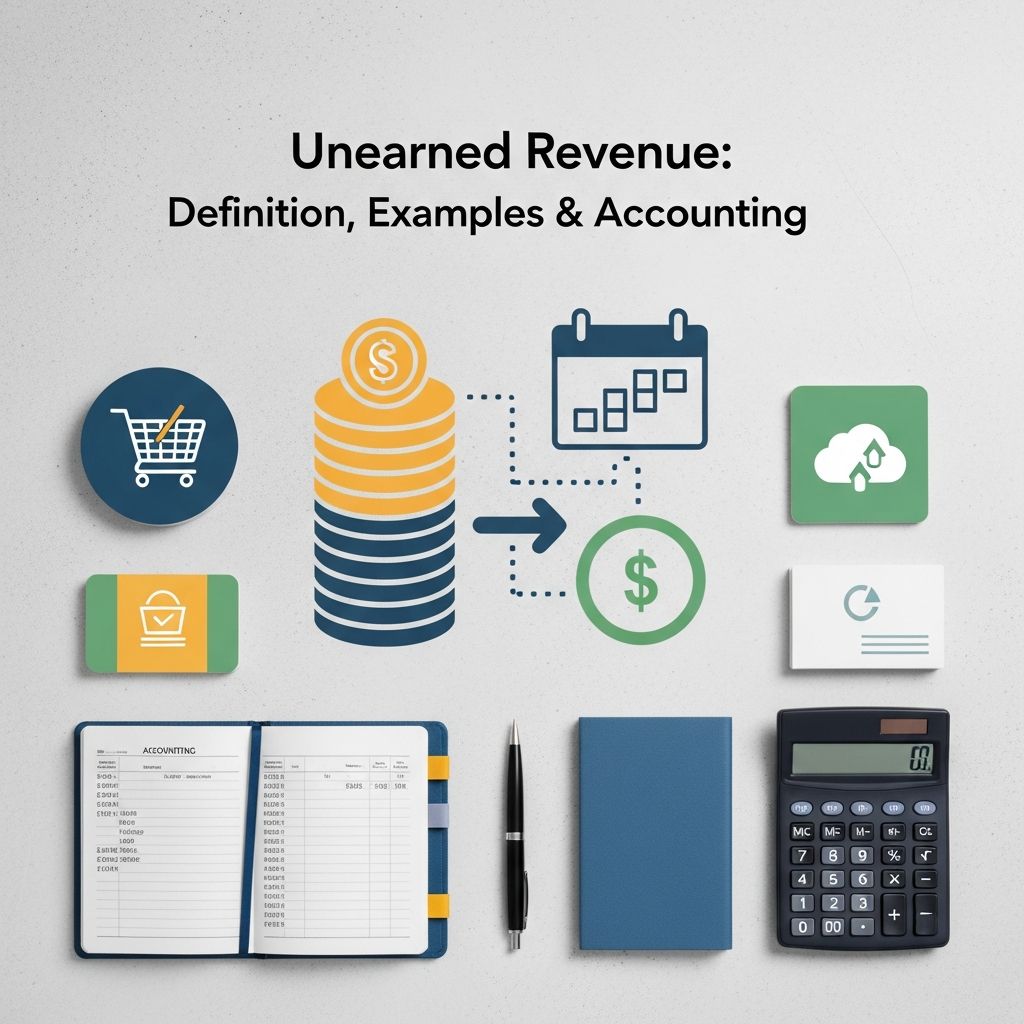
Unearned revenue, also known as deferred revenue, is payment received by a company from customers for products or services that have not yet been delivered or performed. In accounting terminology, this represents advance payments or prepaid revenue that creates a liability on the company’s balance sheet. When a customer pays upfront before receiving goods or services, the business has an obligation to fulfill that commitment, which is why unearned revenue must be classified as a liability rather than immediate income.
The concept of unearned revenue is fundamental to accrual accounting, which recognizes revenue only when it has been earned through the delivery of goods or performance of services, regardless of when payment is received. This approach ensures that financial statements accurately reflect a company’s economic performance during a specific accounting period.
Understanding Unearned Revenue as a Liability
Unearned revenue is recorded as a liability on the company’s balance sheet because the business has received cash but has not yet fulfilled its obligation to the customer. From an accounting perspective, this creates an unfulfilled duty: the seller has the customer’s money but must still provide the promised products or services.
The classification as a liability is critical for accurate financial reporting. If unearned revenue were incorrectly recorded as an asset or immediate revenue, the company’s profit would be overstated in the current accounting period. This violates the matching principle of accounting, which requires that revenue and related expenses be recorded in the same period in which they are earned and incurred.
Generally, unearned revenues are classified as current liabilities when the obligation is expected to be fulfilled within one year. However, in cases where delivery or service completion extends beyond twelve months, the unearned revenue may be recorded as a long-term liability.
Common Examples of Unearned Revenue
Unearned revenue appears in many business contexts and industries. Understanding these examples helps clarify how this accounting principle works in practice:
- Service contracts paid in advance
- Legal retainers paid upfront before work begins
- Advance rent payments collected by landlords
- Prepaid insurance premiums
- Magazine or subscription renewals paid before delivery
- Annual software licenses paid upfront
- Concert or event tickets sold in advance
- Gift cards or store credits purchased by customers
A practical example involves a freelance consultant who receives a $1,200 payment for three months of weekly consulting services. The consultant cannot immediately record this as revenue. Instead, they record a $1,200 credit to the unearned revenue liability account and a $1,200 debit to cash. As each month passes and services are delivered, the consultant moves $400 from unearned revenue to the revenue account through monthly adjusting journal entries.
How to Record Unearned Revenue
Recording unearned revenue involves specific journal entry procedures that maintain the balance sheet equation and ensure accurate financial reporting.
Initial Receipt of Payment
When a customer makes an advance payment, the business records a debit to the cash account (increasing assets) and a credit to the unearned revenue account (increasing liabilities). This journal entry reflects that the company has received money but has not yet earned it.
Recognition of Earned Revenue
As the business delivers goods or performs services, it recognizes portions of the unearned revenue as earned revenue through adjusting journal entries. The accountant debits the unearned revenue account (decreasing the liability) and credits the appropriate revenue account (increasing revenue on the income statement). This process continues until the entire obligation has been fulfilled and all revenue has been recognized.
Example Journal Entries
Consider a business that receives $1,200 for a three-month service contract:
- Initial Receipt: Debit Cash $1,200, Credit Unearned Revenue $1,200
- Month 1: Debit Unearned Revenue $400, Credit Service Revenue $400
- Month 2: Debit Unearned Revenue $400, Credit Service Revenue $400
- Month 3: Debit Unearned Revenue $400, Credit Service Revenue $400
By the end of three months, the unearned revenue account has been completely eliminated, and the full $1,200 has been recognized as earned revenue.
Unearned Revenue on the Balance Sheet
Unearned revenue appears as a line item in the liabilities section of the balance sheet, specifically under current liabilities when the obligation will be fulfilled within twelve months. On a typical balance sheet, it is listed separately and included in the calculation of total current liabilities and total liabilities.
The fundamental accounting equation states that assets must equal liabilities plus equity. When unearned revenue is recorded, this equation remains balanced because the increase in the cash asset (debit) is offset by the increase in the liability (credit). As revenue is earned and recognized, the liability decreases while revenue (part of equity through net income) increases, maintaining the balance.
The placement of unearned revenue on the balance sheet serves an important function: it clearly communicates to investors, creditors, and other stakeholders that the company has outstanding obligations to customers and has not yet fulfilled its promises to deliver goods or services.
Impact on Financial Statements
Unearned revenue significantly affects how financial statements present a company’s financial condition and performance.
Balance Sheet Impact
On the balance sheet, unearned revenue reduces the apparent profitability of the current period by appearing as a liability. This prevents companies from overstating their assets or equity. The presence of unearned revenue on the balance sheet indicates that while cash has been collected, the company still owes performance or delivery obligations.
Income Statement Impact
Unearned revenue does not appear on the income statement at the time of payment. Instead, it only appears on the income statement as revenue when the company has actually delivered the goods or performed the services. This timing ensures that revenue recognition matches the accounting period in which the economic benefit is delivered to the customer, adhering to the matching principle.
Cash Flow Statement Impact
From a cash flow perspective, unearned revenue increases operating cash flow in the period when the payment is received (classified as cash from operations), even though revenue is not recognized on the income statement until later periods. This creates a timing difference that sophisticated analysts understand when evaluating cash position versus reported earnings.
Unearned Revenue vs. Deferred Revenue
While unearned revenue and deferred revenue are often used interchangeably, there are subtle distinctions in their application:
| Aspect | Unearned Revenue | Deferred Revenue |
|---|---|---|
| Classification | Typically short-term (current liability, less than 1 year) | Can be short-term or long-term depending on fulfillment timeline |
| Usage | More specific to advance payments expected to be earned within 12 months | More general term for any advance payment or deferred recognition |
| Balance Sheet Location | Listed under current liabilities | May appear under current or long-term liabilities |
| Industry Examples | Subscriptions, memberships, short-term service contracts | Maintenance contracts, extended warranties, multi-year agreements |
In practice, many accountants use these terms synonymously, but understanding the distinction helps in more precisely categorizing obligations based on expected fulfillment timelines.
Revenue Recognition Under ASC 606
Modern accounting standards, specifically ASC 606 (Revenue from Contracts with Customers), have established a comprehensive framework for recognizing unearned revenue. This five-step process ensures consistency and accuracy across industries and companies:
- Identify the contract with the customer
- Identify the performance obligations in the contract
- Determine the transaction price
- Allocate the transaction price to performance obligations
- Recognize revenue when performance obligations are satisfied
Under ASC 606, companies must evaluate whether they have control of goods or services before recognizing revenue. Unearned revenue remains on the balance sheet until the company has satisfied its performance obligation by transferring promised goods or services to the customer.
Unearned Revenue vs. Unrecorded Revenue
It is important to distinguish unearned revenue from unrecorded revenue, as these represent different accounting situations:
Unearned Revenue: Payment received in advance for future goods or services; recorded as a liability on the balance sheet.
Unrecorded Revenue: Revenue that has been earned but not yet entered into the company’s accounting records; may result from errors, timing delays, or contractual agreements specifying that payment will not be due until job completion.
While unearned revenue appears on the balance sheet as an obligation, unrecorded revenue is simply delayed in the recording process. Both require adjusting entries to ensure accurate financial reporting, but they represent fundamentally different situations in the accounting cycle.
Why Unearned Revenue Matters for Business
Understanding and properly accounting for unearned revenue is essential for several reasons:
- Ensures compliance with GAAP and accounting standards
- Provides accurate representation of financial position and performance
- Prevents overstating profits in the current period
- Helps creditors and investors assess true financial health
- Supports internal decision-making and business planning
- Demonstrates company’s actual cash collection efficiency
For subscription-based businesses, SaaS companies, and service providers, managing unearned revenue is particularly important because these business models inherently generate advance payments for future services.
Frequently Asked Questions
Q: Is unearned revenue considered a current liability or long-term liability?
A: Unearned revenue is typically classified as a current liability when the obligation is expected to be fulfilled within one year. If the company will not deliver the goods or services for more than twelve months, it may be classified as a long-term liability.
Q: How does unearned revenue affect a company’s profitability?
A: Unearned revenue does not directly affect reported profitability when received; it only affects profitability as revenue is earned through delivery of goods or services. Proper accounting prevents the overstatement of profits in the current period.
Q: Can unearned revenue ever become a long-term liability?
A: Yes, in cases where a company receives advance payment for services or products to be delivered more than twelve months in the future, the unearned revenue is classified as a long-term liability on the balance sheet.
Q: What happens if a customer cancels an order after paying in advance?
A: If a customer cancels and the company must return the payment, the company would debit the unearned revenue account and credit cash, reversing the initial entry. The unearned revenue liability is eliminated when the company returns the money.
Q: How does unearned revenue relate to the matching principle?
A: The matching principle requires that revenue and expenses be recorded in the same period. Unearned revenue supports this principle by ensuring that revenue is not recognized until the accounting period in which the service is actually delivered or goods are provided.
References
- What Is Unearned Revenue? A Definition and Examples for Small Business — FreshBooks. 2025. https://www.freshbooks.com/hub/accounting/unearned-revenue
- Unearned Revenue – Definition, How To Record, Example — Corporate Finance Institute. 2025. https://corporatefinanceinstitute.com/resources/accounting/unearned-revenue/
- Unearned Revenue | Formula + Calculation Example — Wall Street Prep. 2025. https://www.wallstreetprep.com/knowledge/unearned-revenue/
- What Is Unearned Revenue and How to Account for It — Baremetrics. 2025. https://baremetrics.com/blog/what-is-unearned-revenue-and-how-to-account-for-it
- What is unearned revenue? How it can impact your business finances — Stripe. 2025. https://stripe.com/resources/more/what-is-unearned-revenue-how-it-can-impact-your-business-finances
- What Is Unearned Revenue? — QuickBooks Global. 2025. https://quickbooks.intuit.com/global/resources/accounting/what-is-unearned-revenue/
- Q&A: What Is Unearned Revenue? (With Examples) — Indeed. 2025. https://www.indeed.com/career-advice/career-development/unearned-revenue
Similar Articles








Read full bio of medha deb