Understanding the Real Unemployment Rate
Discover why the official unemployment rate differs from the true rate of unemployment.
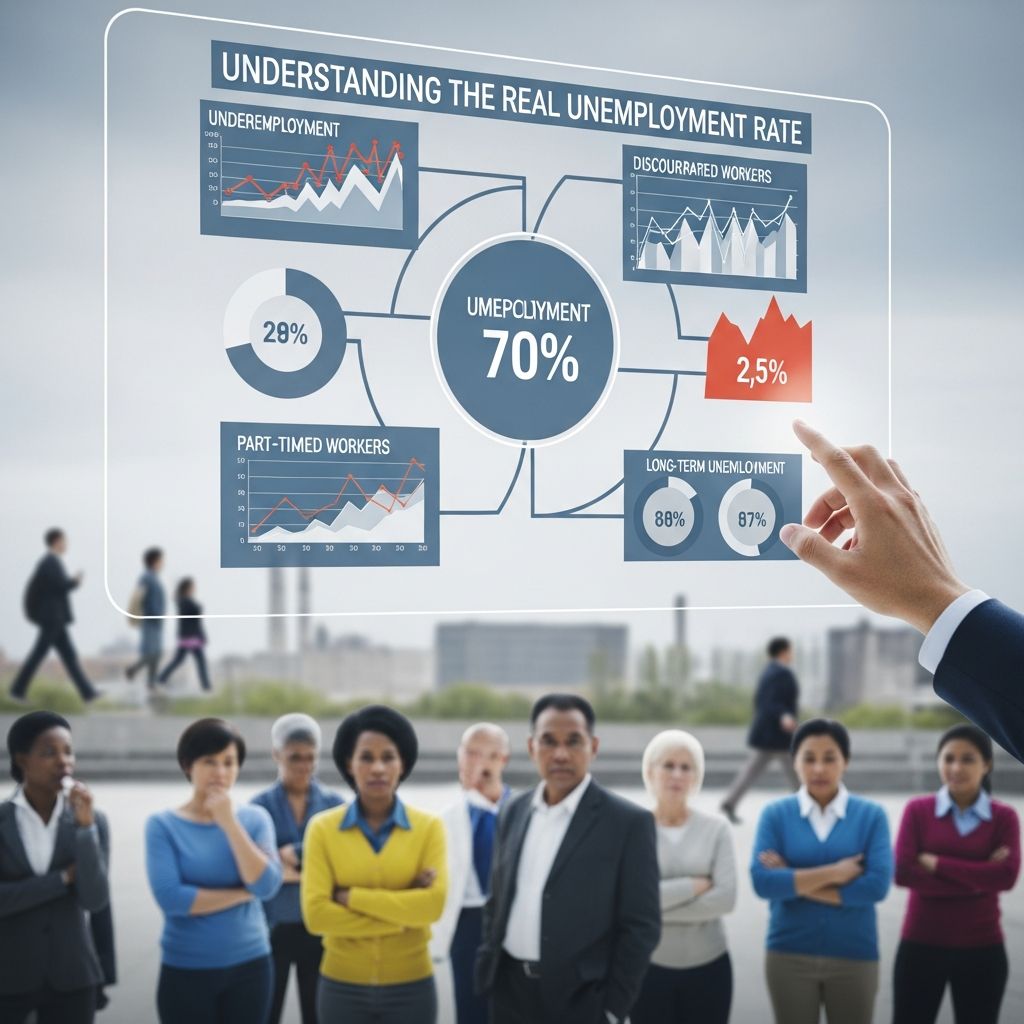
When the government releases monthly employment data, headlines often focus on a single number: the official unemployment rate. In recent years, this figure has hovered around 3 to 4 percent, suggesting a healthy job market. However, this straightforward statistic tells only part of the story. Behind the official numbers lies a more complex reality that economists, policymakers, and workers themselves increasingly recognize. The real unemployment rate—a broader measure that captures the true state of labor market conditions—often reveals significant challenges that the headline figure obscures.
Understanding the difference between the official unemployment rate and the real unemployment rate is crucial for anyone seeking to comprehend the actual health of the job market. The official rate, also known as the U-3 rate, counts only those individuals who are actively seeking employment and have not worked in the past four weeks. This narrow definition excludes millions of Americans who face employment challenges but don’t fit this specific criteria. Workers who have given up searching for jobs, those working part-time when they want full-time employment, and individuals earning below subsistence wages remain invisible in the official statistics, yet their struggles are very real.
What Is the Official Unemployment Rate?
The official unemployment rate, technically known as the U-3 unemployment rate, is the most commonly cited labor market statistic. The U.S. Bureau of Labor Statistics calculates this figure by dividing the number of unemployed persons by the total labor force, then multiplying by 100 to express it as a percentage. An unemployed person, according to official definitions, is someone who is not currently employed, has actively looked for work within the past four weeks, and is currently available for employment.
This definition creates significant limitations. The official unemployment rate only counts people in the labor force—those actively seeking work or currently employed. It excludes discouraged workers who have stopped looking for employment, full-time students not seeking employment, and stay-at-home parents. Additionally, someone working just one hour per week is technically classified as employed, even if they desperately need more work to support themselves.
The True Rate of Unemployment Explained
The True Rate of Unemployment (TRU) represents a more comprehensive measure of joblessness that captures a broader spectrum of labor market challenges. Developed by researchers at institutions like the Ludwig Institute for Shared Economic Prosperity, the TRU includes individuals who are “functionally unemployed.” This encompasses workers actively looking for employment but unable to secure full-time positions, individuals currently employed part-time who desire full-time work, and workers earning wages below the poverty line despite being technically employed.
According to recent data, the TRU paints a dramatically different picture than headline unemployment figures. Where official unemployment stood at 4.2 percent, the real unemployment rate was measured at approximately 24.3 percent of the labor force. This substantial gap reveals the extent to which traditional unemployment statistics underestimate labor market distress. The TRU provides a more honest assessment of how many Americans either lack work or cannot secure employment that meets basic living standards.
Types of Unemployment Not Captured by Official Statistics
Several categories of unemployment and underemployment fall outside official labor statistics but significantly impact workers’ wellbeing and economic security:
Underemployment
Underemployment occurs when someone works part-time but desires full-time employment, or holds a job requiring fewer skills than their education or experience. A software engineer driving for a rideshare company or a college graduate working retail hours represent classic examples. These workers have jobs but lack sufficient hours, income, or opportunity for career development. Underemployment contributes substantially to the discrepancy between official and real unemployment rates.
Discouraged Workers
Discouraged workers have stopped actively searching for employment because they believe no suitable jobs exist. They may have faced repeated rejection, lack necessary skills for available positions, or encountered age or other discrimination. Once someone stops actively seeking work, they disappear from official unemployment statistics entirely, yet their labor market exclusion reflects genuine economic hardship.
Low-Wage Workers Below Poverty Level
The real unemployment rate includes individuals working full-time but earning wages below the poverty line. These workers, despite being employed, cannot meet basic living expenses through their employment income. The federal poverty line for 2024 stands at approximately $20,000 annually for a single adult, yet millions of full-time workers fall below this threshold.
Marginally Attached Workers
Marginally attached workers want employment and have looked for work recently but are not currently looking for various reasons. They represent a reservoir of potential labor force participants who would return to active job seeking under more favorable conditions.
Geographic Variations in Real Unemployment
Real unemployment rates vary dramatically across the country. Research shows that some metropolitan areas experience true unemployment rates exceeding 50 percent of the adult population. Metropolitan areas including Cape Coral, Florida; New York-New Jersey-Connecticut; and Chicago-Illinois face particularly severe challenges. In contrast, other regions with stronger economic foundations report lower real unemployment rates, reflecting the uneven distribution of economic opportunity across the nation.
Cities like El Paso, Texas; Augusta, Georgia; and Las Vegas experienced true unemployment rates above 30 percent in 2021, according to Ludwig Institute data. The Greensboro-High Point area of North Carolina saw its true unemployment rate reach 60 percent of the adult population, representing the most significant deterioration among major metropolitan areas. These regional disparities suggest that national statistics mask considerable localized economic distress.
Why the Official Rate Understates Unemployment
Several factors explain why the official unemployment rate provides an incomplete picture of labor market health:
Labor Force Participation Exclusions
The official rate only includes those in the labor force. When people stop searching for work, they exit the official labor force entirely, and their unemployment effectively becomes invisible. Since the Great Recession, labor force participation has declined substantially, meaning millions of potential workers are not counted in unemployment statistics.
Part-Time Work Classified as Employment
Anyone employed even one hour weekly counts as employed in official statistics. This classification inflates the employment count without reflecting the reality that many part-time workers desperately seek full-time employment. The government does track “underemployment,” but this receives far less media attention than the headline unemployment figure.
Wage Inadequacy Not Considered
Official unemployment ignores whether employed individuals earn living wages. Someone working full-time at minimum wage, unable to afford housing or meet basic needs, appears as successfully employed in government statistics. The real unemployment rate corrects this by including workers whose wages fall below poverty thresholds.
The Problem of Recency Bias
The official definition requires that unemployed individuals have actively sought work within the past four weeks. Someone searching intensively for three weeks, then suffering a week of discouragement, would not be counted. This narrow timeframe misses the reality of sporadic job searching.
Impact on Income and Living Standards
The gap between official and real unemployment rates has profound implications for American living standards. Real weekly earnings for median American workers have declined significantly when adjusted for inflation. Despite headline wage growth figures, workers’ actual purchasing power has contracted as inflation outpaced nominal wage increases. Additionally, workers’ share of national economic output remains roughly equal to pre-pandemic levels, meaning labor has not benefited proportionally from overall economic growth.
These income challenges occur simultaneously with rising underemployment and wage stagnation, creating a squeeze on household finances. Many American households maintain stable finances only through accumulating debt, depleting savings, or relying on multiple household earners. The real unemployment rate more accurately captures this underlying economic fragility than official statistics.
Government Unemployment Statistics: U-3 Through U-6
The Bureau of Labor Statistics actually calculates six different unemployment measures, each providing different perspectives on labor market conditions:
| Measure | Definition | Current Scope |
|---|---|---|
| U-1 | Unemployed 15+ weeks | Long-term joblessness |
| U-2 | Job losers and persons who completed temporary jobs | Recent job separations |
| U-3 | Official unemployment rate | Actively seeking work |
| U-4 | Unemployed plus discouraged workers | Includes discouraged job seekers |
| U-5 | Unemployed plus marginally attached workers | Includes those weakly attached to labor force |
| U-6 | Total unemployed, part-time for economic reasons, marginally attached | Broadest measure including underemployment |
The U-6 measure, often called the “broadest” unemployment rate, typically runs 2-3 percentage points higher than the official U-3 rate. However, even the U-6 measure stops short of the comprehensive approach used by real unemployment calculations, which additionally account for full-time workers earning inadequate wages.
Factors Contributing to Hidden Unemployment
Technological Disruption
Automation and artificial intelligence continue displacing workers across sectors. While some displaced workers find new employment, many transition to lower-wage work or leave the labor force entirely. Technological change accelerates without corresponding retraining or wage support mechanisms, contributing to hidden unemployment.
Skill Mismatches
Geographic and skill mismatches between available jobs and worker qualifications create persistent unemployment in some regions while labor shortages exist elsewhere. Workers cannot simply relocate to opportunity-rich areas due to housing costs, family responsibilities, and other constraints.
Wage Suppression
Despite tight labor markets and rising nominal wages, real wage growth—wages adjusted for inflation—remains weak. Workers accepting part-time work or positions below their qualifications represent a form of hidden unemployment or underemployment reflecting inadequate job quality and compensation.
Demographic Shifts
Aging populations and changing labor force participation rates, particularly among prime-age workers and young adults, affect overall employment levels. These demographic trends contribute to labor force changes that official statistics may not fully capture.
How to Interpret Unemployment Data Critically
When reviewing labor market statistics, maintain healthy skepticism toward single-number headlines. Always examine the broader context: labor force participation rates, underemployment levels, wage growth adjusted for inflation, and regional variations. The U-6 unemployment rate provides a more comprehensive picture than U-3, though both fall short of capturing functional unemployment fully. Consider whether unemployment measures align with your personal economic observations and experiences within your community.
Frequently Asked Questions
What is the difference between unemployment and underemployment?
Unemployment technically means having no job while actively seeking work. Underemployment refers to working part-time when full-time work is desired, or working in a position below one’s skill level or earning inadequate wages. Many underemployed workers do not appear in official unemployment statistics despite facing significant economic challenges.
Why does the real unemployment rate differ so significantly from the official rate?
The official unemployment rate excludes discouraged workers, part-time employees seeking full-time work, and low-wage workers. The real unemployment rate includes these populations, providing a more comprehensive picture of labor market distress and functional unemployment.
Which unemployment measure should I use to understand labor market health?
Consider using the U-6 measure as a more complete alternative to U-3, though the real unemployment rate developed by the Ludwig Institute offers an even broader perspective by including full-time workers earning below-poverty wages. Different measures serve different analytical purposes.
How does real wage decline affect real unemployment figures?
Real wage decline—wages increasing slower than inflation—means workers need more income to maintain living standards. Full-time workers whose inflation-adjusted wages decline effectively experience a form of hidden unemployment or underemployment, as their work no longer provides adequate subsistence.
Are regional unemployment differences significant?
Yes, substantial regional variations exist. Some metropolitan areas experience real unemployment rates exceeding 50 percent while others remain below 25 percent. These differences reflect unequal economic conditions, industrial composition, and opportunity distribution across the country.
References
- True unemployment is a lot higher than you think — Politico. 2022-05-31. https://www.politico.com/newsletters/morning-money/2022/05/31/true-unemployment-is-a-lot-higher-than-you-think-00035922
- Real Unemployment is 24% — YouTube. 2025. https://www.youtube.com/watch?v=H8pXFKdTQKY
- Real income sustains weak trend, while cash balances remain stable — JPMorgan Chase Institute. 2025. https://www.jpmorganchase.com/institute/all-topics/financial-health-wealth-creation/real-income-sustains-weak-trend-cash-liquidity-remains-stable
- The Employment Situation — U.S. Bureau of Labor Statistics. 2025. https://www.bls.gov/news.release/empsit.nr0.htm
Similar Articles








Read full bio of medha deb