Understanding Private Mortgage Insurance
Unlock homeownership sooner with PMI: Learn its mechanics, costs, benefits, and strategies to eliminate it efficiently.

Private Mortgage Insurance, commonly known as PMI, is a policy that lenders require for conventional mortgages when buyers put down less than 20% of the home’s purchase price. This insurance protects the lender against potential losses if the borrower defaults, allowing more people to enter homeownership without needing a large upfront payment.
Why Lenders Require PMI on Low Down Payments
Lenders assess risk using the loan-to-value (LTV) ratio, which compares the loan amount to the property’s appraised value. A down payment under 20% results in an LTV above 80%, increasing the lender’s exposure since there’s less borrower equity to cover losses in foreclosure.
PMI acts as the first line of defense, reimbursing lenders for shortfalls after selling the foreclosed property. It enables lenders to offer loans to a broader range of buyers, including first-time homeowners and those with moderate incomes.
- High LTV loans carry greater default risk due to limited equity.
- PMI covers losses up to a set amount, stabilizing lending practices.
- In 2023, over 800,000 homeowners used MI-covered loans, with 65% being first-time buyers.
Financial Cost of PMI to Borrowers
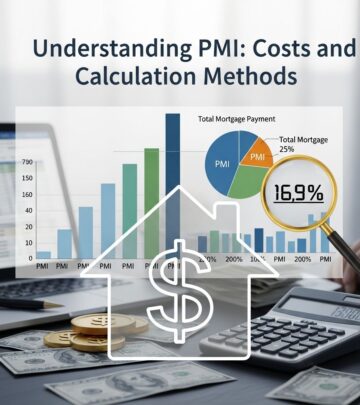
Borrowers pay PMI premiums, typically 0.5% to 1.5% of the original loan amount annually, added to monthly mortgage payments. For a $300,000 home with 10% down ($30,000), the loan is $270,000, leading to PMI costs of about $90 to $337 monthly.
| Loan Amount | Down Payment % | LTV Ratio | Est. Annual PMI Rate | Monthly PMI Cost |
|---|---|---|---|---|
| $270,000 | 10% | 90% | 0.5%-1% | $112-$225 |
| $240,000 | 20% | 80% | None | $0 |
| $285,000 | 5% | 95% | 1%-1.5% | $237-$356 |
Rates vary based on credit score, debt-to-income ratio, and property type. Higher credit scores (above 760) often secure lower premiums.
Key Benefits for Homebuyers and the Housing Market
While PMI benefits lenders directly, it indirectly helps buyers by removing the 20% down payment barrier. Saving for 20% could take middle-class workers 27 years; PMI allows entry with as little as 3% down.
- Accelerates homeownership, enabling equity building and appreciation gains.
- 65% of MI-purchased homes in 2023 went to first-time buyers; 35% to households under $75,000 income.
- Provides stability during hardships via loss mitigation options like loan modifications.
PMI also bolsters the housing finance system by de-risking government-sponsored enterprises (GSEs) like Fannie Mae and Freddie Mac, reducing taxpayer exposure. Since 2008, private MI has covered nearly $60 billion in claims.
Different Types of Private Mortgage Insurance
PMI comes in several formats to suit borrower preferences and lender requirements.
- Borrower-Paid PMI: Monthly premiums paid by the borrower directly to the insurer.
- Single-Premium PMI: One-time lump sum at closing, often financed into the loan.
- Lender-Paid PMI (LPMI): Lender covers premiums in exchange for a slightly higher interest rate.
- Split-Premium PMI: Part paid upfront, part monthly.
Note: FHA loans use Mortgage Insurance Premium (MIP), not PMI, which is mandatory for most FHA mortgages and harder to remove.
PMI vs. Other Insurance: Homeowners and MIP
PMI differs sharply from homeowners insurance, which protects the property and belongings from hazards like fire or theft. PMI only covers lender losses from default and does not prevent foreclosure or aid borrowers in distress.
| Feature | PMI | Homeowners Insurance | FHA MIP |
|---|---|---|---|
| Purpose | Protects lender from default | Protects home/contents | Required for FHA loans |
| Down Payment Trigger | <20% conventional | Always required | All FHA loans (esp. <10% down) |
| Removal | At 20-22% equity | N/A | Refinance needed |
| Beneficiary | Lender | Borrower | Lender/Gov’t |
Strategies to Eliminate PMI Payments
Federal law (Homeowners Protection Act) mandates automatic PMI cancellation at 78% LTV based on original amortization, or borrower-requested termination at 80% LTV with current appraisal.
- Reach 20% Equity: Pay down principal or benefit from appreciation; get a new appraisal.
- Refinance: Into a loan with 20%+ equity or no-PMI product like VA/USDA.
- Extra Payments: Target principal to accelerate equity buildup.
Track equity via annual statements from servicers. For example, on a $300,000 home, 20% equity is $60,000 ($30,000 down + $30,000 paid down/appreciation).
Is PMI Worth the Cost? Weighing Pros and Cons
PMI’s value shines for those unable to save 20% quickly. If home values rise faster than PMI costs (e.g., 5% annual appreciation vs. 1% PMI), net wealth grows.
- Pros: Earlier ownership, equity growth, market access for low/moderate-income buyers.
- Cons: Ongoing expense (potentially $30,000+ over years), no borrower protection.
Shop lenders for best PMI rates; consider LPMI if rates are favorable long-term.
Frequently Asked Questions (FAQs)
What triggers PMI requirement?
PMI is required on conventional loans with less than 20% down payment, corresponding to LTV over 80%.
How much does PMI cost monthly?
Typically 0.5%-1.5% of loan amount yearly, or $90-$210/month on a $300,000 loan.
Can I cancel PMI early?
Yes, request at 80% LTV with appraisal; automatic at 78% LTV.
Does PMI protect me as the borrower?
No, it only protects the lender from default losses.
What’s the difference between PMI and FHA MIP?
PMI applies to conventional loans and is removable; MIP is for FHA and often lifelong unless refinanced.
Practical Tips for Managing PMI in Your Mortgage Plan
Incorporate PMI into budgeting from day one. Use online calculators to project removal timelines. Prioritize high-interest debt payoff alongside extra principal payments to hit 20% equity faster. For repeat buyers, explore no-PMI options like VA loans if eligible.
Consult a loan officer early to compare PMI-inclusive quotes versus delaying purchase for larger down payment. In rising markets, PMI’s upfront cost often yields long-term gains through ownership tenure.
References
- Private Mortgage Insurance Benefits — USMI. 2023. https://www.usmi.org/private-mi/benefits/
- Intro to Private Mortgage Insurance (PMI) — Fifth Third Bank. Accessed 2026. https://www.53.com/content/fifth-third/en/financial-insights/personal/home-ownership/intro-to-private-mortgage-insurance.html
- What Is PMI? (Private Mortgage Insurance) — Equifax. Accessed 2026. https://www.equifax.com/personal/education/loans/articles/-/learn/what-is-private-mortgage-insurance/
- What You Need to Know About Private Mortgage Insurance (PMI) — Academy Bank. Accessed 2026. https://www.academybank.com/article/what-you-need-to-know-about-private-mortgage-insurance-pmi
- What Is PMI? How Private Mortgage Insurance Works — NerdWallet. Accessed 2026. https://www.nerdwallet.com/mortgages/learn/pmi-private-mortgage-insurance
- What is Private Mortgage Insurance (PMI)? — Allstate. 2025-12. https://www.allstate.com/resources/home-insurance/what-is-pmi
Similar Articles








Read full bio of Sneha Tete