No-Fault Insurance: 12 States Plus Puerto Rico Guide
Explore how no-fault insurance simplifies claims, covers injuries without blame, and varies by state for faster recovery.

No-fault insurance, often called personal injury protection (PIP), allows drivers to claim medical expenses and lost income from their own policy after a car accident, irrespective of who caused it. This system prioritizes quick compensation over determining blame, operating in specific U.S. states to reduce court battles and expedite aid.
The Fundamentals of No-Fault Coverage
At its core, no-fault insurance shifts the initial responsibility for injury claims to the injured party’s insurer. Policyholders receive reimbursement for healthcare costs, wage losses, and sometimes essential services like childcare during recovery. Unlike traditional setups where the at-fault driver’s liability coverage pays, here your own PIP handles immediate needs.
This approach emerged to tackle rising litigation costs from auto crashes. By mandating first-party coverage, it ensures victims get support promptly without awaiting fault investigations, which can drag on for months. Coverage typically caps at policy limits, ranging from $10,000 to unlimited in some areas, with deductibles applying in select cases.
How No-Fault Insurance Operates in Practice
When an accident occurs, all involved parties report to their respective insurers for bodily injuries. Your PIP pays for hospital visits, surgeries, therapy, and partial income replacement—often up to 85% of lost earnings. Passengers and certain family members may qualify too, broadening protection.
Property damage follows standard rules: collision coverage for your vehicle if at fault, or the other driver’s liability if they are. No-fault strictly applies to personal injuries, leaving vehicle repairs under separate handling. Claims must usually file within 30 days, streamlining administration.
- Medical bills: Doctor fees, ambulance rides, prescriptions.
- Lost wages: Compensation for work missed due to injury.
- Other expenses: Funeral costs, household help if disabled.
States Requiring No-Fault Insurance
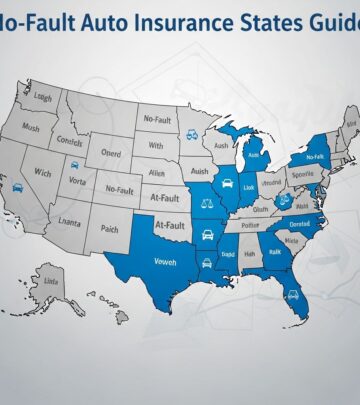
Twelve states plus Puerto Rico enforce no-fault laws as of 2026: Delaware, Hawaii, Kansas, Kentucky, Maryland, Massachusetts, Michigan, Minnesota, New Jersey, New York, North Dakota, Pennsylvania, and Utah. These mandate minimum PIP amounts, varying by jurisdiction—for instance, Michigan offers unlimited options post-reforms.
Other states like California and Texas provide PIP optionally. In tort states (most of the U.S.), traditional at-fault rules prevail, where lawsuits determine payouts. No-fault hybrids exist, allowing suits only for severe cases.
| State | PIP Minimum | Threshold Type |
|---|---|---|
| Michigan | Unlimited option | Verbal (serious injury) |
| New York | $50,000 | Monetary ($50K) |
| Florida | $10,000 | Verbal |
| Pennsylvania | $5,000 | Choice (no-fault or tort) |
Note: Florida shifted toward tort in recent reforms, but retains no-fault elements.
No-Fault vs. At-Fault: A Side-by-Side Comparison
No-fault contrasts sharply with tort systems. In at-fault (tort) setups, the responsible driver’s bodily injury liability covers victims’ claims, potentially leading to lawsuits for pain, suffering, and full damages. No-fault limits such actions unless thresholds met—either monetary (e.g., $10,000+ bills) or verbal (e.g., permanent loss).
| Aspect | No-Fault | At-Fault (Tort) |
|---|---|---|
| Claims Filing | Own insurer | At-fault insurer |
| Speed | Faster (no fault probe) | Slower (investigation needed) |
| Lawsuits | Restricted | Common for injuries |
| Premiums | Higher PIP costs | Variable by risk |
| Coverage Scope | Basic economic losses | Full damages possible |
No-fault curbs frivolous suits but may undercompensate severe victims; tort offers fuller recovery at litigation’s expense.
Advantages of Adopting No-Fault Insurance
Proponents highlight efficiency: quicker payouts mean less financial stress post-crash. Studies show reduced court overload and stable premiums in mature systems. Victims avoid adversarial battles, securing funds for recovery sooner. In pedestrian or multi-vehicle scenarios, coverage clarity simplifies aid.
Additionally, it protects against underinsured drivers—your PIP activates regardless. Families benefit from dependent care provisions, and overall societal costs drop via fewer trials.
Drawbacks and Criticisms of No-Fault Systems
Critics argue it shields negligent drivers from accountability, inflating premiums universally. Serious injury victims might recover less, capped at PIP limits without pain/suffering awards unless suing. Fraud risks rise with easy claims, prompting deductibles in reforms.
Some states saw rate hikes; Michigan’s unlimited mandates drew scrutiny before 2019 tweaks. Transitioning states face pushback over choice erosion.
Choosing PIP Limits and Costs
PIP premiums depend on limits, deductibles, and location—higher in no-fault mandates. A $50,000 limit might add $100-300 yearly; unlimited in Michigan costs more but ensures comprehensive care. Shop quotes, weigh health needs against budgets.
Deductibles ($250-$2,000) lower rates but increase out-of-pocket at claims. Med pay (optional elsewhere) overlaps minimally, covering deductibles sometimes.
Special Scenarios in No-Fault Environments
Exceeding limits: Tap at-fault driver’s liability post-threshold.
Out-of-state accidents: Your policy’s rules often govern.
Rideshare/pedestrians: Host or nearby vehicle PIP may apply.
Hit-and-runs or uninsured? Uninsured motorist coverage supplements if elected.
Frequently Asked Questions
Is no-fault insurance the same as PIP?
Yes, synonymous—PIP denotes the no-fault component covering injuries.
Does no-fault cover car repairs?
No, only injuries; use collision/property damage for vehicles.
Can I sue in a no-fault state?
Yes, for serious injuries surpassing verbal/monetary thresholds.
Are premiums higher in no-fault states?
Often, due to mandatory broader coverage, but litigation savings balance.
What if I’m hit by an uninsured driver?
PIP pays first; uninsured coverage handles excess.
Recent Developments and Future Outlook
States like Florida and Michigan reformed no-fault amid cost concerns—Florida added lawsuits for major injuries, Michigan capped care fees. Debates continue on hybrids balancing speed and justice. Drivers should verify state rules annually, as laws evolve.
With rising medical costs, unlimited PIP appeals despite premiums, especially for families or high-risk areas.
References
- No-fault insurance – Wikipedia — Wikipedia. 2026-02-01. https://en.wikipedia.org/wiki/No-fault_insurance
- What Does No-Fault State Mean? | Progressive — Progressive. 2025-10-15. https://www.progressive.com/answers/no-fault-state-meaning/
- Comparing No-Fault and At-Fault Insurance Systems — Georgia Trial Firm. 2024-11-20. https://georgiatrialfirm.com/blog/comparing-no-fault-and-at-fault-insurance-systems/
- What is No-fault Insurance? – Nationwide — Nationwide. 2025-09-10. https://www.nationwide.com/lc/resources/auto-insurance/articles/what-is-no-fault-insurance
- What Is No-Fault Insurance? – Experian — Experian. 2025-08-05. https://www.experian.com/blogs/ask-experian/what-is-no-fault-insurance/
- No-fault insurance states – What are they? – Liberty Mutual — Liberty Mutual. 2025-12-12. https://www.libertymutual.com/insurance-resources/auto/what-are-no-fault-insurance-states
- Brief Explanation of Michigan No-Fault Insurance — Michigan.gov. 2023-02-01. https://www.michigan.gov/-/media/Project/Websites/autoinsurance/PDFs/FIS-PUB_0202a.pdf
Similar Articles








Read full bio of medha deb