Lease Money Factor: Expert Guide To Lower Payments 2025
Master the lease money factor to slash costs and secure smarter car lease deals with expert insights on calculations and strategies.

The lease money factor represents the interest component in vehicle leasing agreements, directly impacting monthly payments by determining financing costs over the lease term. Often presented as a small decimal like 0.00125, it functions similarly to an interest rate but uses a unique quoting method tailored to leasing structures.
Core Role in Vehicle Leasing
In auto leases, payments cover three main elements: vehicle depreciation, applicable taxes, and financing charges. The money factor specifically governs the financing portion, applied to the average of the vehicle’s starting and ending values during the lease period. Unlike purchase loans where interest accrues on the full principal, leasing interest is calculated on the depreciating asset’s interim value, making the money factor a critical yet sometimes opaque figure.
Lessees pay only for the portion of the vehicle’s value used, typically 40-60% over 24-48 months. High residual values—projected end-of-lease worth—reduce depreciation costs, indirectly benefiting from a favorable money factor by lowering the base for interest computation.
Converting Money Factor to APR
Dealers quote money factors in a scaled format for simplicity, but converting to Annual Percentage Rate (APR) reveals true costs. Multiply the money factor by 2400 to obtain the equivalent APR: for instance, 0.0025 yields 6% APR (0.0025 × 2400 = 6).
This convention stems from leasing math, where interest applies monthly to the sum of capitalized cost and residual value. A factor of 0.0025 or below signals competitive terms, akin to 6% APR, while rates above 0.0035 (8.4% APR) indicate higher costs, often tied to credit profiles or market conditions.
| Money Factor | Equivalent APR | Rating |
|---|---|---|
| 0.0010 | 2.4% | Excellent |
| 0.0025 | 6.0% | Good |
| 0.0035 | 8.4% | Average |
| 0.0050 | 12.0% | Poor |
This table illustrates benchmarks; actual rates vary by credit score, vehicle, and lender.
Breaking Down the Calculation Formula
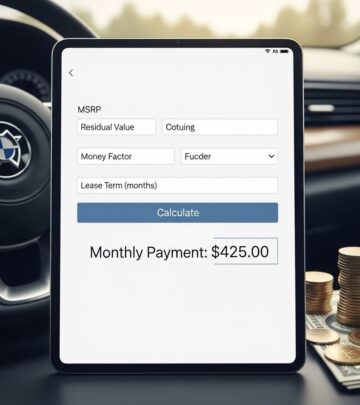
Dealers derive the money factor using: Money Factor = (Lease Charge) / [(Capitalized Cost + Residual Value) × Lease Term in Months]. Here, lease charge aggregates all finance fees; capitalized cost is the negotiated vehicle price plus fees minus down payments or rebates; residual value estimates end-term worth; and term spans the lease duration.
To verify independently, request these figures from the dealer. For example, with a $30,000 capitalized cost, $18,000 residual, 36-month term, and $1,800 total lease charge: Money Factor = 1800 / [(30000 + 18000) × 36] ≈ 0.001736, or about 4.17% APR.
- Capitalized Cost Reduction: Negotiate lower price, apply trade-ins, or make down payments to shrink this base.
- Residual Value Boost: Choose models with strong retention, like certain SUVs or luxury brands.
- Lease Term: Shorter terms amplify residual impact but raise monthly payments.
Factors Influencing Money Factor Rates
Creditworthiness dominates: scores above 750 often secure sub-0.0025 factors as low-risk profiles. Market interest rates, vehicle demand, and manufacturer incentives also play roles. Dealers may add markups, varying by brand—captives like Toyota Financial offer tighter controls than independents.
Residual percentages, set by firms like ALG, depend on model history and mileage allowances. Low-mileage leases (10,000 miles/year) yield higher residuals, easing overall costs. Economic shifts, like rising rates in 2023-2025, pushed factors upward, underscoring shopping timing.
Negotiation Strategies for Lower Factors
Approach leasing like purchasing: pre-qualify credit, compare quotes from banks, credit unions, and dealers. Request the buy rate—dealers’ base—and haggle markups, often 0.0005-0.002.
- Obtain multiple offers, emphasizing total lease cost over isolated factors.
- Leverage promotions: subvented factors (manufacturer-subsidized) can drop to 0.00001 for select models.
- Bundle with trade-ins or rebates to offset cap costs, indirectly improving effective rates.
- Audit contracts: ensure residuals match published guides and factors align with credit tier.
Strong credit alone cuts rates; monitor scores via annualcreditreport.com and dispute errors pre-lease.
Common Pitfalls and Red Flags
Opacity breeds issues: undisclosed markups or inflated cap costs disguise high factors. Always compute total payments: (Depreciation + Rent Charge + Taxes)/Term. Rent charge = (Cap Cost + Residual) × Money Factor × Term.
Avoid end-of-term fees like disposition ($400 average) by returning vehicles cleanly. Excessive mileage (above 10-15k/year) erodes residuals retroactively. Skip unnecessary add-ons like gap insurance if covered elsewhere.
- Verify no hidden fees in lease charge.
- Compare apples-to-apples: same term, mileage across quotes.
- Understand buyout: residual + fees sets purchase price.
Real-World Examples and Scenarios
Consider a $40,000 SUV lease: cap cost $38,000 (post-negotiation), 50% residual ($20,000), 36 months, 0.0020 factor. Monthly rent charge = ($38k + $20k) × 0.002 × 36 ≈ $1,512 total, or $42/month. Depreciation = ($38k – $20k)/36 ≈ $500/month; total payment ~$550 pre-tax.
Improving credit drops factor to 0.0015, saving ~$180 over term. Choosing a high-residual model (55%) cuts depreciation by $150/month. Combined, payments fall 25%, highlighting leverage points.
Alternatives to Traditional Leasing
If factors exceed 0.0030, consider financing purchases—current auto rates hover 5-7% for strong credit—or subscriptions like Fair/FINN for flexibility sans long terms. Used car leases occasionally offer lower factors due to stabilized residuals.
EV leases benefit from incentives: residuals near 60%+ and sub-0.001 factors via rebates. Weigh total ownership cost: leases suit low-mileage drivers avoiding depreciation risk.
Frequently Asked Questions
What exactly is a lease money factor?
It’s the decimal representing lease interest, converted to APR by ×2400, influencing rent charges in payments.
Is a 0.0025 money factor good?
Yes, equating to 6% APR—solid for most profiles amid 2025 rates.
Can I negotiate the money factor?
Absolutely; shop competitors and cite buy rates to pressure dealers.
How does credit score affect it?
Higher scores (720+) unlock tier 1 rates, often 1-2 points below average.
What’s the formula for monthly payments?
(Cap Cost – Residual)/Term + [(Cap Cost + Residual) × Factor] + Taxes.
Advanced Tips for Savvy Lessees
Utilize calculators from Edmunds or Leasehackr for validation. Track manufacturer lease programs quarterly—e.g., luxury brands subvent for conquests. Multiple-security deposits waive factors in rare deals. Post-lease, sell privately if buying out beats residuals.
In 2026’s market, hybrid/EV residuals climb 5-10% yearly, amplifying savings. Always project 3-year totals: cap reduction + low factor + high residual = optimal math.
References
- What is the Lease Money Factor? | Capital One Auto Navigator — Capital One. 2024. https://www.capitalone.com/cars/learn/managing-your-money-wisely/what-is-the-lease-money-factor/1700
- What Is A Money Factor On A Lease? – JD Power — JD Power. 2024. https://www.jdpower.com/cars/shopping-guides/what-is-a-money-factor-on-a-lease
- Money Factor – Definition, Formula, Calculate, Example — Corporate Finance Institute. 2024. https://corporatefinanceinstitute.com/resources/commercial-lending/money-factor/
- Caredge Money Factor Explained: See This Month’s Lease Buy Rates — CareEdge. 2026. https://caredge.com/money-factors
- What Is The Lease Money Factor? – Chase Bank — Chase. 2025. https://www.chase.com/personal/auto/education/leasing/what-is-the-lease-money-factor
Similar Articles








Read full bio of medha deb