IRAs: 4 Essential Types For Retirement Security
Explore Individual Retirement Accounts: tax benefits, types, and strategies to build a secure retirement future.
Individual Retirement Accounts (IRAs) serve as powerful tools for building long-term wealth with significant tax advantages. These self-directed accounts allow individuals to save and invest for retirement independently of employer plans, offering flexibility and growth potential unmatched by standard savings options.
Core Fundamentals of Retirement Savings Accounts
At their essence, IRAs are specialized investment vehicles designed specifically for retirement preparation. They enable earners to set aside funds from their income into trusts or custodial accounts that hold diverse assets like stocks, bonds, mutual funds, and certificates of deposit. Unlike regular brokerage accounts, IRAs provide tax-deferred or tax-free growth, meaning earnings compound without annual tax drags, accelerating wealth accumulation over decades.
Eligibility hinges on having taxable compensation, such as wages, salaries, commissions, or self-employment income. Spouses can contribute based on the working partner’s earnings even if they lack personal income. These accounts stand apart from employer-sponsored options like 401(k)s by granting full control over providers, investments, and management, making them ideal supplements or primary vehicles for freelancers, small business owners, and maxed-out plan participants.
Primary Categories of Individual Retirement Plans
Navigating the IRA landscape starts with recognizing the main variants, each tailored to different financial profiles and goals. Selection depends on factors like current versus future tax brackets, income levels, and employment status.
Traditional IRA: Defer Taxes for Later
The cornerstone of IRA options, Traditional IRAs allow pre-tax contributions that reduce your taxable income in the contribution year, provided you meet deductibility rules. Funds grow tax-deferred until withdrawal, typically post-age 59½, when distributions are taxed as ordinary income. This structure suits those anticipating lower retirement tax rates, maximizing current deductions while postponing taxes.
Key perks include penalty-free access for qualified expenses like first-time home purchases (up to $10,000), higher education, or health insurance during unemployment. However, required minimum distributions (RMDs) begin at age 73, enforcing withdrawals regardless of need.
Roth IRA: Pay Now, Withdraw Tax-Free
Contrasting the Traditional model, Roth IRAs fund with after-tax dollars, forgoing upfront deductions but promising tax-free qualified withdrawals in retirement. Earnings grow tax-free, and contributions (not earnings) can be withdrawn anytime penalty-free, offering liquidity. This appeals to younger savers or those expecting higher future taxes, as post-59½ distributions escape income tax entirely if the account is at least five years old.
Income limits apply: for 2026, full contributions phase out for singles above $146,000 and married couples filing jointly above $230,000, per IRS adjustments. No RMDs during the owner’s lifetime add estate planning flexibility.
Employer-Focused Variants: SEP and SIMPLE IRAs
For business owners, Simplified Employee Pension (SEP) IRAs permit generous contributions up to 25% of compensation or $69,000 (2026 limit), funded solely by employers. Ideal for sole proprietors or small firms, they mirror Traditional IRA tax treatment with high limits and minimal paperwork.
Savings Incentive Match Plan for Employees (SIMPLE) IRAs target businesses with fewer than 100 employees, mandating employer matches (up to 3%) on employee deferrals up to $16,000 (2026). Employees face a 25% penalty on early withdrawals within two years, but administration remains straightforward compared to 401(k)s.
Financial Advantages Driving IRA Popularity
IRAs excel through multifaceted benefits that amplify savings efficiency. Tax deferral or exemption lets money compound uninterrupted, potentially doubling or tripling balances over 30+ years versus taxable accounts. A $7,000 annual contribution at 7% return grows to over $500,000 in 30 years tax-deferred.
- Investment Diversity: Choose from thousands of options including low-cost index funds, ETFs, bonds, and alternatives, far exceeding most 401(k) menus.
- Portability: Accounts transfer seamlessly between custodians without tax events.
- Creditor Protection: Federal law shields IRAs up to $1.5 million (inflation-adjusted) in bankruptcy, with full exemption for certain rollovers.
- Hedge Against Inflation: Equity-heavy allocations historically outpace rising costs.
| IRA Type | Contribution Tax Treatment | Growth | Withdrawal Taxes | RMDs? |
|---|---|---|---|---|
| Traditional | Deductible (often) | Tax-deferred | Taxed as income | Yes, age 73 |
| Roth | After-tax | Tax-free | Tax-free (qualified) | No |
| SEP | Employer pre-tax | Tax-deferred | Taxed as income | Yes |
| SIMPLE | Pre-tax deferral + match | Tax-deferred | Taxed as income | Yes |
Navigating Contribution Rules and Limits
Annual limits unify accessibility: $7,000 for 2026 under age 50, $8,000 with catch-up for 50+. Contributions must occur by tax filing deadline, typically April 15. Earned income caps apply—no contributions exceed your compensation. Roth phase-outs enforce fairness for high earners.
Strategic timing involves dollar-cost averaging to mitigate market volatility, investing fixed amounts regularly. Spousal IRAs extend benefits to non-working partners, doubling household savings potential.
Withdrawal Guidelines and Penalties
Access before 59½ incurs 10% penalty plus taxes, barring exceptions like disability, medical bills exceeding 7.5% of AGI, or substantially equal periodic payments. Roth principal exits freely; Traditional demands careful planning to avoid depleting funds prematurely.
Post-59½, flexibility reigns, but RMDs for Traditional/SEP/SIMPLE enforce 27-year drawdown phases, calculated via IRS Uniform Lifetime Table. Non-compliance triggers 25% excise tax, reducible to 10% if corrected timely.
Integrating IRAs with Broader Retirement Strategies
IRAs complement 401(k)s by filling contribution gaps—max one, then IRA. Rollovers from job-change plans preserve tax status, converting 401(k)s to IRAs for superior choices. Backdoor Roth strategies bypass income limits: contribute Traditional non-deductibly, then convert.
For self-employed, Solo 401(k)s pair with IRAs for ultra-high savings, but SIMPLE/SEPs suffice for simplicity.
Inheritance and Beneficiary Considerations
IRAs pass to designated beneficiaries, sidestepping probate. Spouses inherit seamlessly, treating as own with continued contributions. Non-spouses face 10-year depletion under SECURE Act, taxing distributions. Eligible designated beneficiaries (minors, disabled) use life expectancy. Naming trusts adds control but complicates taxes—consult advisors.
Frequently Asked Questions
Can I have multiple IRAs?
Yes, aggregate contributions across all count toward annual limits. Diversify providers for redundancy.
What’s the difference between IRA and 401(k)?
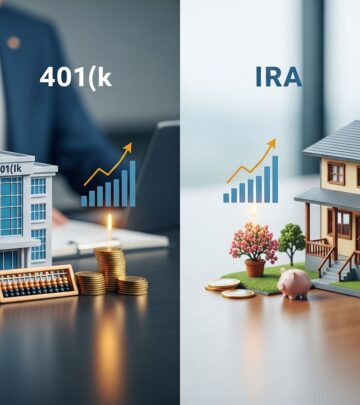
401(k)s offer higher limits ($23,500 employee + employer match, 2026) but limited investments and job-tied. IRAs provide broader choices and individual control.
Are there income limits for Traditional IRA deductions?
Deductibility phases out if covered by workplace plan and income exceeds $77,000-$87,000 single/$123,000-$143,000 joint (2026).
Can I roll over a 401(k) to an IRA?
Absolutely, direct rollovers avoid withholding; indirect within 60 days preserve status.
What investments are prohibited in IRAs?
Life insurance, collectibles (art, stamps, gems), and personal-use real estate. Most securities qualify.
Steps to Open and Optimize Your IRA
- Assess eligibility and goals: tax bracket trajectory, risk tolerance.
- Select provider: low-fee brokers like Vanguard, Fidelity for index funds.
- Choose type: model scenarios with calculators.
- Fund via bank transfer, payroll, or rollover.
- Invest diversely: 60/40 stocks/bonds for balance, rebalance annually.
- Automate contributions; review yearly amid life changes.
Professional guidance from fee-only planners ensures alignment. Start small—consistency trumps timing.
References
- Individual Retirement Accounts (IRAs): Types & Advantages — Guardian Life. 2025. https://www.guardianlife.com/ira
- Individual Retirement Accounts Explained — Farm Bureau Bank. 2024-10-15. https://www.farmbureau.bank/Resources/Blog/Individual-Retirement-Accounts-Explained
- Individual retirement account — Wikipedia. 2026-02-01. https://en.wikipedia.org/wiki/Individual_retirement_account
- What is an IRA? — Citizens Bank. 2025. https://www.citizensbank.com/learning/what-is-an-ira.aspx
- Individual Retirement Accounts (IRAs) — Charles Schwab. 2025. https://www.schwab.com/ira
- Self-Directed Plans: Individual Retirement Accounts (IRAs) — Investor.gov (SEC). 2025-01-20. https://www.investor.gov/additional-resources/retirement-toolkit/self-directed-plans-individual-retirement-accounts-iras
- Individual retirement arrangements (IRAs) — Internal Revenue Service. 2026-01-15. https://www.irs.gov/retirement-plans/individual-retirement-arrangements-iras
Similar Articles








Read full bio of medha deb