Understanding IRAs: Your Guide to Retirement Savings
Discover how Individual Retirement Accounts can secure your financial future with tax benefits and flexible investing options for long-term growth.

Individual Retirement Accounts (IRAs) serve as powerful tools for building wealth toward retirement through tax-efficient investing. These personal accounts allow individuals to save and invest independently of employer plans, offering flexibility in asset choices and potential tax savings.
Defining the Individual Retirement Account
An IRA is a personal investment account designed specifically for retirement purposes, enabling contributions from earned income that grow under favorable tax rules. Unlike standard savings accounts, IRAs hold diverse assets like stocks, bonds, certificates of deposit (CDs), and mutual funds, with the account holder directing investment decisions based on risk tolerance and goals.
Established as trusts or custodial accounts by financial institutions such as banks, brokerages, or credit unions, IRAs provide a structured way to accumulate funds over decades. They are particularly valuable for self-employed workers, those without workplace retirement options, or individuals maxing out employer-sponsored plans like 401(k)s.
Core Benefits of Opening an IRA
IRAs stand out due to their tax advantages, which accelerate savings growth compared to taxable brokerage accounts. Key perks include:
- Tax-deferred or tax-free growth: Earnings compound without annual taxes, allowing reinvestment of full returns.
- Diversified investment control: Choose from a broad menu of assets, unlike limited employer plan options.
- Portability: Accounts remain yours regardless of job changes, with easy rollovers to new providers.
- Long-term compounding: Early contributions benefit from decades of market growth and reinvested gains.
These features make IRAs essential for anyone aiming to replace 55-80% of pre-retirement income in later years, often supplementing employer plans.
Primary Types of IRAs Explained
Several IRA variants cater to different financial situations, each with unique tax treatments and eligibility rules. Here’s a breakdown:
| Type | Tax on Contributions | Tax on Withdrawals | Best For |
|---|---|---|---|
| Traditional IRA | Often deductible | Taxed as income | Those expecting lower retirement tax bracket |
| Roth IRA | Non-deductible (after-tax) | Tax-free (qualified) | Younger savers or rising earners |
| SEP IRA | Deductible (employer-funded) | Taxed as income | Self-employed or small businesses |
| SIMPLE IRA | Deductible | Taxed as income | Small businesses with employee matching |
Traditional IRAs allow pre-tax contributions, reducing current taxable income, with taxes deferred until withdrawal. Roth IRAs use after-tax dollars but offer tax-free qualified distributions, ideal if future tax rates rise.
SEP (Simplified Employee Pension) IRAs suit sole proprietors or small firms, permitting high contributions up to 25% of compensation. SIMPLE (Savings Incentive Match Plan for Employees) IRAs require employer matches, mimicking 401(k) features with simpler administration.
Contribution Rules and Limits
The Internal Revenue Service sets annual IRA contribution caps, adjusted periodically for inflation. For 2026, limits typically hover around $7,000 for those under 50, with catch-up contributions of $1,000 for ages 50+. Spousal IRAs allow non-working partners to contribute based on the working spouse’s income.
- Contributions must come from earned income like wages or self-employment earnings.
- Deadlines align with tax filing: April 15 of the following year.
- SEP limits reach $69,000 or 25% of compensation (lesser amount); SIMPLE caps at $16,000 plus catch-up.
Exceeding limits triggers a 6% excise tax per year until corrected. Phase-out ranges apply for high earners, especially Roth eligibility.
Investment Flexibility Within IRAs
IRA holders enjoy broad latitude in asset selection, fostering personalized portfolios. Common options include:
- Stocks and bonds for growth and stability.
- Mutual funds and ETFs for diversification.
- CDs and money market funds for low-risk preservation.
Rebalancing incurs no capital gains taxes within the account, enhancing tax efficiency. Self-directed IRAs even permit alternative assets like real estate, though with added complexity and custodian approval.
Withdrawal Guidelines and Penalties
IRAs encourage long-term holding with rules on distributions:
- Penalty-free withdrawals start at age 59½.
- Early withdrawals face 10% penalty plus income taxes, except for exceptions like first-time homebuying ($10,000 lifetime), education, or health emergencies.
- Required Minimum Distributions (RMDs) begin at age 73 for Traditional IRAs, based on life expectancy.
- Roth IRAs have no RMDs during the owner’s lifetime.
These rules protect savings while providing limited access for hardships.
What Happens to IRAs After the Owner’s Death?
Inheritance rules vary by beneficiary type. Spouses can treat the IRA as their own, delaying RMDs and allowing continued contributions. Non-spouse beneficiaries follow the 10-year rule under SECURE Act 2.0, depleting the account within 10 years of death, with taxes on distributions.
IRAs enjoy strong creditor protection in bankruptcy, up to $1.5 million (inflation-adjusted), bolstering their security.
Strategies to Maximize Your IRA
To optimize IRA effectiveness:
- Start early: Harness compounding; $6,500 annual contributions at 7% return could grow to over $1 million in 40 years.
- Maximize contributions: Prioritize if employer match is exhausted.
- Diversify: Balance stocks, bonds, and alternatives per age and risk.
- Convert strategically: Roth conversions in low-tax years ladder tax payments.
- Review annually: Adjust for life changes or market shifts.
IRA vs. 401(k): Key Differences
| Feature | IRA | 401(k) |
|---|---|---|
| Setup | Individual | Employer-sponsored |
| Contribution Limit | Lower (~$7,000) | Higher (~$23,000) |
| Investment Choices | Broad | Limited |
| Loans | No | Often yes |
| Fees | Typically lower | Variable |
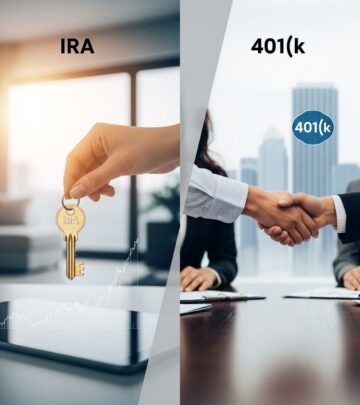
IRAs complement 401(k)s, offering superior flexibility post-employment.
Frequently Asked Questions (FAQs)
Can I have both Traditional and Roth IRAs?
Yes, contributions count toward a combined annual limit.
What is a rollover IRA?
A Traditional IRA holding funds transferred from employer plans, preserving tax-deferral.
Are there income limits for IRAs?
Roth has phase-outs; Traditional deductibility phases for those with workplace plans.
Can I contribute if I’m 70½ or older?
Yes, for Roth; no age limit since 2020 for Traditional.
How do I choose an IRA provider?
Compare fees, investment options, and tools from banks, brokerages, or robo-advisors.
Getting Started with Your IRA
Opening an IRA is straightforward: Select a provider, fund via bank transfer or rollover, and invest. Consult a financial advisor for tailored advice, especially on tax implications. Consistent contributions and smart investing can transform modest savings into substantial retirement security.
References
- Individual Retirement Accounts Explained — Farm Bureau Bank. 2023. https://www.farmbureau.bank/Resources/Blog/Individual-Retirement-Accounts-Explained
- Individual retirement account — Wikipedia. Accessed 2026. https://en.wikipedia.org/wiki/Individual_retirement_account
- What is an IRA? | Individual Retirement Account — Citizens Bank. 2024. https://www.citizensbank.com/learning/what-is-an-ira.aspx
- Individual Retirement Accounts (IRAs) — Charles Schwab. 2025. https://www.schwab.com/ira
- Individual Retirement Accounts (IRAs) — Investor.gov (SEC). 2025. https://www.investor.gov/additional-resources/retirement-toolkit/self-directed-plans-individual-retirement-accounts-iras
- Individual Retirement Accounts (IRAs): Types & Advantages — Guardian Life. 2024. https://www.guardianlife.com/ira
- What is an IRA? | why you should invest — Fidelity. 2025. https://www.fidelity.com/learning-center/smart-money/what-is-an-ira
- Individual retirement arrangements (IRAs) — Internal Revenue Service. 2026-02-01. https://www.irs.gov/retirement-plans/individual-retirement-arrangements-iras
Similar Articles








Read full bio of Sneha Tete