Understanding Intersection Over Union (IoU)
Master IoU metric: The essential measurement for evaluating object detection accuracy in AI models.
Understanding Intersection over Union (IoU): A Complete Guide
Intersection over Union, commonly abbreviated as IoU, represents one of the most fundamental metrics in computer vision and machine learning. This evaluation metric has become indispensable for professionals developing and refining object detection algorithms. Whether you’re working with autonomous vehicles, medical imaging, surveillance systems, or any application requiring precise object localization, understanding IoU is critical to assessing model performance and ensuring reliable results.
What Is Intersection over Union?
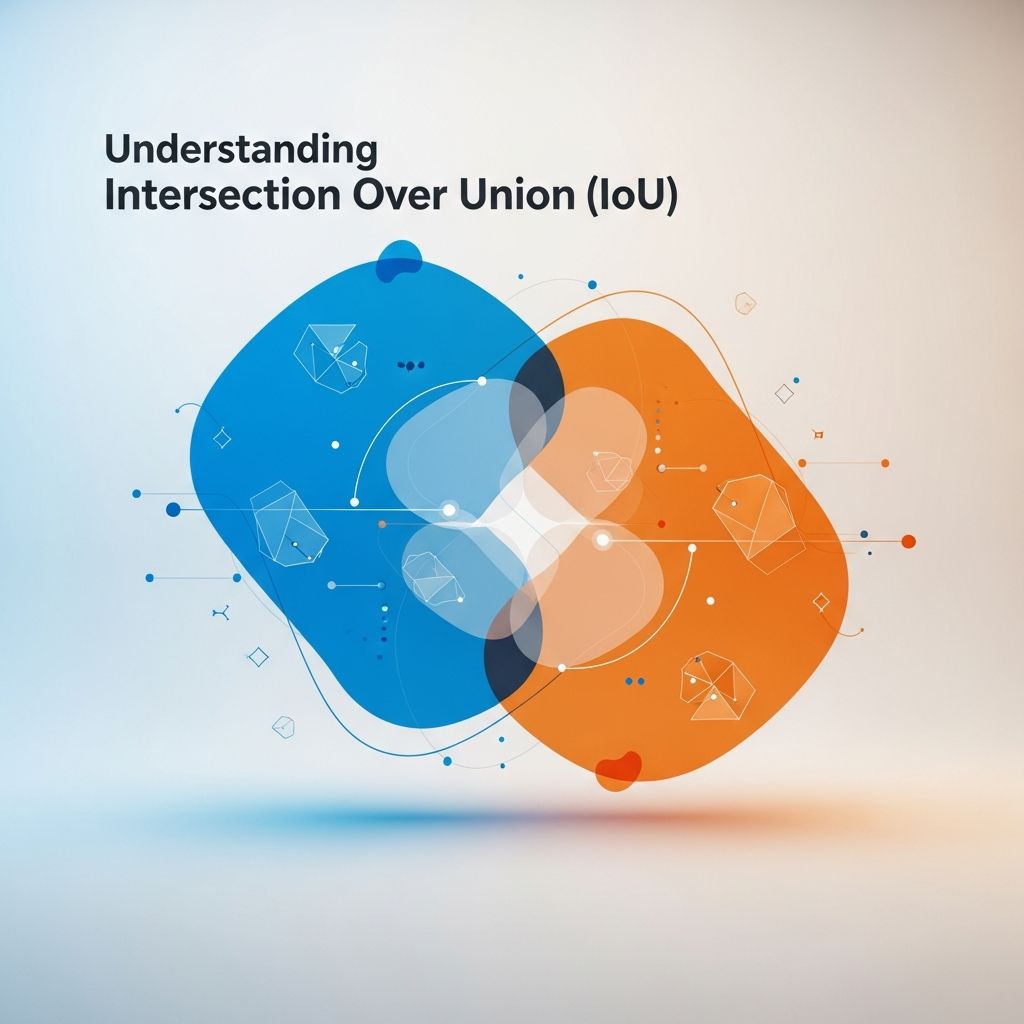
Intersection over Union is a quantitative measure that evaluates how accurately a machine learning model predicts the location of objects within images. At its core, IoU calculates the degree of overlap between two bounding boxes: the predicted bounding box generated by your model and the ground truth bounding box, which represents the actual location of the object as manually annotated by humans.
The metric produces a normalized value ranging from 0 to 1, where 0 indicates absolutely no overlap between the predicted and actual bounding boxes, and 1 represents a perfect match indicating complete alignment. This scale-invariant nature makes IoU particularly valuable because it measures prediction quality regardless of object size, ensuring consistent evaluation across different detection scenarios.
In academic literature, IoU is also referred to as the Jaccard Index or Jaccard similarity coefficient, reflecting its origins in set theory and its widespread adoption across computer vision research.
The Mathematical Foundation of IoU
The calculation of IoU follows a straightforward mathematical formula that divides the intersection area by the union area:
IoU = Area of Intersection / Area of Union
For binary classification tasks, the formula can also be expressed as:
IoU = TP / (TP + FN + FP)
Where TP represents True Positives (correctly identified objects), FN represents False Negatives (missed detections), and FP represents False Positives (incorrect detections).
To understand the mathematical derivation, consider two bounding boxes with coordinates. The intersection area represents where both boxes overlap, calculated by finding the minimum and maximum coordinates of both boxes. The union area encompasses the total space covered by either or both boxes, calculated by adding individual box areas and subtracting their intersection to avoid double-counting.
Step-by-Step IoU Calculation
Calculating IoU involves several methodical steps that ensure accuracy in evaluating model predictions:
Step 1: Gather Bounding Box Coordinates
First, obtain the coordinates of both the ground truth bounding box and the predicted bounding box. These coordinates typically include x and y values representing the top-left corner and bottom-right corner positions.
Step 2: Calculate Individual Box Areas
Determine the area of each bounding box by multiplying width by height. For a box with coordinates (x1, y1) to (x2, y2), the area equals (x2 – x1) × (y2 – y1).
Step 3: Find the Intersection Area
The intersection area represents the overlapping region. Calculate this by finding the maximum of the left coordinates, maximum of the top coordinates, minimum of the right coordinates, and minimum of the bottom coordinates. If these values result in a negative width or height, the intersection area is zero.
Step 4: Calculate the Union Area
The union area equals the sum of both individual box areas minus their intersection area, preventing double-counting of the overlapping region.
Step 5: Apply the IoU Formula
Divide the intersection area by the union area to obtain the IoU score.
Practical Example of IoU Calculation
Consider a real-world example where a deep learning model attempts to detect a dog in an image. The ground truth bounding box has coordinates [50, 100, 200, 300], and the predicted bounding box has coordinates [80, 120, 220, 310].
Following the calculation steps:
Ground truth area = (200 – 50) × (300 – 100) = 30,000 square units
Predicted area = (220 – 80) × (310 – 120) = 26,600 square units
Intersection area = 120 × 180 = 21,600 square units
Union area = 30,000 + 26,600 – 21,600 = 35,000 square units
IoU score = 21,600 / 35,000 = 0.62
This score of 0.62 indicates reasonably good alignment between the predicted and actual bounding boxes, though there’s room for improvement.
How IoU Works in Object Detection
IoU serves as the fundamental mechanism for determining detection accuracy in object detection systems. When a model makes predictions, IoU quantifies how well those predictions match reality, providing an objective measure of performance.
Different IoU thresholds establish whether detections should be classified as correct or incorrect. In many applications, an IoU score above 0.5 indicates a correct detection, while lower scores suggest the prediction misses the target sufficiently to warrant classification as an incorrect detection.
This threshold-based approach allows researchers and engineers to fine-tune their models and understand exactly where predictions fall short. By analyzing distributions of IoU scores across test datasets, developers can identify systematic issues, such as models consistently over-predicting or under-predicting object sizes.
Advanced Variants: Beyond Standard IoU
Generalized Intersection over Union (GIoU)
Standard IoU has limitations, particularly when predicted and ground truth boxes don’t overlap at all. In such cases, IoU remains at zero regardless of how close the boxes actually are to each other. Generalized Intersection over Union addresses this limitation by considering not just the intersection but also the enclosing area—the smallest bounding box that encompasses both the predicted and ground truth boxes.
GIoU proves more robust in evaluating misaligned bounding boxes and provides better gradient information for optimization algorithms, making it particularly valuable for training object detection models. This metric is differentiable, enabling its use with gradient-based optimization techniques commonly employed in deep learning.
IoU Applications in Real-World Scenarios
Autonomous Vehicles and Traffic Detection
In autonomous driving systems, IoU evaluates how accurately the vehicle detection algorithms identify cars, pedestrians, and traffic signs. Precise IoU measurements ensure that safety-critical detections meet required accuracy standards.
Medical Imaging
Healthcare applications use IoU to assess algorithm performance in detecting organs, tumors, and lesions in medical images such as MRI scans and X-ray images. Accurate IoU scores are essential for diagnostic reliability.
Surveillance and Security
Security systems employ IoU to evaluate object detection in surveillance videos, identifying suspicious movements, intrusions, and unauthorized activities in restricted areas.
General Computer Vision Tasks
Beyond these specialized applications, IoU remains fundamental for evaluating algorithms like YOLO, Faster R-CNN, and other popular object detection frameworks across countless applications.
Implementing IoU in Your Workflow
To effectively use IoU in your machine learning projects, follow these essential steps:
Prepare Ground Truth Data
Begin with carefully annotated datasets where human experts have marked the exact locations of objects with bounding boxes or masks. This ground truth data forms the foundation for all IoU calculations.
Configure Your Model
Ensure your object detection model can generate predictions in a format matching your ground truth annotations, maintaining consistency in coordinate systems and units.
Generate Predictions
Run your trained model on test images to produce predicted bounding boxes for each detected object.
Calculate IoU Scores
Compute the IoU score for each prediction by dividing the intersection area by the union area. Most computer vision frameworks provide built-in functions for this calculation.
Evaluate and Iterate
Analyze the distribution of IoU scores to understand model performance. Scores clustering around 0.8 or higher indicate strong performance, while concentrations around 0.5 suggest the model requires refinement.
Optimize Based on Results
Use IoU analysis to identify specific failure modes and guide model improvements, whether through architecture changes, additional training data, or hyperparameter adjustments.
Interpreting IoU Scores
Understanding what different IoU values mean is crucial for meaningful model evaluation:
| IoU Score Range | Interpretation |
|---|---|
| 0.9 – 1.0 | Excellent detection with near-perfect alignment |
| 0.7 – 0.9 | Very good detection with minor misalignment |
| 0.5 – 0.7 | Acceptable detection; typically considered a correct detection |
| 0.3 – 0.5 | Poor detection; significant misalignment present |
| 0 – 0.3 | Failed detection with minimal or no overlap |
IoU and Mean Average Precision (mAP)
While IoU measures individual prediction quality, the broader evaluation metric Mean Average Precision (mAP) aggregates IoU values across entire datasets. mAP calculates the average precision at different IoU thresholds, typically reporting results at IoU=0.5 and IoU=0.75 for comprehensive model evaluation.
This hierarchical approach allows researchers to understand not just that a model performs well, but specifically at what IoU levels it excels, enabling more nuanced performance comparisons between different architectures.
Frequently Asked Questions (FAQs)
Q: What is the difference between IoU and accuracy in object detection?
A: Accuracy measures overall correctness across all predictions, while IoU specifically quantifies the quality of spatial alignment for detected objects. IoU provides more detailed information about detection precision.
Q: Can IoU be used for image segmentation?
A: Yes, IoU extends beyond bounding boxes to evaluate pixel-level masks in semantic and instance segmentation tasks, comparing the predicted segmentation mask with the ground truth mask.
Q: What IoU threshold should I use for my application?
A: Application requirements dictate the appropriate threshold. Safety-critical systems like autonomous vehicles may require IoU ≥ 0.7 or higher, while other applications might accept IoU ≥ 0.5.
Q: How does IoU handle overlapping predictions for the same object?
A: Non-maximum suppression techniques identify overlapping predictions and retain only the highest-confidence detection, eliminating duplicate detections before IoU evaluation.
Q: Is IoU invariant to object size?
A: Yes, IoU is scale-invariant. It evaluates prediction quality relative to object size, ensuring fair comparison across objects of varying dimensions within the same image.
Q: How does GIoU improve upon standard IoU?
A: GIoU provides gradient information even when boxes don’t overlap, enabling better optimization during model training. It also offers more informative evaluation of prediction proximity to ground truth.
References
- Intersection over Union (IoU): Definition, Calculation, Code — V7 Labs. 2024. https://www.v7labs.com/blog/intersection-over-union-guide
- Intersection over Union (IoU) Explained — Ultralytics. 2024. https://www.ultralytics.com/glossary/intersection-over-union-iou
- Intersection over Union (IoU) for Object Detection — SuperAnnotate. 2024. https://www.superannotate.com/blog/intersection-over-union-for-object-detection
- IoU in AI: Key to Precision in Computer Vision — Innovatiana. 2024. https://www.innovatiana.com/en/post/intersection-over-union
- Intersection over Union (IoU) – Computer Vision Wiki — CloudFactory. 2024. https://wiki.cloudfactory.com/docs/mp-wiki/metrics/iou-intersection-over-union
Similar Articles








Read full bio of medha deb