Sector: Understanding Economic Sectors and Investment
Learn about economic sectors, their classification, and investment opportunities.
Understanding Economic Sectors
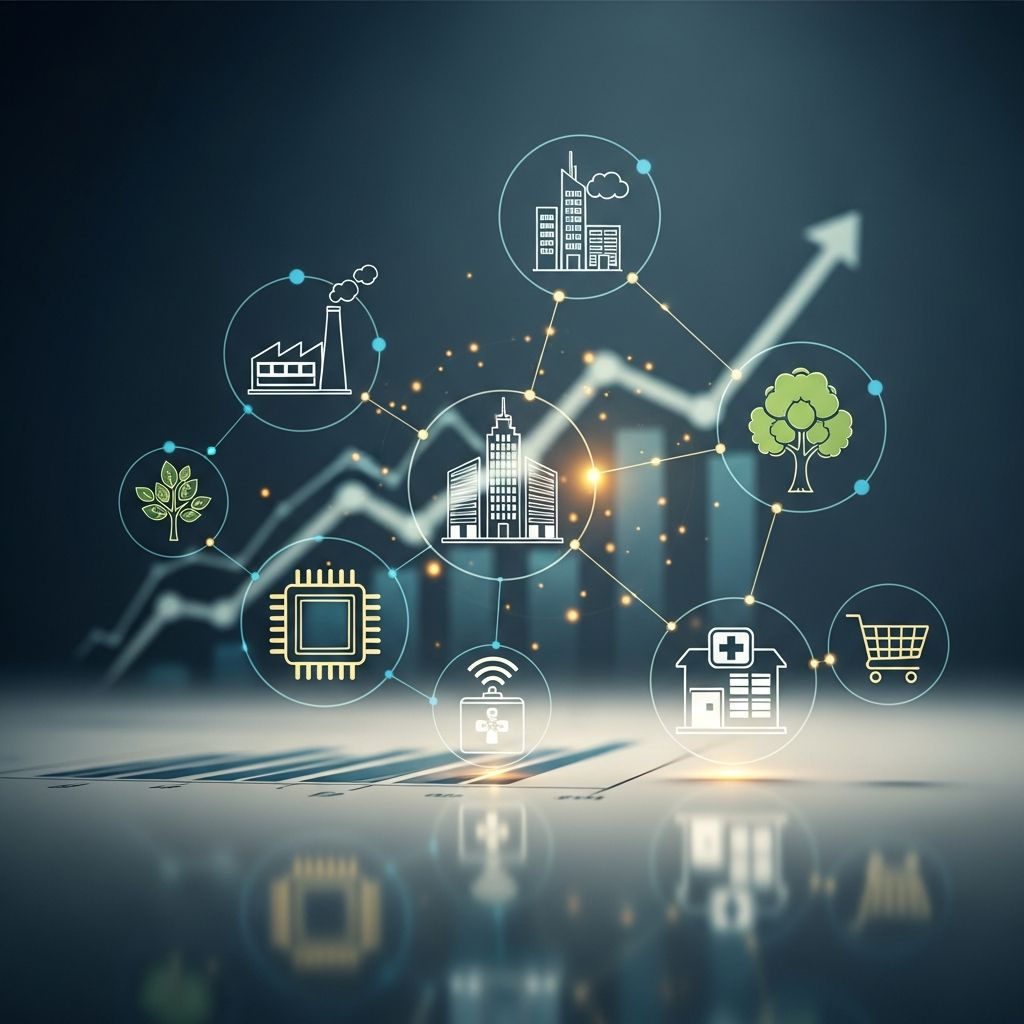
An economic sector represents a grouping of different businesses that are related by a common product or service. These divisions help economists, investors, and policymakers understand how different parts of the economy function and contribute to overall economic growth. Sectors serve as a fundamental framework for analyzing market trends, evaluating investment opportunities, and assessing economic health across different industries.
The concept of sectors provides a structured way to categorize the vast complexity of the modern economy. By grouping similar businesses together, sectors allow for meaningful comparisons between companies operating in different countries and time periods. This classification system helps investors identify patterns, risks, and opportunities within specific areas of the market.
The Primary Sectors of the Economy
Economists traditionally divide the economy into four main sectors, each representing different levels of economic activity and value creation. Understanding these classifications is essential for comprehending how modern economies function.
Primary Sector
The primary sector encompasses activities that extract or harvest products from the earth. This includes agriculture, fishing, forestry, and mining. Companies in the primary sector focus on producing raw materials that form the foundation for other economic activities. Examples include wheat farmers, petroleum extraction companies, and timber operations. The primary sector is often characterized by direct dependence on natural resources and environmental conditions.
Secondary Sector
The secondary sector consists of manufacturing and construction industries that transform raw materials into finished goods. This sector adds significant value to primary products through processing, assembly, and construction. Examples include automotive manufacturers, textile producers, food processors, and construction firms. The secondary sector typically requires substantial capital investment in facilities and equipment.
Tertiary Sector
The tertiary sector, also known as the service sector, includes businesses that provide services rather than tangible products. This expansive sector encompasses retail, healthcare, education, finance, transportation, and hospitality. The tertiary sector has grown substantially in developed economies and now represents the largest employment source in most industrialized nations.
Quaternary Sector
The quaternary sector represents knowledge-intensive and technology-driven industries. This emerging sector includes information technology, research and development, consulting, and education. Companies in the quaternary sector focus on creating and distributing information and intellectual capital. The growth of this sector reflects the increasing importance of innovation and knowledge in modern economies.
The Global Industry Classification Standard (GICS)
While traditional sector classification provides a general framework, modern investors often rely on more sophisticated classification systems. The Global Industry Classification Standard (GICS) represents one of the most widely used frameworks for categorizing companies by their primary business activities.
GICS Structure
The GICS system organizes companies into a hierarchical structure consisting of 11 sectors, 24 industry groups, 68 industries, and 157 sub-industries. This detailed classification allows for precise categorization of companies based on their revenue sources and business operations. The 11 GICS sectors include:
- Energy
- Materials
- Industrials
- Consumer Discretionary
- Consumer Staples
- Health Care
- Financials
- Information Technology
- Communication Services
- Utilities
- Real Estate
Industry Groups Within GICS
Each GICS sector subdivides into industry groups that represent more specific business categories. For example, the Energy sector includes both oil and gas exploration companies and oil and gas refining businesses. These industry groups allow for more granular analysis of market segments and help investors identify companies with similar business models and risk profiles.
The Standard & Poor’s Classification System
Before the adoption of GICS, Standard & Poor’s developed its own sector classification system. This alternative framework organizes companies into different categories based on their economic function. While less commonly used today, understanding this classification system provides historical context for how sectors have been traditionally defined in financial markets.
How Investors Use Sector Analysis
Sector analysis represents a critical component of investment strategy and portfolio management. By understanding sector dynamics, investors can make more informed decisions about asset allocation and risk management.
Portfolio Diversification
One of the primary reasons investors analyze sectors is to achieve diversification. By spreading investments across different sectors, investors reduce their exposure to sector-specific risks. If one sector experiences a downturn, gains in other sectors may offset those losses. A well-diversified portfolio typically includes exposure to multiple sectors with varying economic sensitivities.
Economic Cycle Positioning
Different sectors perform differently depending on the stage of the economic cycle. Cyclical sectors, such as consumer discretionary and industrials, typically perform well during periods of economic expansion and struggle during recessions. Defensive sectors, such as consumer staples and utilities, tend to maintain more stable performance throughout economic cycles. Understanding these relationships helps investors position their portfolios appropriately.
Risk Assessment
Sector analysis provides valuable insights into specific risks affecting groups of companies. Regulatory changes, commodity price fluctuations, and technological disruption often affect entire sectors simultaneously. By analyzing sector-specific risks, investors can better understand the factors that may influence their investments.
Comparative Valuation
Sector analysis enables meaningful comparisons between companies operating in similar industries. Investors can evaluate whether a company’s valuation is reasonable relative to its peers. This comparative analysis helps identify companies that may be undervalued or overvalued within their respective sectors.
Sector Performance and Economic Conditions
Sector performance varies significantly based on prevailing economic conditions and market trends. Understanding these relationships helps investors anticipate sector rotation patterns.
Growth Sectors
Growth sectors are characterized by companies expanding revenues and earnings faster than the overall economy. Information technology, consumer discretionary, and communication services often exhibit growth characteristics. These sectors attract investors seeking capital appreciation, though they typically carry higher volatility and valuation multiples.
Value Sectors
Value sectors typically include mature industries with stable cash flows and established market positions. Utilities, consumer staples, and financials often trade at lower valuation multiples relative to earnings and book value. These sectors attract investors seeking income generation and lower volatility.
Cyclical vs. Defensive Sectors
Cyclical sectors such as industrials, consumer discretionary, and materials are highly sensitive to economic conditions. These sectors flourish during economic expansions but struggle during recessions. Defensive sectors such as consumer staples, healthcare, and utilities maintain relatively stable performance regardless of economic conditions, as consumers continue purchasing essential goods and services.
Sector Rotation Strategies
Sophisticated investors employ sector rotation strategies to enhance returns by shifting portfolio allocations based on anticipated economic and market conditions.
Early Cycle Rotation
During the early stages of economic recovery, cyclical sectors typically outperform. Industrials, consumer discretionary, and information technology often lead market advances as businesses and consumers gain confidence and increase spending.
Mid-Cycle Performance
As the economic cycle matures, growth sectors continue performing well, but returns may moderate. Investors may maintain exposure to growth sectors while beginning to consider more defensive positions.
Late Cycle Positioning
As the economic cycle approaches its peak, defensive sectors become increasingly attractive. Utilities, consumer staples, and healthcare offer relative stability as economic growth slows and uncertainty increases.
Recessionary Protection
During recessions, defensive sectors typically provide downside protection. These sectors maintain relatively stable revenues and cash flows, providing investors with more predictable returns during challenging economic periods.
Sector-Specific Considerations for Investors
Different sectors present unique characteristics, opportunities, and risks that investors must carefully evaluate.
Technology Sector
The technology sector experiences rapid innovation and disruption, creating both significant opportunities and risks. Companies in this sector often command premium valuations based on growth expectations. Regulatory scrutiny, competitive dynamics, and rapid technological change significantly impact sector performance.
Healthcare Sector
Healthcare sector performance is influenced by regulatory developments, pharmaceutical approvals, and demographic trends. Healthcare companies often provide defensive characteristics due to consistent demand for medical services, though regulatory risks can create significant volatility.
Financial Sector
The financial sector includes banks, insurance companies, and investment firms. Interest rate movements, credit conditions, and regulatory changes significantly impact financial sector performance. This sector often exhibits cyclical characteristics tied to economic activity.
Energy Sector
The energy sector is heavily influenced by commodity prices, geopolitical events, and energy policy decisions. Oil and gas companies represent significant components of this sector, with performance closely tied to petroleum prices.
Global Sector Considerations
Investors with international portfolios must consider how sectors perform differently across geographical regions. Sector composition varies significantly by country based on local economic structures, resource endowments, and industrial development levels. Understanding these regional variations helps investors construct more effective global diversification strategies.
Frequently Asked Questions
What is the difference between a sector and an industry?
A sector represents a broad grouping of related businesses, while an industry is a more specific category within a sector. For example, the consumer discretionary sector includes the automotive industry, retail industry, and hospitality industry.
How many sectors are there in the economy?
The GICS system identifies 11 major sectors in the global economy. Traditional economic classifications identify four primary sectors (primary, secondary, tertiary, and quaternary), though the specific number can vary depending on the classification system used.
Why is sector analysis important for investors?
Sector analysis helps investors understand economic dynamics, identify diversification opportunities, manage risk, and anticipate market trends. By analyzing sector performance patterns, investors can make more informed portfolio allocation decisions.
Which sectors perform best during inflation?
During inflationary periods, sectors with pricing power typically outperform. Energy, materials, and consumer staples often maintain performance during inflation, while sectors with high debt levels and limited pricing power may struggle.
What is sector rotation?
Sector rotation refers to the strategy of shifting portfolio allocations between sectors based on anticipated economic and market conditions. Investors rotate toward defensive sectors during economic weakness and cyclical sectors during expansion.
How can I invest in specific sectors?
Investors can gain sector exposure through individual stocks, sector-specific exchange-traded funds (ETFs), sector mutual funds, or diversified index funds. Each approach offers different levels of diversification and flexibility.
References
- Global Industry Classification Standard (GICS) — S&P Global Market Intelligence. 2024. https://www.spglobal.com/marketintelligence/en/client-segments/enterprise/data/gics
- Sectors of the Economy: Primary, Secondary, Tertiary and Quaternary — U.S. Bureau of Labor Statistics. 2024. https://www.bls.gov/
- Understanding Market Sectors and Their Role in Portfolio Diversification — CFA Institute. 2023. https://www.cfainstitute.org/
- Economic Sectors and Market Performance Analysis — Federal Reserve Board. 2024. https://www.federalreserve.gov/
- Sector Investing and Portfolio Construction — MSCI Research. 2024. https://www.msci.com/
- Investment Strategy: Sector Rotation and Economic Cycles — Vanguard Investment Strategy Office. 2023. https://www.vanguard.com/
Similar Articles








Read full bio of medha deb