Understanding Your Credit Utilization Ratio
Learn how to calculate and optimize your credit utilization for better financial health
Your credit utilization ratio represents a fundamental aspect of your financial profile that directly influences lending decisions and your overall creditworthiness. This metric measures the proportion of available credit you actively use across your revolving credit accounts. Understanding how to calculate, monitor, and optimize this ratio can significantly impact your ability to secure favorable loan terms and maintain financial flexibility.
What Exactly Is Credit Utilization?
Credit utilization refers to the percentage of your total available revolving credit that you are currently using. Revolving credit accounts include credit cards, personal lines of credit, and home equity lines of credit (HELOCs). Unlike installment loans with fixed payment schedules, revolving credit allows you to borrow, repay, and borrow again up to your credit limit.
When you carry a balance on these accounts, credit bureaus track the reported balance and compare it to your credit limit. This comparison creates your utilization ratio, which appears on your credit report and influences credit scoring models. It’s important to recognize that credit bureaus use the balances reported by your creditors—typically from your monthly statements—rather than your current real-time balance.
The Mathematical Foundation: Calculating Your Ratio
The calculation of credit utilization involves straightforward mathematics. You need three pieces of information: your total revolving account balances, your total available credit limits, and a basic division formula.
The formula is: (Total Balance ÷ Total Credit Limit) × 100 = Credit Utilization Percentage
Let’s examine a practical example. Suppose you have two credit cards. The first card carries a $500 balance with a $2,000 credit limit. The second card has a $500 balance with a $3,000 credit limit. Your total balance is $1,000, and your total credit limit is $5,000. Dividing $1,000 by $5,000 equals 0.20, which converts to 20% utilization.
Per-Card Versus Overall Utilization: Understanding Both Metrics
Credit utilization can be measured in two distinct ways, and both matter for your credit profile.
Overall Utilization
Overall utilization considers all your revolving accounts combined. This is calculated by summing all balances across every revolving account, then dividing by the sum of all credit limits. This figure provides credit scoring models with a comprehensive view of how much credit you’re using relative to what’s available to you.
Per-Card Utilization
Per-card utilization examines individual accounts in isolation. Each credit card’s balance is divided by that specific card’s credit limit. This metric is significant because credit scoring algorithms may consider the highest utilization rate on any single account when calculating your score. Having one card maxed out while maintaining a low overall ratio can still harm your credit score.
Why the 30% Benchmark Matters
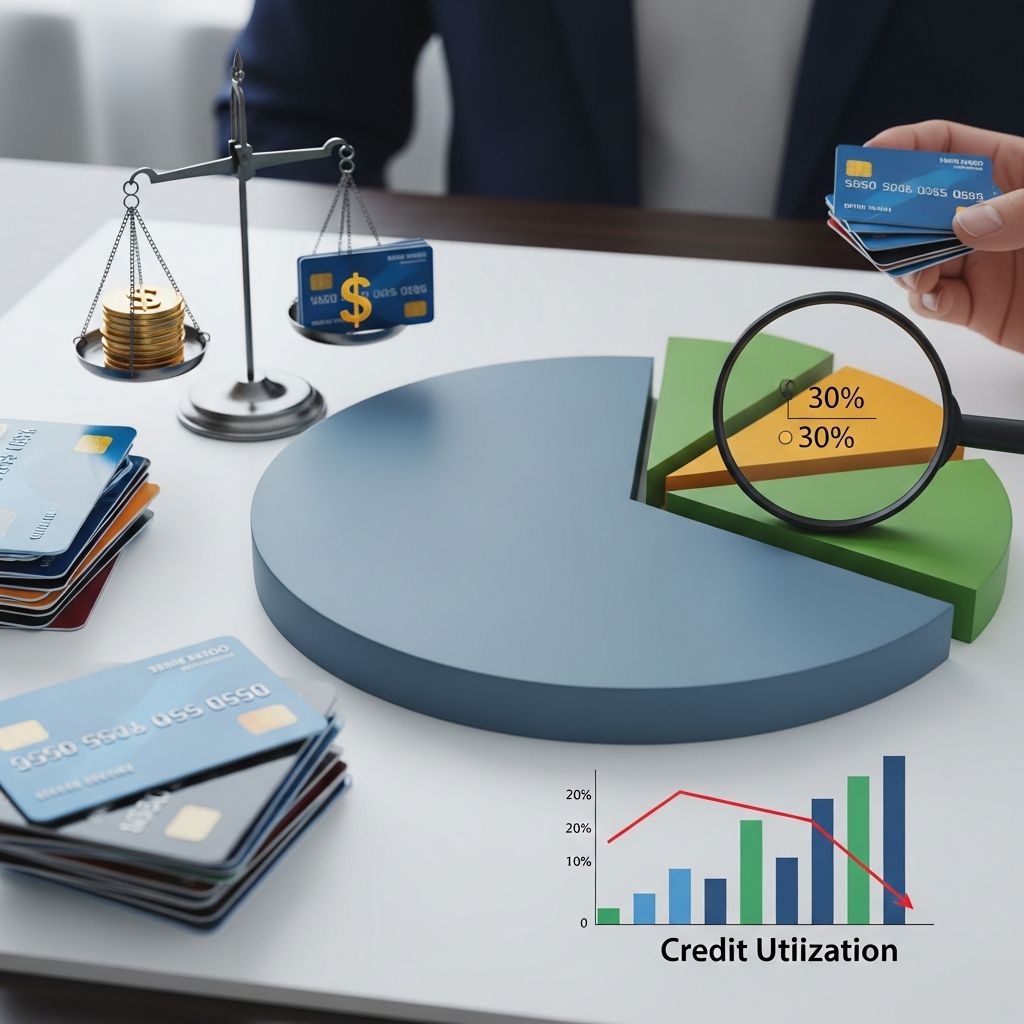
Financial experts and credit bureaus consistently recommend maintaining credit utilization below 30%. This threshold represents a sweet spot where you demonstrate responsible credit management without appearing financially strained.
When your utilization exceeds 30%, lenders interpret this as a potential signal that you’re living beyond your means or struggling with debt management. Conversely, a utilization ratio below 30%—and especially in the single digits—indicates that you maintain significant financial flexibility and manage available credit responsibly.
To illustrate this principle: if your total available credit is $10,000, keeping your balances below $3,000 signals to lenders that you have substantial available credit and can handle financial emergencies without maxing out your accounts.
The Impact on Your Credit Score
Credit utilization significantly influences your credit score calculations. Payment history remains the dominant factor in most credit scoring models, but utilization typically represents the second-most important consideration. This substantial weight means that even with perfect payment records, high utilization can limit your credit score potential.
Credit scoring models may evaluate both your overall utilization and your highest per-card utilization when determining your score. Some algorithms weight the account with the highest utilization more heavily, recognizing that a maxed-out card signals financial stress even when other accounts carry minimal balances.
Common Pitfalls That Damage Your Utilization Ratio
Several strategic mistakes can inadvertently harm your utilization ratio.
Closing Unused Accounts
One of the most counterintuitive errors involves closing credit card accounts with zero balances. When you close a card, you lose access to that card’s credit limit, which reduces your total available credit. This reduction can dramatically increase your overall utilization ratio even if you haven’t charged additional purchases.
Consider this scenario: You have three cards with limits of $5,000, $2,000, and $3,000, respectively. You’ve maxed out the first two cards ($7,000 balance) while keeping the third card unused. Your utilization is 70%. If you then close the third card, your available credit drops to $7,000, making your utilization jump to 100%.
Offset Strategy Limitations
Opening a new credit card to offset high utilization on existing accounts provides only limited benefits. While your overall utilization may improve with the additional credit limit, the maxed-out card still carries its high per-card utilization, which credit models evaluate separately.
Strategies for Optimizing Your Utilization Ratio
Several practical approaches can help you maintain or improve your credit utilization.
Strategic Payments Throughout Your Billing Cycle
Making multiple payments during your billing cycle—rather than one payment at month’s end—can reduce the balance reported to credit bureaus. Credit card companies typically report your account balance at a specific point in your monthly cycle. By making payments before this reporting date, you can ensure a lower balance is recorded.
Requesting Credit Limit Increases
Asking your credit card issuer to increase your credit limit effectively expands your available credit without increasing your balance. This reduction in utilization ratio requires no additional financial effort. Many issuers allow you to request increases online without hard inquiries that could temporarily affect your credit score.
Focusing on Per-Card Utilization
If you maintain multiple cards, ensure no single card approaches or exceeds your 30% target. This approach prevents any individual card from damaging your credit profile while maintaining flexibility across accounts.
Understanding How Credit Bureaus Calculate Your Ratio
An important distinction exists between your actual current balances and the balances that credit bureaus use in their calculations. Credit bureaus rely on reported account information from your creditors, which is typically your monthly statement balance, not your current real-time balance.
This means you could pay off your entire credit card balance today, but the previous month’s balance may still be reported to bureaus for several weeks. Understanding this lag time helps explain why your credit utilization might not improve immediately after paying down balances.
Additionally, the credit limits reported to bureaus may differ from your current limits, particularly if you’ve recently received a credit line increase that hasn’t been updated on your credit report.
The Broader Financial Implications
Your credit utilization ratio extends beyond simple credit score calculations. It serves as a fundamental indicator of your financial health to lenders evaluating you for mortgages, auto loans, personal loans, and other credit products.
A low utilization ratio demonstrates that you have financial discipline and can manage available credit responsibly. Lenders interpret this positively when considering whether to extend additional credit or offer favorable interest rates. Conversely, high utilization signals that you may be financially stretched, making lenders reluctant to provide additional credit or requiring them to offer less favorable terms to compensate for perceived risk.
Moving Forward With Your Credit Strategy
Mastering your credit utilization ratio represents a controllable and immediate way to improve your creditworthiness. Unlike payment history, which requires years to build, utilization changes can positively affect your credit profile within billing cycles. By understanding your current utilization, calculating it accurately, and implementing strategic payment approaches, you can optimize this important credit metric and strengthen your overall financial position.
Frequently Asked Questions
What is considered a good credit utilization ratio?
Most financial experts recommend keeping your credit utilization below 30%. Individuals with excellent credit scores often maintain utilization in the single digits, indicating exceptional credit management.
Does closing a credit card account immediately hurt my credit score?
Closing an account reduces your total available credit, which increases your utilization ratio, potentially harming your credit score. However, the impact may not be immediate if the account closure doesn’t affect your reported balance or if credit bureaus take time to update information.
If I pay my balance in full each month, do I still have a utilization ratio?
Yes. Even if you pay in full, your utilization ratio is calculated based on the balance reported to credit bureaus, typically your monthly statement balance, which occurs before your payment is processed.
Can I have different utilization ratios across different credit cards?
Absolutely. Each card has its own per-card utilization based on that card’s balance divided by its limit. While maintaining consistent low ratios across all cards is ideal, even one maxed-out card can negatively impact your overall credit profile.
How long does it take for improved utilization to affect my credit score?
Credit bureaus typically update information monthly when creditors report new balances. Your credit score may reflect improved utilization within one to two billing cycles of consistently maintaining lower balances.
References
- What Is Credit Utilization Ratio? How to Calculate Yours — NerdWallet. Accessed February 2026. https://www.nerdwallet.com/finance/learn/how-is-credit-utilization-ratio-calculated
- What Is a Credit Utilization Rate? — Experian. Accessed February 2026. https://www.experian.com/blogs/ask-experian/credit-education/score-basics/credit-utilization-rate/
- What Is a Credit Utilization Ratio? — Equifax. Accessed February 2026. https://www.equifax.com/personal/education/debt-management/articles/-/learn/credit-utilization-ratio/
- Understanding Credit Utilization — American 1 Credit Union. Accessed February 2026. https://www.american1cu.org/financial-resources/understanding-credit-utilization
- Credit Utilization Ratio: The Lesser-Known Key to Your Credit Health — VantageScore. Accessed February 2026. https://vantagescore.com/resources/knowledge-center/credit-utilization-ratio-the-lesser-known-key-to-your-credit-health
Similar Articles








Read full bio of medha deb