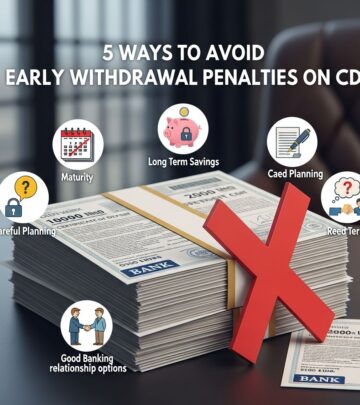
Understanding CD Early Withdrawal Penalties
Learn how CD early withdrawal penalties work and strategies to avoid them.

Certificates of deposit (CDs) are popular savings vehicles that offer fixed interest rates in exchange for committing your money for a specific period. However, life circumstances often change, and you may need access to your funds before your CD reaches maturity. When this happens, banks typically impose early withdrawal penalties. Understanding how these penalties work, what factors influence their amount, and how to minimize their impact is essential for anyone considering a CD investment.
What Exactly Is a CD Early Withdrawal Penalty?
A CD early withdrawal penalty is a charge that financial institutions assess when you access your funds before the agreed-upon maturity date. Rather than a flat fee, these penalties typically take the form of forfeited interest that you would have earned had you left your money untouched. In some cases, penalties may be calculated based on a percentage of your principal or through alternative formulas established by individual banks.
The penalty structure varies significantly among financial institutions. Some banks calculate penalties using a fixed number of days’ interest, while others might use months’ interest or more complex formulas that could even dip into your principal balance in extreme cases.
Federal Requirements and Legal Framework
The federal government establishes baseline requirements for CD early withdrawal penalties. Federal law dictates that a minimum penalty must be charged for early withdrawals from a CD, and this minimum is specifically designed to protect banks’ interests in lending activities.
According to federal regulations, if you withdraw money within the first six days after deposit, the penalty must be at least seven days’ simple interest on the amount withdrawn. However, it’s important to note that while federal law establishes this minimum threshold, there is no federally mandated maximum penalty. This means banks retain significant discretion in determining how severe their penalties can be, allowing some institutions to charge substantially higher fees than others.
How Banks Calculate Early Withdrawal Penalties
Financial institutions employ various methodologies for calculating early withdrawal penalties, making it crucial to understand your specific CD’s terms.
Interest-Based Calculations
The most common penalty method involves calculating a specific number of days’ interest based on your CD’s term length. The formula typically used is:
Penalty = (Amount withdrawn) × (Annual interest rate ÷ 365 days) × Number of penalty days
Alternatively, some banks calculate penalties monthly:
Penalty = (Amount withdrawn) × (Interest rate ÷ 12 months) × Number of penalty months
To illustrate this calculation in practice: if you have a 12-month CD earning 5% APY and withdraw your initial $5,000 deposit six months before maturity, your penalty would be calculated by multiplying $5,000 by (5% ÷ 365) by the number of penalty days specified in your account terms.
Principal-Based Penalties
Some financial institutions, notably Citi, structure their penalties based on a percentage of the principal withdrawn rather than interest earned. For CD terms of one year or less, Citi charges 90 days of simple interest as a penalty. For terms exceeding one year, the penalty increases to 180 days of simple interest.
Hybrid and Alternative Methods
Certain banks employ more complex penalty structures. Some may charge half of the interest you would have earned over the entire CD term, or a percentage of the amount withdrawn, whichever is greater, plus a flat fee. A few institutions, like PenFed, use expected dividends rather than actual earned interest, which can result in penalties that erode your principal balance.
Penalty Variations Based on CD Term Length
The duration of your CD significantly influences the severity of an early withdrawal penalty. Longer-term CDs generally carry heftier penalties to compensate banks for locking up capital at fixed rates.
| CD Term | Typical Penalty Range | Example (Based on Various Banks) |
|---|---|---|
| 3-Month to 1-Year | 60-90 days of interest | Ally: 60 days; Citi: 90 days for 1-year |
| 3-Year | 90-180 days of interest | Ally: 90 days; Some banks: 180+ days |
| 5-Year | 150-365 days of interest | Ally: 150 days; Popular Direct: 365 days |
The rationale behind term-based penalties is straightforward: banks invest your CD deposits in longer-term lending products. Early withdrawal disrupts these business plans, necessitating larger penalties for longer commitments.
Real-World Examples of Bank Penalties
Different financial institutions maintain distinct penalty structures, reflecting their individual risk management strategies.
- Ally Bank: Charges 60 days of interest for 3-month to 2-year CDs, escalating to 150 days for 5-year CDs
- Wells Fargo: Assesses 3 months of interest for 3-month to 1-year CDs, with higher penalties for longer terms
- Popular Direct: Charges 90 days for 1-year CDs and 270 days for 3-year CDs
- Bread Savings: Maintains a consistent 180 days of interest regardless of CD term
- Colorado Federal Savings Bank: Uses 3 months of interest for 1-year CDs and 6 months for 3-year CDs
These variations underscore the importance of comparing CD terms before committing your funds. A $5,000 deposit into a 12-month CD earning 5% APY might result in a penalty ranging from approximately $62.50 to over $200, depending on which institution you choose.
Special Penalty Structures at Credit Unions
Credit unions often feature more favorable penalty structures compared to traditional banks. Institutions like Alliant and Navy Federal Credit Union calculate penalties based solely on dividends actually earned, rather than using projected interest rates. This means if you withdraw before the penalty period expires, you only forfeit the interest you’ve already accumulated, not penalties on future earnings.
Conversely, some credit unions employ expected dividend calculations that may be stricter than traditional interest-based methods, potentially resulting in losses that extend into your principal balance.
Factors Influencing Your Specific Penalty
Beyond term length and bank policies, several additional factors may affect your early withdrawal penalty amount:
- Withdrawal timing: The number of days or months your CD has been open before withdrawal significantly impacts the penalty calculation
- Withdrawal amount: Whether you withdraw partially or fully influences both the calculation and the bank’s willingness to permit the transaction
- Initial deposit size: Larger deposits may subject to different penalty structures at some institutions
- Current interest rates: Higher APY rates result in larger interest-based penalties when calculated on the same number of days
- Partial versus full withdrawal: Not all banks permit partial withdrawals; forcing full liquidation may result in larger penalties
Why Banks Impose These Penalties
Understanding the rationale behind CD penalties provides context for their existence and structure. Banks charge early withdrawal penalties for two primary reasons:
First, federal law mandates minimum penalties to protect the banking system. These regulatory requirements ensure that early withdrawals carry costs, discouraging frivolous account closures.
Second, banks deploy your CD deposits into business operations, particularly funding loans to other customers. When you withdraw early, the bank loses access to predictable capital, disrupting lending plans and potentially forcing the institution to adjust its financial strategies. The penalty compensates the bank for this disruption and lost opportunity cost.
Penalty Scenarios: Practical Examples
Two-Year CD Withdrawal
Assume you invest $10,000 in a two-year CD earning 2% annual interest, with a penalty of 12 months’ interest. After 18 months, you need the funds and withdraw early. Your earned interest equals $300 ($10,000 × 2% × 1.5 years), but your penalty is $200 (12 months’ interest on $10,000). You would receive $10,100 ($10,300 total minus the $200 penalty).
Five-Year CD Early Withdrawal
Consider a $10,000 five-year CD earning 3% annually with a penalty structure of one year’s interest ($300). If you withdraw after three years, your interest earned totals $900 ($10,000 × 3% × 3 years), but the penalty removes $300. You receive $10,600.
Strategies for Minimizing Penalty Impact
Shop Before Committing
Compare penalty structures across multiple banks and credit unions before opening a CD. Some institutions offer significantly lower penalties than others, potentially saving hundreds of dollars if early withdrawal becomes necessary.
Consider Shorter Terms
If you anticipate potential access needs, shorter-term CDs (6-12 months) typically carry lower penalties than 3-5 year products, though they generally offer lower interest rates.
Use CD Laddering
Ladder CDs by purchasing multiple certificates with staggered maturity dates. This strategy provides periodic access to portions of your investment without triggering penalties on all funds.
Verify Your Account Terms
Thoroughly review your CD agreement before opening the account. Understanding exact penalty calculations helps you make informed withdrawal decisions later.
Explore Penalty-Free CD Options
Some financial institutions offer no-penalty CDs that allow limited withdrawals without penalties, though these typically offer lower interest rates to offset the banks’ reduced protection.
Frequently Asked Questions
What is the minimum federal penalty for CD early withdrawal?
Federal law mandates a minimum penalty of at least seven days’ simple interest if you withdraw within the first six days after deposit. Beyond this initial period, the minimum penalty can be higher depending on your specific account terms.
Can a CD penalty exceed my total interest earned?
Yes, particularly with longer-term CDs. Some penalties are structured to potentially erode your principal balance if you withdraw very early in the CD term. Always review your specific account agreement.
Do all banks allow partial CD withdrawals?
No. Some banks require you to withdraw the entire CD balance, which can result in larger penalties than partial withdrawals would trigger. Verify your bank’s policy before opening an account.
How can I calculate my specific penalty?
Contact your bank directly or review your CD agreement for the specific formula. Most institutions use the standard interest calculation method: (Amount withdrawn) × (Annual rate ÷ 365) × (Penalty days).
Are CD penalties tax-deductible?
Consult a tax professional, as CD penalty treatment depends on your specific circumstances and applicable tax regulations.
References
- CD Early Withdrawal Penalty: What You Should Know — Ally Bank. 2024. https://www.ally.com/stories/save/cd-early-withdrawal-penalties/
- What to Know about CD Early Withdrawal Penalties — Citigroup Inc. 2024. https://www.citi.com/banking/personal-banking-guide/basic-finance/cd-early-withdrawal-penalty
- CD Early Withdrawal Penalty, Explained — SoFi. 2024. https://www.sofi.com/learn/content/early-cd-withdrawal-penalties/
- CD early withdrawal penalties: Everything you need to know — Fortune. 2024. https://fortune.com/article/cd-early-withdrawal-penalty-explained/
- CD Early Withdrawal Penalty Calculator — NerdWallet. 2024. https://www.nerdwallet.com/banking/learn/cd-early-withdrawal-penalty-by-bank
- CD Penalty for Early Withdrawal Explained — Gainbridge. 2024. https://gainbridge.com/post/cd-early-withdrawal-penalty
- What are the penalties for withdrawing money early from a certificate of deposit (CD)? — Consumer Financial Protection Bureau. 2024. https://www.helpwithmybank.gov/help-topics/bank-accounts/certificates-of-deposit/cd-penalties.html
Similar Articles








Read full bio of Sneha Tete