Annuities: A Comprehensive Guide To Retirement Income
Explore how annuities deliver reliable retirement income through guaranteed payments and diverse investment options tailored to your financial goals.

Annuities serve as financial contracts between individuals and insurance companies, designed to deliver a stream of payments over time, often extending into retirement years. These instruments provide a mechanism for converting savings into predictable income, helping mitigate the risk of outliving one’s resources.
Defining Annuities and Their Core Purpose
At their essence, annuities involve an agreement where the purchaser makes one or more payments to an insurer, which then disburses periodic funds to the annuitant. This setup ensures payments continue for a specified duration or lifetime, offering stability amid market uncertainties. Unlike traditional investments such as stocks or bonds, annuities emphasize income assurance over capital appreciation, making them particularly appealing for retirees seeking to replace employment earnings.
The IRS characterizes an annuity as a contract mandating regular disbursements exceeding one full year to the entitled recipient. This structure supports long-term financial planning by locking in income streams insulated from daily economic fluctuations.
Primary Categories of Annuities by Payment Timing
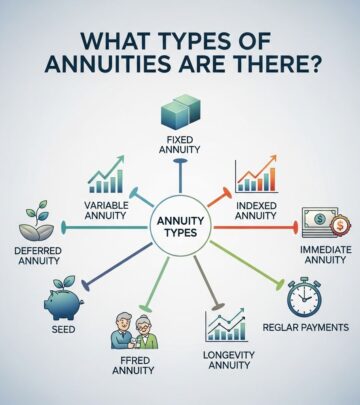
Annuities divide into two broad classifications based on when payments commence: immediate and deferred. Each caters to distinct life stages and objectives.
Immediate Annuities: Instant Income Access
Immediate annuities activate payouts shortly after funding, typically within 30 days to a year. Funded by a single lump-sum premium, they suit those entering retirement who require prompt cash flow. For instance, a retiree might allocate a portion of their 401(k) or savings to generate monthly checks mimicking a paycheck.
- Ideal for individuals aged 60+ needing immediate liquidity.
- Payments calculated via actuarial factors considering age, gender, and interest rates.
- Options include lifetime coverage or fixed-term durations.
Deferred Annuities: Growth Before Distribution
Deferred annuities postpone payouts, permitting tax-deferred accumulation during the accumulation phase. Contributions grow until annuitization, when they convert to income. This appeals to pre-retirees aiming to bolster nest eggs.
- Accumulation phase: Funds build value based on contract terms.
- Annuity phase: Regular payments begin at a chosen future date.
- Flexible premium schedules, single or multiple deposits.
Annuity Variations by Investment Mechanism
Beyond timing, annuities differ in growth strategies, spanning conservative guarantees to market-linked potential. Understanding these helps align choices with risk tolerance.
Fixed Annuities: Predictable Returns
Fixed annuities promise a specified interest rate, shielding principal from market volatility. Issuers credit earnings directly, yielding steady growth and reliable payouts. Variants include multi-year guaranteed annuities (MYGAs), locking rates for 2-10 years, often outperforming CDs.
| Type | Key Feature | Best For |
|---|---|---|
| MYGA | Fixed rate for multi-year term | Conservative savers |
| Fixed Deferred | Guaranteed growth until payout | Long-term accumulation |
Variable Annuities: Market-Driven Performance
Variable annuities tie returns to subaccounts resembling mutual funds, exposing owners to stock and bond markets. Higher growth potential accompanies elevated risk, with payouts fluctuating per investment outcomes. Death benefits and living benefits may offset losses.
- Investor selects portfolios from low- to high-risk options.
- Tax-deferred growth enhances compounding.
- Suitable for those comfortable with volatility.
Indexed Annuities: Balanced Exposure
Fixed indexed annuities (FIAs) link credits to market indexes like the S&P 500, offering upside participation with downside safeguards. Minimum guarantees prevent total loss, though caps limit maximum gains. Registered index-linked annuities (RILAs) introduce buffers absorbing partial declines.
These hybrids appeal to moderate-risk profiles, blending fixed security with indexed growth.
Benefits Driving Annuity Popularity
Annuities address key retirement challenges: longevity risk, market downturns, and inflation erosion.
- Lifetime Income: Certain types guarantee payments for life, eliminating outliving assets fears.
- Tax Deferral: Earnings accrue tax-free until withdrawal, surpassing taxable accounts.
- Principal Protection: Fixed and indexed options preserve capital against losses.
- Customization: Riders add features like step-up guarantees or income floors.
- Legacy Planning: Joint options ensure survivor benefits; some permit withdrawals.
Potential Drawbacks and Risk Considerations
Despite advantages, annuities carry trade-offs warranting scrutiny.
- Fees: Variable products incur mortality, expense, and investment charges eroding returns.
- Liquidity Limits: Surrender periods (5-10 years) penalize early exits.
- Inflation Risk: Fixed payments may lose purchasing power without cost-of-living adjustments.
- Complexity: Indexed crediting methods and caps demand careful review.
- Opportunity Cost: Locked funds miss higher market returns during bull phases.
Tax Implications of Annuity Ownership
Annuities offer tax efficiencies but trigger ordinary income rates on gains, not preferential capital gains treatment. Qualified annuities (IRA-funded) follow retirement account rules; non-qualified use after-tax dollars with return-of-principal exclusion.
| Annuity Type | Tax Treatment | Key Note |
|---|---|---|
| Non-Qualified | Exclusion ratio for principal | Gains taxed as ordinary income |
| Qualified | Fully taxable distributions | Required minimum distributions apply |
| Roth-Funded | Potentially tax-free | Meets 5-year/age rules |
Integrating Annuities into a Diversified Portfolio
Position annuities as 20-40% of retirement assets, complementing Social Security, pensions, and investments. Conservative investors favor fixed/immediate for income floors; aggressive profiles layer variables for growth. Consult advisors to match products with goals, health, and legacy needs.
Frequently Asked Questions
What is the minimum investment for an annuity?
Thresholds vary by issuer but often start at $5,000-$10,000 for deferred and $50,000+ for immediate.
Can I lose money in a fixed annuity?
No, fixed annuities guarantee principal and credited interest, barring insurer insolvency.
Are annuities FDIC-insured?
No, but state guaranty associations protect up to statutory limits per insurer.
How do joint annuities function?
Payments continue to a survivor at potentially reduced rates post-primary annuitant’s death.
Is there a free look period?
Yes, most states mandate 10-30 days to cancel without penalty.
Choosing the Right Annuity Provider
Prioritize insurers with superior ratings from A.M. Best (A or better) and financial strength. Review contract details, rider costs, and surrender schedules. Shop via independent agents for competitive quotes, ensuring alignment with regulatory oversight by state insurance departments and SEC/FINRA for variables.
References
- Annuities – A brief description — Internal Revenue Service. 2024-01-15. https://www.irs.gov/retirement-plans/annuities-a-brief-description
- What are the Different Types of Annuities? — Equifax. 2025-03-20. https://www.equifax.com/personal/education/personal-finance/articles/-/learn/what-types-of-annuities-are-there/
- Types of Annuities Made Easy — Annuity.org. 2025-06-10. https://www.annuity.org/annuities/types/
- Annuities — FINRA. 2025-09-05. https://www.finra.org/investors/investing/investment-products/annuities
- Annuities Explained: Types, Benefits, & How They Work — Guardian Life. 2025-11-12. https://www.guardianlife.com/annuities
- What Are the Various Types of Insured Annuities? — American Academy of Actuaries. 2022-08-01. https://www.actuary.org/sites/default/files/2022-08/IB.Annuities.8.22.pdf
Similar Articles








Read full bio of Sneha Tete