APY Explained: Comprehensive Guide To Growing Your Savings
Learn how APY works and why it matters for your savings growth
When you’re evaluating where to place your money, whether in a savings account, certificate of deposit, or money market account, you’ll encounter a crucial metric that determines how quickly your funds can grow. This metric is known as annual percentage yield, commonly abbreviated as APY. Understanding this concept is essential for making informed financial decisions and maximizing your earning potential.
The Foundation: What Is Annual Percentage Yield?
Annual percentage yield represents the actual rate of return you can expect to earn on your deposited funds over a one-year period. Unlike a simple interest rate, which only calculates earnings on your original deposit, APY accounts for the effects of compound interest. This distinction is critical because it reveals the true earning power of your investment.
Think of APY as the complete picture of your earnings. When a financial institution advertises an interest rate, it’s showing you one component of the equation. The APY, however, tells you the full story of what your money will actually earn when all the compounding effects are factored in throughout the year.
The Mechanics of Compound Interest
The power of APY lies in its relationship with compound interest. Compound interest is the phenomenon where you earn returns not only on your initial deposit but also on the accumulated interest from previous periods. This creates a snowball effect where your earnings generate their own earnings.
Consider a practical example: if you deposit $10,000 into an account with a 5% APY and monthly compounding, you don’t simply earn $500 over the year. Instead, each month the bank calculates interest on your balance and adds it back to your account. The following month, you earn interest on both your original deposit and the previously accumulated interest. By year’s end, you’ll have earned $512 rather than $500, a difference created entirely by compounding.
The more frequently interest compounds—whether daily, weekly, monthly, or annually—the more you ultimately earn. Daily compounding will always produce higher returns than monthly compounding at the same interest rate, because interest is being calculated and added to your balance more often.
Decoding the APY Formula
The mathematical relationship between interest rate and APY follows a specific formula that financial institutions use consistently:
APY = (1 + r ÷ n)^n – 1
In this formula, ‘r’ represents the annual interest rate expressed as a decimal, and ‘n’ represents the number of times interest compounds during the year. To illustrate how this works in practice, let’s walk through a detailed calculation.
Imagine you have a savings account offering 4% annual interest that compounds daily. Here’s how you would calculate the APY:
- First, convert the percentage to a decimal: 0.04
- Divide the rate by the number of compounding periods: 0.04 ÷ 365 = 0.000110 (approximately)
- Add 1 to this quotient: 1.000110
- Raise this result to the 365th power (representing 365 compounding periods): 1.000110^365 = 1.041 (approximately)
- Subtract 1 to get your APY expressed as a decimal: 1.041 – 1 = 0.041
- Convert to a percentage: 0.041 or 4.1%
This calculation reveals that while the advertised interest rate is 4%, the actual annual percentage yield is 4.1%. Though this might seem like a small difference, on larger deposit amounts or over extended time periods, this variance becomes increasingly significant.
Comparing Different Compounding Frequencies
The frequency of compounding has a measurable impact on your ultimate returns. To demonstrate this principle, consider a $10,000 deposit at 4% interest under different compounding scenarios:
| Deposit Amount | Interest Rate | Compounding Frequency | Total Earnings After One Year |
|---|---|---|---|
| $10,000 | 4% | Annually | $400 |
| $10,000 | 4% | Monthly | $407.42 |
| $10,000 | 4% | Daily | $408.08 |
While the differences between monthly and daily compounding might appear modest on a $10,000 deposit, these gaps expand considerably with larger principal amounts. On a $100,000 deposit, the difference between daily and annual compounding would be approximately $800 per year—a distinction that definitely warrants attention.
APY Versus APR: Understanding the Critical Distinction
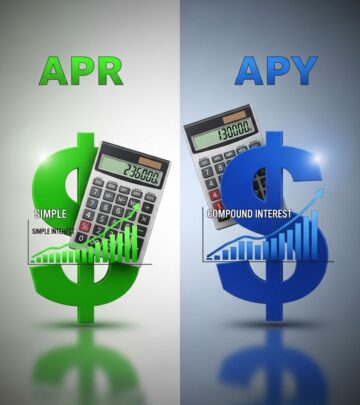
A common source of confusion in personal finance is the conflation of APY with APR, or Annual Percentage Rate. While these terms sound similar and both involve annual percentages, they serve entirely different purposes and apply to different financial products.
APY applies to deposit accounts where you are the creditor earning returns on your money. You’ll encounter APY when evaluating savings accounts, certificates of deposit, money market accounts, and similar products designed to help you accumulate wealth. APY always factors in the compounding effect because the goal is to show you the true earning potential of your deposited funds.
APR, conversely, applies to borrowing situations where you are the debtor paying interest on borrowed funds. Credit cards, mortgages, personal loans, and auto loans all display APR figures. APR represents what you will pay to borrow money and typically includes not just the interest charge but also any associated fees the lender may impose.
A key distinction: APY usually accounts for compounding, while APR typically does not incorporate compounding effects. This difference reflects the fundamental nature of each product—APY is designed to maximize transparency about what you’ll earn, while APR is designed to show the complete cost of borrowing.
When managing your finances, remember this useful principle: you want the highest possible APY on your savings and the lowest possible APR on your debt. A higher APY accelerates wealth accumulation, while a lower APR minimizes the cost of borrowing.
The Strategic Importance of Comparing APY Rates
One of the most valuable applications of understanding APY is using it as a comparison tool when selecting financial institutions for your savings. Banks and credit unions often advertise their interest rates prominently, but the APY figure is what truly matters for your earnings.
Consider that in the current financial environment, high-yield savings accounts might offer APY rates around 4.20%, while traditional savings accounts at larger banks average only 0.61% APY. This represents a difference of more than six times the earnings on identical deposit amounts. Over the course of several years, this differential can mean thousands of dollars in additional gains.
When shopping for savings products, always ask for the APY rather than relying on advertised interest rates. Some institutions intentionally emphasize their interest rate while downplaying the APY, which may be lower if their compounding frequency is limited. By requesting APY figures and comparing them across different financial institutions, you ensure you’re making decisions based on complete and accurate information.
Real-World Application: A Practical Example
To illustrate why APY matters in practical terms, imagine you’ve decided to deposit $5,000 into a savings account. Institution A advertises a 4% interest rate with annual compounding. Institution B also advertises 4% but compounds interest daily. Both seem identical at first glance, but the difference is significant.
At Institution A with annual compounding, your APY equals your stated interest rate: 4%. Your $5,000 would earn exactly $200 in interest over the year, leaving you with $5,200.
At Institution B with daily compounding, your APY would be approximately 4.08%. Your $5,000 would earn about $204 in interest over the year, leaving you with $5,204. While $4 might not seem substantial on a small deposit, this principle scales proportionally with larger amounts and longer time horizons.
Understanding APY Assumptions and Limitations
When a financial institution quotes an APY rate for your account, several assumptions underlie that figure. The institution assumes that the stated interest rate remains constant throughout the year, that you make no additional deposits beyond your initial placement, that you incur no fees, and that you make no withdrawals during the period.
In reality, these assumptions don’t always hold true. Interest rates can fluctuate, particularly for accounts without a fixed rate guarantee. You may make additional deposits, which would increase your earnings. Your account might be subject to monthly maintenance fees that reduce your net returns. You might need to access your funds before the year concludes.
These variables can cause your actual earnings to differ from the quoted APY. However, the APY still provides a standardized baseline for comparing products and understanding the theoretical earning potential if conditions remain stable.
Frequently Asked Questions About APY
How often should I check my account’s APY rate?
You should review your APY rate at least annually, particularly if you have variable-rate accounts. Economic conditions influence interest rates, and rates may change as the central bank adjusts monetary policy. By checking periodically, you can identify if your current account remains competitive or if you should consider switching to a higher-yielding alternative.
Can APY be negative?
In standard circumstances, APY on savings accounts will never be negative. However, accounts subject to monthly fees or other charges could produce net negative returns if the fees exceed the interest earned. This situation is particularly relevant in low-interest environments or with accounts that have high fee structures.
Is APY guaranteed?
Not all APY rates are guaranteed. Fixed-rate products like certificates of deposit typically lock in a guaranteed APY for the entire term. Savings accounts and money market accounts usually offer variable rates that can change based on market conditions and the institution’s policies. Always clarify whether your rate is fixed or variable before opening an account.
How does APY compare to other return metrics?
APY is specifically designed for interest-bearing deposit accounts. For other investments like stocks, bonds, or mutual funds, different metrics like yield, total return, or return on investment are more appropriate. These metrics account for price appreciation or depreciation in addition to income generated, whereas APY focuses solely on interest earned.
Maximizing Your Returns Through Strategic APY Selection
Armed with a thorough understanding of annual percentage yield, you’re positioned to make smarter financial decisions. The first step is always to prioritize APY over advertised interest rates when evaluating savings products. Second, compare APY rates across multiple institutions—the differences can be substantial.
Third, consider the compounding frequency. Even if two accounts offer the same APY, the one with more frequent compounding might be preferable if rates change in the future, as more frequent compounding means you’ll benefit more from any rate increases.
Finally, remember that APY is just one factor in your decision. Ensure your chosen institution is FDIC-insured if you’re using a bank, or NCUA-insured if you’re using a credit union. Check for account features you need, such as easy access to funds or the ability to make additional deposits without restrictions.
By understanding and leveraging APY in your financial planning, you ensure that your savings work as efficiently as possible, allowing you to build wealth faster and achieve your financial goals more effectively.
References
- What is APY and How is it Calculated? — PNC Insights. 2025. https://www.pnc.com/insights/personal-finance/save/what-is-apy.html
- What Is APY? How Annual Percentage Yield Works — Axos Bank. 2025. https://www.axosbank.com/personal/insights/finance/digital-banking/what-is-apy
- What is APY on a savings account? — Citizens Bank. 2025. https://www.citizensbank.com/learning/what-is-apy-on-a-savings-account.aspx
- What is APY and how is it calculated? — Fidelity Investments. 2025. https://www.fidelity.com/learning-center/smart-money/what-is-apy
- What is Annual Percentage Yield (APY)? — Bankrate. 2025. https://www.bankrate.com/banking/savings/what-is-apy/
- A Guide to Annual Percentage Yield — Citi.com. 2025. https://www.citi.com/banking/personal-banking-guide/savings/a-guide-to-annual-percentage-yield
- Explaining the Difference Between APY vs. APR — CIBC U.S. 2025. https://us.cibc.com/en/personal/cibc-insights/apy-vs-apr-differences.html
Similar Articles








Read full bio of Sneha Tete