Understanding Annual Percentage Rate: A Complete Guide
Master APR basics and learn how it impacts your borrowing costs across loans and credit cards.

When evaluating financial products—whether you’re applying for a mortgage, credit card, auto loan, or personal loan—you’ll encounter the term Annual Percentage Rate, commonly abbreviated as APR. This metric plays a crucial role in understanding the true cost of borrowing, yet many consumers remain confused about what it means and how it differs from other lending terminology. Grasping the fundamentals of APR can help you make more informed financial decisions and potentially save thousands of dollars over the life of a loan.
Defining Annual Percentage Rate
An Annual Percentage Rate (APR) represents the total yearly cost of borrowing money, expressed as a percentage of the principal amount. Rather than showing only the interest you’ll pay, APR encompasses a broader picture by including the interest rate along with additional fees and charges associated with the loan. This comprehensive approach makes APR a more useful tool for comparing different lending offers from various institutions.
The fundamental purpose of APR is to standardize how borrowing costs are communicated to consumers. Since all lenders are required to calculate and disclose APR using the same methodology, you can use this figure as a reliable basis for comparison across different loan products and lending sources. The APR formula multiplies the interest rate per payment period by the number of payment periods occurring within a year, creating a standardized annual measurement.
The Distinction Between APR and Interest Rate
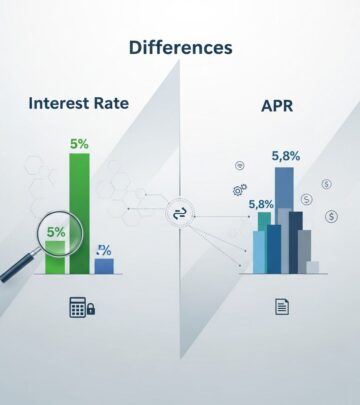
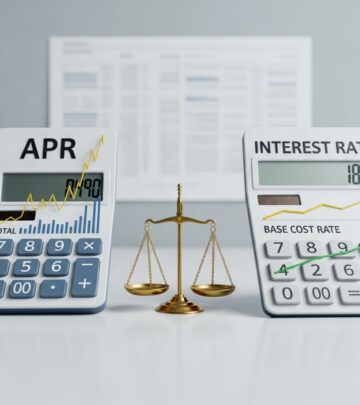
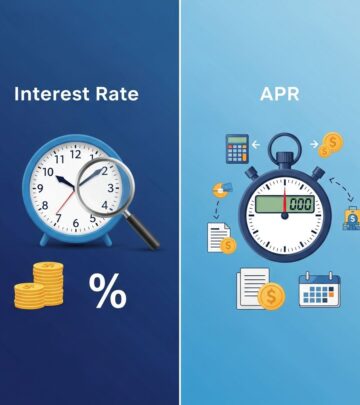
A common source of confusion in lending is the relationship between APR and interest rate—terms that are frequently used interchangeably but carry different meanings. Understanding this distinction is essential for evaluating loan offers accurately.
An interest rate is simply the cost charged to borrow the principal amount, expressed as a percentage. This represents the pure cost of accessing borrowed money. The interest rate forms the largest component of your APR calculation but does not include any additional fees or charges. When you see an advertised interest rate on a loan, it reflects only the percentage you’ll pay on the borrowed amount, typically calculated annually, monthly, or sometimes even daily.
APR, by contrast, incorporates the interest rate plus all associated fees and costs. On mortgages, for example, APR includes not only the interest rate but also closing costs, origination fees, broker fees, and discount points. For credit cards, APR may include annual membership fees. This broader scope makes APR typically higher than the stated interest rate, though not always.
To illustrate this distinction with a practical example: a mortgage advertised with a 6.0% interest rate might have an APR of 6.25% when closing costs and origination fees are factored in. When comparing loan offers, focusing solely on the interest rate could lead you to choose a less favorable option than the one with the lowest APR.
Components Included in APR Calculations
Different types of loans include different components in their APR calculations. Understanding what factors contribute to your APR helps you evaluate the total cost more effectively.
For Mortgage Loans
Mortgage APR calculations typically include:
- The base interest rate charged on the loan amount
- Discount points (prepaid interest paid at closing to reduce the interest rate)
- Origination fees charged by the lender
- Closing costs associated with finalizing the loan
- Broker fees for loan arrangement services
One discount point equals approximately one percent of the loan amount and represents prepaid interest. Paying discount points upfront can reduce your monthly payment and overall interest costs if you plan to keep the loan long-term.
For Credit Cards
Credit card APR calculations are generally more straightforward than mortgage APR. The APR on a credit card represents the yearly interest rate you’ll pay if you carry a balance on the card. While credit card companies may include annual membership fees in some cases, they typically do not factor in additional charges like cash advance fees or late payment penalties into the advertised APR.
An important distinction with credit cards is that you can avoid paying interest entirely by paying off your complete balance each month by the due date. This makes credit card APR applicable only when you maintain a balance from one billing cycle to the next.
For Auto and Personal Loans
Auto loans and personal loans typically include the interest rate plus any origination fees or lender charges in their APR calculations. The specific fees included may vary between lenders, which is why comparing APRs across multiple offers provides a more accurate basis for comparison than looking at interest rates alone.
Why APR Matters in Your Financial Decisions
APR serves several critical functions in the lending landscape that directly impact your financial wellbeing.
Enabling Accurate Comparisons
APRs allow you to compare lending offers on equal footing. Since lenders must follow standardized rules for calculating APR, this metric eliminates some of the confusion that arises when different institutions present their loan terms differently. A credit card with a 16% APR from one bank can be directly compared to a 18% APR card from another bank, knowing that both figures were calculated using the same methodology.
Revealing True Borrowing Costs
The Federal Truth in Lending Act requires all consumer loan agreements to disclose the APR, recognizing that this figure better represents what you’ll actually pay. By including all fees and charges, APR cuts through marketing language and simplifies loan comparison. A loan advertised with an attractive interest rate might become significantly less appealing when the full APR is considered.
Supporting Informed Decision-Making
When you understand APR, you gain the ability to calculate potential interest charges and make decisions based on accurate information about borrowing costs. This knowledge becomes particularly valuable when deciding between accepting a loan with lower monthly payments but a higher APR versus one with higher monthly payments but a lower APR.
APR Variations Across Different Loan Types
Different credit products employ APR in distinct ways based on their structure and risk profiles.
Fixed vs. Variable APR
Some loans feature a fixed APR that remains constant throughout the loan term, providing predictability in your monthly payments and total interest costs. Other products, particularly certain credit cards and adjustable-rate mortgages, offer variable APRs that can change over time based on market conditions or the specific terms of the agreement. Understanding whether your APR is fixed or variable helps you anticipate potential changes in your borrowing costs.
Introductory APR Rates
Credit cards frequently offer promotional or introductory APR rates—often 0% APR for a specified period—to attract new customers. These introductory rates apply to purchases, balance transfers, or both, depending on the card. Once the introductory period expires, the standard APR applies to any remaining balance.
Penalty APRs
Some credit cards include a penalty APR that applies when you miss a payment or violate the card’s terms. This higher rate may persist for a specified period or until you demonstrate improved payment behavior.
APR Versus APY: Another Important Distinction
While APR measures the cost of borrowing, Annual Percentage Yield (APY) measures earnings on deposits and investments. APR represents the total yearly cost of borrowing money, while APY refers to the total amount of money you earn on a savings account or investment, accounting for compound interest. When evaluating savings accounts or certificates of deposit, APY provides the equivalent measure to what APR does for loans—a standardized basis for comparison that accounts for compounding effects.
Practical Applications: Using APR in Your Financial Planning
Understanding APR becomes invaluable when you’re actually shopping for credit. Here’s how to leverage this knowledge:
Mortgage Shopping
When comparing mortgage offers, request the APR from each lender, not just the interest rate. This ensures you’re accounting for all costs—not just interest—and can identify the genuinely most affordable option. A loan with a lower advertised rate might actually cost more overall once all fees are factored into the APR.
Credit Card Evaluation
Compare credit cards primarily based on their APRs if you anticipate carrying a balance. Consider whether the card offers an introductory rate and calculate when that rate expires. For cards you’ll pay off monthly, the APR matters less than annual fees and rewards benefits.
Loan Approval Considerations
Lenders examine your debt-to-income (DTI) ratio when determining your interest rate and ultimately your APR. Maintaining a DTI ratio of 35% or less creates better conditions for favorable APR offers. Reducing existing debt before applying for new credit can improve the APR you receive.
Factors Influencing Your APR
Several elements determine the specific APR you’ll receive on a loan or credit card:
- Credit Score: Higher credit scores typically qualify for lower APRs, as they indicate a history of responsible borrowing
- Credit History: Lenders review your past payment behavior and overall credit management
- Loan Type: Secured loans (backed by collateral) often carry lower APRs than unsecured loans
- Loan Amount and Term: Larger amounts or longer terms may affect the APR offered
- Market Conditions: The broader economic environment influences baseline lending rates
- Lender Policies: Different institutions employ different risk assessment methodologies
Key Takeaways on Annual Percentage Rate
- APR provides a comprehensive measure of borrowing costs by including both interest and associated fees
- APR differs from interest rate, which reflects only the cost of borrowing the principal
- Federal regulations require all lenders to disclose APR using standardized calculations
- Comparing APRs across lenders enables more accurate evaluation than comparing interest rates alone
- Fixed APRs remain constant, while variable APRs can change during the loan term
- Credit cards may offer introductory 0% APR periods before standard rates apply
- Your credit score and overall financial profile influence the APR you receive
- APY, not APR, applies to savings and investment accounts
References
- Annual Percentage Rate (APR) — Cornell Law School Legal Information Institute. 2021. https://www.law.cornell.edu/wex/annual_percentage_rate_(apr)
- What Is an Annual Percentage Rate (APR)? | APR vs. APY — Equifax. https://www.equifax.com/personal/education/credit-cards/articles/-/learn/what-is-apr/
- What is APR | Wells Fargo — Wells Fargo. https://www.wellsfargo.com/mortgage/learn/what-is-apr/
- What is the difference between a loan interest rate and the APR? — Consumer Finance Protection Bureau. https://www.consumerfinance.gov/ask-cfpb/what-is-the-difference-between-a-loan-interest-rate-and-the-apr-en-733/
- APR vs Interest Rate – What is the Difference — Bank of America. https://www.bankofamerica.com/mortgage/learn/apr-vs-interest-rate/
- How APR Works and Your Credit Score Impact — Citizens Bank. https://www.citizensbank.com/learning/what-is-apr.aspx
Similar Articles








Read full bio of medha deb