Typical Monthly Loan Payments in 2026
Discover average monthly payments for auto, student, mortgage, and personal loans in 2026, plus strategies to manage and lower your debt obligations effectively.
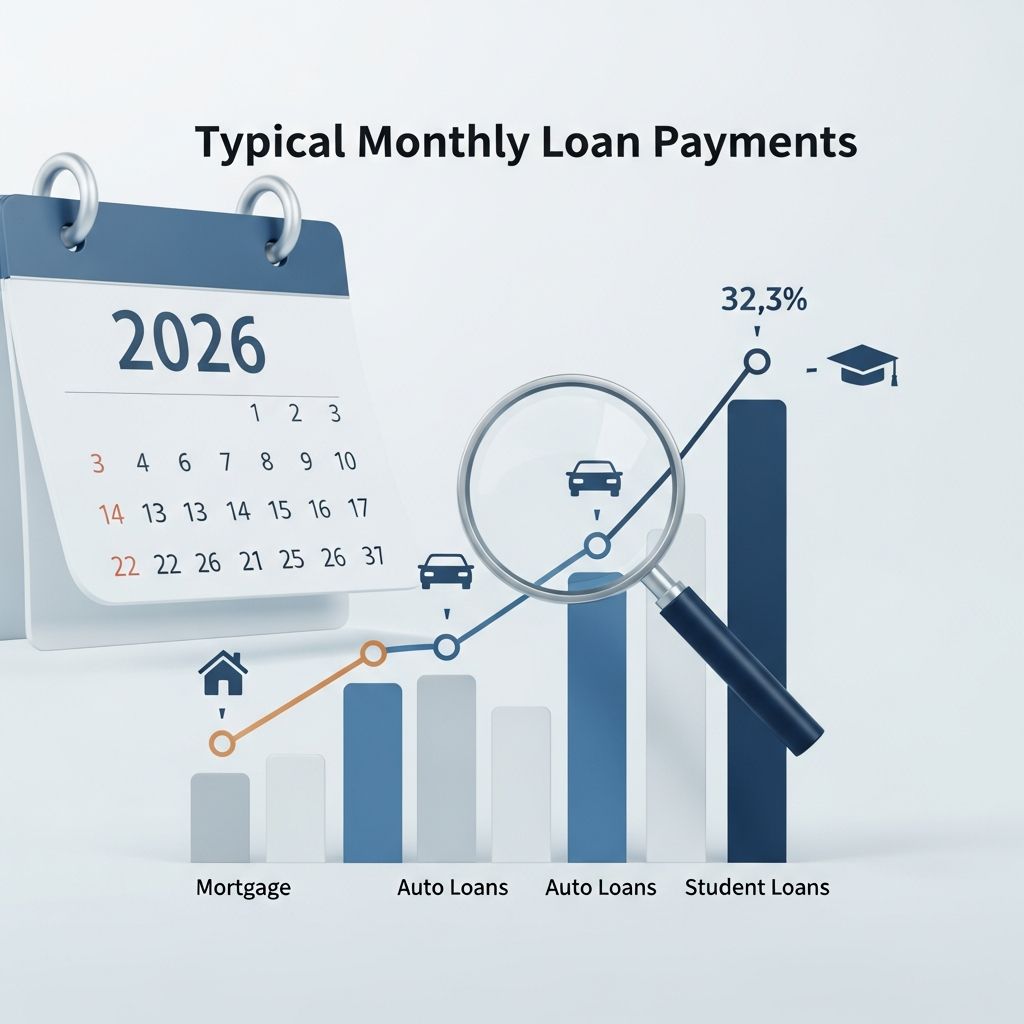
Loan payments form a significant part of household budgets across America, with auto loans, student debt, mortgages, and personal loans leading the way. In 2026, rising interest rates and higher principal amounts have pushed average monthly obligations to new highs, demanding careful financial planning from borrowers. This article breaks down the latest figures, key drivers, and practical steps to navigate these costs.
Breaking Down Loan Types and Their Costs
Understanding the landscape starts with recognizing how different loans contribute to monthly outflows. Auto loans often top the list for new borrowers, while student debt lingers for decades. Mortgages anchor long-term commitments, and personal loans fill short-term gaps but carry steep rates.
Auto Loans: The Rising Price of Mobility
New vehicle financing hit record territory in late 2025, with averages climbing into 2026. Borrowers now face heightened payments due to pricier cars and extended terms. For new cars, the typical monthly outlay reached $767 in Q4 2025, reflecting a 2.8% year-over-year jump. Used car payments averaged $537, up 1.7%, while leases came in at $613, a 1.5% increase.
Credit profiles heavily influence these numbers. Those with super prime scores (781-850) finance larger amounts but secure better rates, averaging lower relative payments on new cars around $41,695 loan sizes. Subprime borrowers (501-600) often pay more monthly despite smaller principals, hitting $792-$810 for new vehicles.
| Credit Score Range | New Car Avg. Amount Financed | Used Car Avg. Amount Financed |
|---|---|---|
| 781-850 (Super Prime) | $41,695 | $29,836 |
| 661-780 (Prime) | $45,944 | $28,770 |
| 601-660 (Nonprime) | $45,944 | $26,425 |
| 501-600 (Subprime) | $40,646 | $23,231 |
| 300-500 (Deep Subprime) | $36,236 | $21,427 |
Source: Adapted from Bankrate 2026 data.
Student Loans: A Decades-Long Burden
Student debt ranks as the second-largest household liability, matching auto loans in total volume. Average monthly payments for bachelor’s degree holders range from $512 to $621, varying by data source and repayment plan. Federal loans average $390-$434, with outstanding balances per borrower at $39,547.
Repayment stretches over 20 years on average, far beyond the standard 10-year plan. At 6.39% interest for 2025-26 federal undergraduate loans, a $39,547 balance requires $446-$449 monthly over 10 years, totaling $53,621 with interest. Lower payments extend timelines: $202 monthly spans 20 years, adding $19,137 in interest.
| Monthly Payment | Total Cost | Interest Paid | Time Period |
|---|---|---|---|
| $319 | $38,288 | $8,888 | 10 years |
| $400 | $35,933 | $6,533 | 7.5 years |
| $202 | $48,537 | $19,137 | 20 years |
| $184 | $55,268 | $25,268 | 25 years |
These scenarios highlight how aggressive payments save thousands in interest.
Mortgage Payments: The Homeownership Anchor
Home loans dominate long-term debt, with national averages shaped by property values, rates, and terms. In 2026, a typical 30-year fixed mortgage on a $400,000 home at 6.5% interest yields about $2,500 monthly, principal and interest only. Including taxes and insurance, this escalates to $3,000+ in many markets.
Regional variations are stark: coastal areas push payments over $4,000, while Midwest homes keep them under $2,000. Refinancing booms when rates dip, but 2026 forecasts suggest stability around 6-7%, maintaining high baselines.
Personal Loans: Flexible but Costly
Unsecured personal loans average $500-$800 monthly for $20,000-$30,000 borrowings at 10-15% APR over 3-5 years. They suit debt consolidation or emergencies but accrue interest quickly without collateral. Prime borrowers snag rates under 10%, dropping payments; others pay 20%+, inflating costs.
Factors Driving Monthly Payment Variations
Several elements dictate what borrowers actually pay each month.
- Interest Rates: Federal student loans at 6.39%; auto loans 7-9%; mortgages 6-7%; personal 10-36%.
- Loan Term: Longer stretches (72+ months for autos, 25+ years for students) lower monthlies but balloon total interest.
- Credit Score: Higher scores unlock sub-5% rates, cutting payments 20-30% versus subprime options.
- Principal Amount: Inflation-driven price hikes in cars ($48,000 average new) and tuition amplify bases.
- Repayment Plan: Income-driven student plans cap at 10% of discretionary income, versus fixed schedules.
Trends Shaping 2026 Loan Payments
Auto delinquencies rise as payments strain budgets, with subprime borrowers hit hardest. Student debt forgiveness programs alter landscapes, yet balances grow 1.66% annually. Electric vehicle financing introduces premiums, potentially hiking new car payments further. Overall, household debt service ratios hover near 10%, squeezing discretionary spending.
Strategies to Lower Your Monthly Loan Burden
Proactive steps can reclaim hundreds monthly.
- Refinance: Shop for lower rates; auto refis saved averages $100/month in 2025.
- Extra Principal Payments: Target interest-heavy loans like autos or personal to shorten terms.
- Biweekly Payments: Halves interest accrual on mortgages, equating to one extra payment yearly.
- Debt Avalanche/Snowball: Prioritize high-rate or small balances for momentum.
- Income-Boost: Side gigs cover 9-10% salary equivalents for student/auto debts.
Tools like calculators from federal sites help model scenarios, ensuring affordability.
Comparing Loan Payment Benchmarks
| Loan Type | Avg. Monthly Payment | Avg. Balance | Typical Term |
|---|---|---|---|
| New Auto | $767 | $45,000 | 72 months |
| Used Auto | $537 | $28,000 | 60 months |
| Student (Federal) | $390-$449 | $39,547 | 10-20 years |
| Bachelor’s Student | $512-$621 | $37,000+ | 20 years |
| Mortgage (30-yr) | $2,500+ | $400,000 | 30 years |
| Personal | $500-$800 | $25,000 | 3-5 years |
Benchmarks reveal autos and students as primary mid-range pressures, mortgages as long-haul commitments.
Frequently Asked Questions
What is the average car payment in 2026?
New cars average $767 monthly, used $537, per Q4 2025 data carrying into 2026.
How much are typical student loan payments?
Federal averages $390-$449; bachelor’s holders pay $512-$621 monthly.
Can I lower my auto loan payment?
Yes, via refinancing, term extension (cautiously), or principal paydown.
How do credit scores affect loan payments?
Better scores mean lower rates and payments; subprime adds $50-200 monthly.
What’s the impact of loan terms on total cost?
Longer terms reduce monthlies but increase interest by thousands, e.g., student loans over 20 years.
Planning Ahead for Loan Success
Monitoring debt-to-income ratios under 36% keeps finances healthy. Automate payments to avoid fees, and review annually for optimizations. As 2026 unfolds, economic shifts may ease rates, offering refi windows. Borrowers armed with data position themselves for stability amid rising costs.
References
- Average Student Loan Payments 2026 — ConsumerAffairs. 2026. https://www.consumeraffairs.com/finance/average-student-loan-payments.html
- Average Student Loan Payment [2026] — Education Data Initiative. 2026. https://educationdata.org/average-student-loan-payment
- Average Car Payment and Auto Loan Statistics: 2026 — LendingTree. 2026. https://www.lendingtree.com/auto/debt-statistics/
- Average Car Payments in 2026: What To Expect — Bankrate. 2026. https://www.bankrate.com/loans/auto-loans/average-monthly-car-payment/
- Average Student Loan Debt After College: 2026 — SoFi. 2026. https://www.sofi.com/learn/content/average-student-debt-after-college/
- Student Loan Debt Statistics in 2026 — Student Loan Planner. 2026. https://www.studentloanplanner.com/student-loan-debt-statistics-average-student-loan-debt/
- Student Loan Debt Statistics [2026] — Education Data Initiative. 2026. https://educationdata.org/student-loan-debt-statistics
Similar Articles








Read full bio of Sneha Tete