Types Of Savings Accounts: 10 Options To Consider
Learn how different savings account types work so you can match your money to the right goals and timeline.

Savings accounts all help you set money aside safely, but they do not work the same way. Some pay higher interest, others offer tax benefits, and a few are designed for very specific goals like health costs or education. Choosing the right type of savings account starts with understanding how each one works and when it fits best.
This guide explains the most common types of savings accounts, compares their key features, and offers practical tips to match each type with your short- and long-term financial goals.
What Is a Savings Account?
A savings account is a deposit account at a bank or credit union that lets you earn interest on money you do not plan to spend immediately. In the United States, most savings accounts at banks are insured by the Federal Deposit Insurance Corporation (FDIC) and at credit unions by the National Credit Union Administration (NCUA), typically up to $250,000 per depositor, per institution, per ownership category.
- Purpose: Store cash safely while earning some interest.
- Access: Easier to access than long-term investments, but not meant for day-to-day spending.
- Risk: Very low when held at insured institutions.
Within this broad category, there are several specialized types with different interest rates, rules and tax treatments.
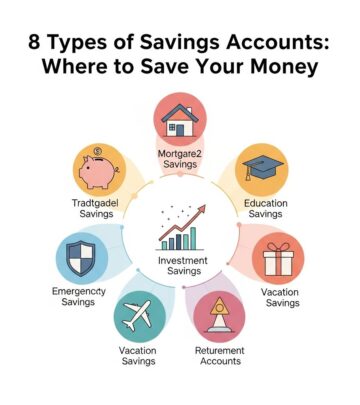
Overview of Common Types of Savings Accounts
Here are the main savings account types you will encounter:
- Traditional savings accounts
- High-yield savings accounts
- Money market accounts
- Certificates of deposit (CDs)
- Cash management accounts
- Health savings accounts (HSAs)
- Education savings accounts and 529 plans
- Retirement-focused savings (IRA savings and CDs)
- Student and youth savings accounts
- Other specialty or goal-based savings accounts
| Account Type | Typical Interest | Liquidity | Main Advantages | Key Trade-offs |
|---|---|---|---|---|
| Traditional savings | Low | High | Simple, widely available, insured | Usually pays the lowest rate |
| High-yield savings | Higher than traditional | High | Better APY, flexible access | May be online-only or require minimums |
| Money market account | Mid to high | High (limited payments) | Check/debit access plus interest | Higher minimums, transaction limits |
| CD (certificate of deposit) | Often higher, fixed | Low during term | Predictable return, FDIC/NCUA insured | Penalty for early withdrawal |
| Cash management | Mid to high (varies) | High | Combines saving and spending, brokerage-based | Different protections, features vary by provider |
| Health savings account (HSA) | Varies | High for qualified medical costs | Triple tax advantage for health expenses | Must have eligible high-deductible health plan |
Traditional Savings Accounts
A traditional savings account is often the first savings product people open. It is designed for general purposes such as small emergency funds or short-term goals.
Key Features
- Available at most banks and credit unions, including branches and online.
- Low minimum opening deposits and straightforward terms.
- FDIC or NCUA insurance up to standard limits.
- Variable interest rates that move with market conditions, usually on the lower end compared with other options.
Pros
- Simple to understand and manage.
- Useful for starter emergency funds or small goals.
- Easy ATM or online transfers to checking.
Cons
- Typically offers the lowest yields among savings options.
- Inflation can erode purchasing power if rates are very low.
Best Uses
- Parking small amounts of cash you may need soon.
- First savings account for new savers.
- Overflow funds linked to checking for overdraft protection, when available.
High-Yield Savings Accounts
A high-yield savings account works like a traditional savings account but usually pays a significantly higher annual percentage yield (APY), especially at online banks. Many online institutions can offer higher rates because they have lower branch-related costs.
Key Features
- Variable APY that often exceeds typical brick-and-mortar savings rates.
- Frequently offered by online-only banks or digital arms of large banks.
- FDIC or NCUA insurance when held at insured institutions.
- May require minimum balances or limit certain types of withdrawals.
Pros
- Higher interest helps money grow faster over time.
- Good flexibility for transfers and online access.
- Useful as a primary emergency fund.
Cons
- Some accounts are online-only, with no physical branches.
- Rates are variable and can decrease if market rates fall.
- May impose minimum opening deposits or balance requirements.
Best Uses
- Emergency savings of three to six months of expenses.
- Short- to medium-term goals (for example, a vacation in 12–24 months).
- Holding cash safely while earning more than a standard savings account.
Money Market Accounts
A money market account (MMA) is a savings account that may pay a higher rate than traditional savings and often includes limited check-writing or debit card access. It should not be confused with money market mutual funds, which are investment products not covered by FDIC insurance.
Key Features
- Typically higher rates than basic savings, though not always higher than the best high-yield accounts.
- May provide a debit card and checkbook, enabling limited payments directly from the account.
- Often require higher minimum balances to open or to earn the top APY.
- FDIC or NCUA insurance when held at insured institutions.
Pros
- Combines the ability to earn interest with some spending convenience.
- Useful for larger emergency funds or irregular expenses.
- Good option for those who want to keep savings and limited payments in one place.
Cons
- Higher minimum balances than many regular savings accounts.
- Transaction limits and possible extra fees for excess withdrawals.
- Rates may lag behind top-tier high-yield savings or certain CDs.
Best Uses
- Emergency savings for people who prefer check/debit access.
- Short-term business cash reserves, when using business money market accounts.
- Savings for irregular but predictable expenses, such as insurance premiums or property taxes.
Certificates of Deposit (CDs)
A certificate of deposit (CD) is a time deposit that pays a fixed interest rate for a set term, such as six months, one year or five years. In exchange for committing your money for a specific period, you typically earn a higher rate than on standard savings accounts.
Key Features
- Fixed term lengths (for example, 3, 12, or 36 months) chosen when you open the CD.
- Fixed interest rate in many cases, making future earnings predictable.
- FDIC or NCUA insured when issued by insured banks or credit unions, up to applicable limits.
- Early withdrawals usually trigger a penalty that can reduce or offset earned interest.
Pros
- Reliable, guaranteed return when held to maturity.
- Often higher rates than traditional savings and some money market accounts.
- Encourages disciplined saving by reducing temptation to spend.
Cons
- Limited liquidity during the term; accessing funds early can be costly.
- Fixed rate can be a downside if market rates rise significantly after you lock in.
Best Uses
- Money you know you will not need until a specific date (for example, tuition next year).
- Part of a CD ladder strategy that staggers maturities to balance access and higher yield.
- Low-risk savings for conservative investors who prioritize stability.
Cash Management Accounts
Cash management accounts (CMAs) are offered by brokerages and fintech firms rather than traditional banks. They aim to combine checking-like features with higher-yield savings elements inside a single, flexible account.
Key Features
- Check writing, debit cards and electronic bill pay in one account.
- Interest on balances, sometimes at rates competitive with high-yield savings.
- Customer assets may be swept into deposit accounts at multiple partner banks for expanded FDIC coverage, or held as brokerage cash subject to Securities Investor Protection Corporation (SIPC) coverage.
- Often integrated with investment accounts, allowing easy movement between cash and investments.
Pros
- Consolidates spending and saving, reducing the need for multiple accounts.
- Can allow high levels of FDIC insurance when deposits are spread across several partner banks.
- Convenient if you already invest with the provider.
Cons
- Protections and features depend on the provider’s structure (bank deposits vs. brokerage cash).
- Customer experience may be different from traditional banks, especially with limited branch access.
- Interest rates and terms can be more variable than standard bank products.
Best Uses
- Household cash management for people who want one hub for income, bills and savings.
- Investors who prefer to keep idle cash close to their brokerage account.
Health Savings Accounts (HSAs)
A health savings account (HSA) is a tax-advantaged savings account for eligible medical expenses. To contribute to an HSA, you must be covered by a qualifying high-deductible health plan (HDHP) and meet other IRS criteria.
Key Features
- Contributions are tax-deductible or made pre-tax through payroll.
- Earnings and interest in the account grow tax-free.
- Withdrawals for qualified medical expenses are tax-free.
- Funds can often be invested once you reach a certain minimum cash balance, giving growth potential beyond basic savings interest.
Pros
- Triple tax advantage (deductible contributions, tax-free growth and tax-free qualified withdrawals).
- Money carries over year to year; there is no use-it-or-lose-it rule, unlike some flexible spending accounts.
- Can help cover deductibles, copays and other healthcare costs.
Cons
- Only available if you have an HSA-eligible high-deductible health plan.
- Non-qualified withdrawals are taxable and may incur penalties before a certain age.
- Investment options and fees vary significantly by provider.
Best Uses
- Setting aside funds for current and future medical expenses.
- Supplementing retirement planning, since HSA funds can be used for health costs in retirement.
Education Savings and 529 Plans
While not savings accounts in the traditional bank sense, education savings accounts and 529 plans are popular tools for education goals. They offer tax advantages when used for qualified education expenses.
Key Features
- 529 plans are sponsored by states or educational institutions and allow tax-advantaged investment growth for education costs.
- Qualified withdrawals for tuition and other approved expenses are typically tax-free at the federal level and often at the state level.
- Some custodial savings or brokerage accounts for minors (such as UGMA/UTMA accounts) can also be used toward education goals, although they do not always have specific tax advantages.
Best Uses
- Saving for college or other qualified education programs.
- Long-term education goals where you can invest for growth.
Retirement-Oriented Savings Options
Many banks and credit unions offer savings accounts and CDs inside individual retirement accounts (IRAs). These are not standard savings accounts, but they use similar deposit structures within a tax-advantaged retirement wrapper.
- IRA savings accounts: Act like regular savings but sit inside a traditional or Roth IRA, where contributions and withdrawals follow retirement tax rules.
- IRA CDs: CDs held in an IRA, combining fixed CD returns with retirement tax treatment.
These vehicles can be useful for conservative portions of a retirement portfolio, particularly for near-retirees who prioritize capital preservation.
Student, Youth and Other Specialty Savings Accounts
Banks frequently provide student or youth savings accounts to help young people learn to save.
- Often lower or no monthly service fees.
- Low minimum balances to open and maintain.
- May include educational tools or automatic conversion to standard accounts at a set age.
Some institutions also offer goal-based or specialty savings accounts for specific purposes—such as holiday savings, vacation funds or small business reserves—to help customers mentally separate savings targets.
How to Choose the Right Type of Savings Account
The right savings account depends on your goals, time frame and need for access. Use these guidelines as a starting point:
- Emergency fund: High-yield savings or money market account for a balance of safety, yield and quick access.
- Short-term goals (under 2 years): High-yield savings or short-term CDs, depending on how certain you are about timing.
- Medium-term goals (2–5 years): Longer-term CDs or a CD ladder, possibly combined with a high-yield savings account.
- Health expenses: HSA if you qualify, to gain tax advantages.
- Education: 529 plans or other education-focused accounts for long-term growth and tax benefits.
- Everyday cash management: Cash management account or interest-bearing checking paired with savings.
Always verify that your account is FDIC or NCUA insured when you keep significant cash balances at a bank or credit union. For brokerage accounts, understand the role of SIPC protection, which covers securities and cash in brokerage accounts if the firm fails, but does not guarantee against investment losses.
Frequently Asked Questions (FAQs)
Q: Which type of savings account is best for an emergency fund?
A: Many experts recommend a high-yield savings account or a money market account at an FDIC- or NCUA-insured institution, because they typically offer higher interest than traditional savings while still allowing quick access when emergencies arise.
Q: Are online high-yield savings accounts safe?
A: Online savings accounts are generally safe when held at FDIC-insured banks or NCUA-insured credit unions. As long as the institution is insured and you stay within coverage limits, your deposits are protected up to standard amounts even if the bank fails.
Q: When does a CD make more sense than a regular savings account?
A: A CD may be better when you have money you will not need for a set period and you want a predictable, often higher, fixed rate. The trade-off is reduced access to your funds until the CD matures, or you pay an early-withdrawal penalty.
Q: How is an HSA different from a regular savings account?
A: An HSA is tied to a qualifying high-deductible health plan and offers tax deductions on contributions, tax-free growth and tax-free withdrawals for eligible medical expenses, whereas a regular savings account does not provide these tax benefits.
Q: Can I lose money in a savings account?
A: You will not lose principal due to bank failure when your deposits are within FDIC or NCUA insurance limits at insured institutions. However, if interest rates are low and inflation is high, the real purchasing power of your savings can decline over time.
References
- 7 Types of Savings Accounts — Experian. 2025-06-10. https://www.experian.com/blogs/ask-experian/types-of-savings-accounts/
- Types of Savings Accounts — TD Bank. 2024-03-01. https://www.td.com/us/en/personal-banking/learning/types-of-savings-accounts
- Understanding the Different Types of Savings Accounts — Simmons Bank. 2023-09-15. https://www.simmonsbank.com/learning-center/understanding-the-different-types-of-savings-accounts
- Savings Accounts Comparison Chart — Wells Fargo. 2023-05-05. https://www.wellsfargo.com/biz/savings/comparison-chart/
- Health Savings Accounts (HSAs) — Internal Revenue Service (IRS). 2024-01-12. https://www.irs.gov/publications/p969
- Types of Savings Accounts — PNC Bank Insights. 2023-08-01. https://www.pnc.com/insights/personal-finance/save/types-of-savings-accounts.html
- How SIPC Protects You — Securities Investor Protection Corporation. 2024-02-20. https://www.sipc.org/for-investors/what-sipc-protects
- 529 Plans: Questions and Answers — U.S. Securities and Exchange Commission. 2023-04-19. https://www.sec.gov/reportspubs/investor-publications/investorpubsintro529htm.html
Similar Articles








Read full bio of medha deb