Trimmed Mean: Definition, Calculation & Applications
Master the trimmed mean: A robust statistical measure that removes outliers for accurate data analysis.
What Is a Trimmed Mean?
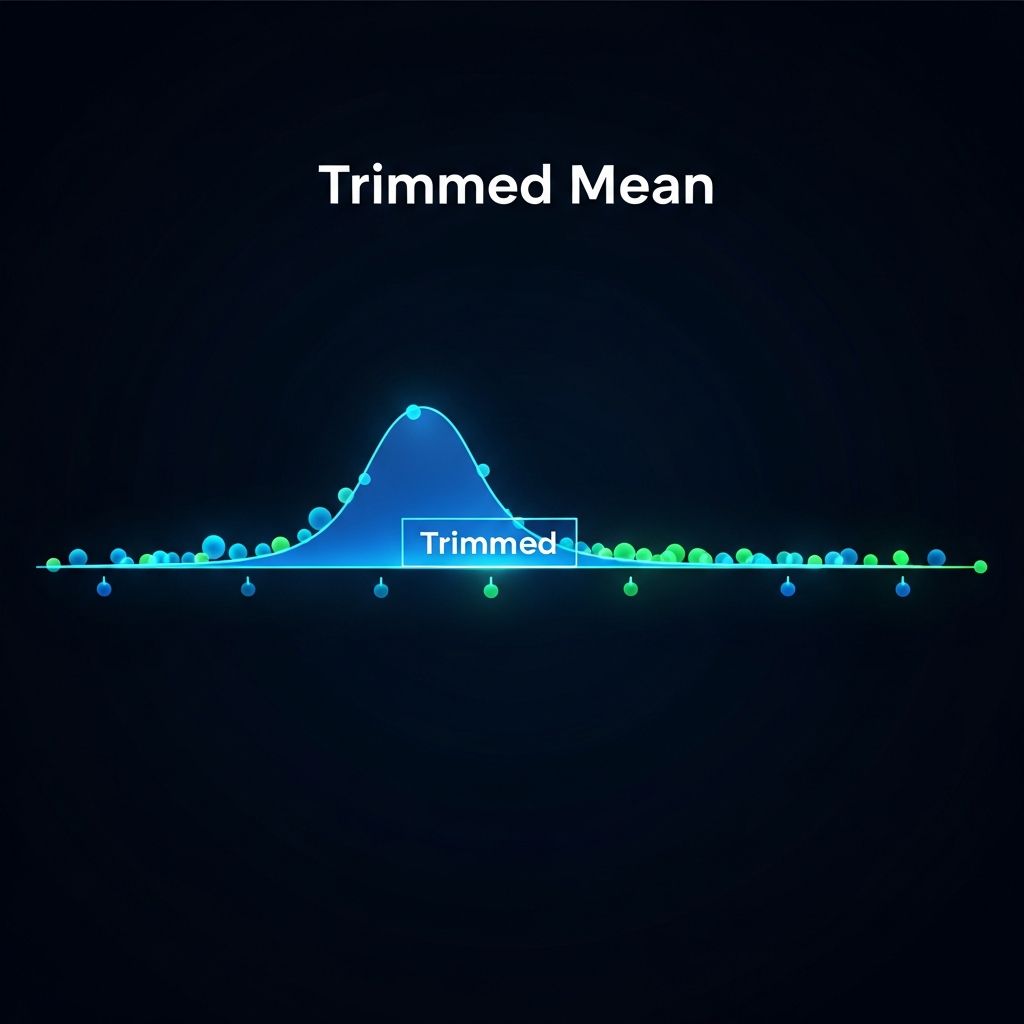
A trimmed mean, also known as a truncated mean, is a statistical measure of central tendency that calculates the average of a dataset after removing a specified percentage of extreme values from both ends of the distribution. For example, a 10% trimmed mean excludes the highest 10% of values and the lowest 10%, using only the middle 80% of the data to calculate the average.
The primary purpose of using a trimmed mean is to create a more robust measure of central tendency by reducing the influence of outliers. While the traditional mean is simple to calculate and widely understood, it can be severely distorted by extreme values that don’t represent the typical data point. The trimmed mean serves as a practical compromise between the standard mean and the median, making it particularly useful when datasets contain moderate outliers or are moderately skewed.
The concept behind the trimmed mean is straightforward: by removing the most extreme values from both tails of the distribution, you reduce the impact of anomalies while still retaining most of the dataset’s information. This makes the trimmed mean more resistant to outliers than the arithmetic mean while maintaining greater efficiency than the median in many practical scenarios.
How the Trimmed Mean Works
Understanding how a trimmed mean functions requires examining its underlying mechanism. Unlike the median, which can discard up to 50% of the data, or the mean, which uses all values equally, the trimmed mean strikes a balance by systematically removing only the most extreme observations.
When you calculate a trimmed mean, you’re essentially asking: “What is the average value if we ignore the most extreme cases?” This approach acknowledges that some data points may be measurement errors, anomalies, or simply represent unusual circumstances rather than typical outcomes. By excluding these extremes, you obtain a measure that better represents the central tendency of the typical observation in your dataset.
The robustness of the trimmed mean increases as you remove more data from the extremes. A 5% trimmed mean (removing 5% from each tail) is more similar to the standard mean, while a 25% trimmed mean is closer to the median in behavior. This flexibility allows analysts to choose the appropriate level of trimming based on their specific data characteristics and analytical needs.
How to Calculate a Trimmed Mean
Calculating a trimmed mean involves a systematic, step-by-step process that ensures accurate results. Here’s the precise methodology:
Step 1: Sort the Dataset
Begin by arranging all data points in ascending order from smallest to largest. This organization is essential because you need to identify and remove the extreme values at both ends of the distribution. Sorting makes it easy to identify which values fall in the upper and lower tails of your dataset.
Step 2: Determine the Trimming Percentage
Decide what percentage of data you want to exclude from each end of the distribution. Common choices range from 5% to 25%, with 20% being a frequently recommended default based on statistical research. The choice depends on how many outliers you expect in your data and how robust you need your estimate to be.
Step 3: Calculate the Number of Observations to Remove
Multiply the trimming percentage by the total number of observations in your dataset. For instance, if you have 100 data points and want a 10% trimmed mean, you would calculate 0.10 × 100 = 10. This means you’ll remove 10 observations from the top and 10 from the bottom, leaving 80 values. Always round to the nearest whole number since you cannot remove a fraction of an observation.
Step 4: Remove the Extreme Values
Once you’ve determined how many observations to exclude, physically remove that number from the beginning and end of your sorted dataset. This creates a new, smaller dataset containing only the middle values.
Step 5: Calculate the Mean
Add all remaining values together and divide by the number of remaining observations. This final calculation gives you your trimmed mean, which represents the average of the middle portion of your data.
Practical Example of Trimmed Mean Calculation
Let’s work through a concrete example to illustrate the trimmed mean calculation. Suppose you have the following dataset of 10 values representing daily sales figures (in hundreds of dollars):
Original data (unsorted): 45, 12, 89, 56, 23, 150, 34, 67, 78, 8
First, sort the data in ascending order: 8, 12, 23, 34, 45, 56, 67, 78, 89, 150
Now, let’s calculate a 20% trimmed mean. With 10 observations, a 20% trim removes 2 values from each end (20% × 10 = 2):
After removing the two lowest (8, 12) and two highest (89, 150) values, your remaining dataset is: 23, 34, 45, 56, 67, 78
Calculate the mean of these 6 values: (23 + 34 + 45 + 56 + 67 + 78) ÷ 6 = 303 ÷ 6 = 50.5
Your 20% trimmed mean is 50.5, which is substantially different from the regular mean (56.2) and better represents the central tendency without the distortion caused by the outlier value of 150.
Trimmed Mean vs. Other Measures of Central Tendency
Understanding how the trimmed mean compares to other statistical measures helps clarify when to use it. Each measure of central tendency has different strengths and weaknesses depending on your data characteristics.
| Measure | Methodology | Outlier Sensitivity | Best Use Case |
|---|---|---|---|
| Mean | Sum all values and divide by count | Very sensitive to outliers | Normal distributions with no extreme outliers |
| Median | Middle value when sorted | Completely robust to outliers | Highly skewed data or extreme outliers present |
| Trimmed Mean | Mean after removing percentage from both ends | Moderately robust to outliers | Moderate outliers or moderate skewness |
| Winsorized Mean | Replace extremes with less extreme values | Moderately robust to outliers | When extreme values shouldn’t be discarded |
Real-World Applications of the Trimmed Mean
Olympic Figure Skating
One of the most famous applications of the trimmed mean occurs in Olympic figure skating judging. Officials remove the highest score and lowest score from each athlete’s panel of judges, then average the remaining scores. This methodology, often called the “Olympic average” or “modified mean,” protects against biased judges who might try to artificially inflate or deflate an athlete’s score. By eliminating just the extreme values at each end, the scoring system becomes resistant to individual manipulation while maintaining most of the judges’ input.
Financial Analysis
In financial markets, extreme values in stock returns, commodity prices, or economic indicators can significantly skew analyses and lead to misleading conclusions. Portfolio managers and financial analysts use trimmed means to obtain more reliable estimates of typical returns and market behavior. By excluding unusually high or low returns that might result from market crashes, earnings surprises, or other anomalies, the trimmed mean provides a clearer picture of normal market conditions.
Sports Scoring Systems
Beyond figure skating, many sports that rely on judge scoring panels use truncated means. Diving competitions, gymnastics events, and martial arts tournaments all employ similar approaches where extreme scores are discarded before calculating the final score. This universal application in competitive sports demonstrates the practical value of the trimmed mean in creating fair, robust scoring systems.
Interest Rate Benchmarking
The LIBOR (London Interbank Offered Rate) benchmark interest rate, which serves as a foundational reference for trillions of dollars in financial contracts, is calculated using a trimmed mean methodology. From 18 bank submissions, the top 4 and bottom 4 are discarded, with the remaining 10 averaged to produce the benchmark rate. This approach prevents any single outlier submission from distorting the benchmark while maintaining sufficient data to ensure market-based pricing.
When to Use Trimmed Means
Choosing the Right Trimming Percentage
Statistical research suggests that for most applications, trimming between 5% and 25% of the data from each end provides an effective balance. A 5% trim removes only the most extreme values and behaves similarly to the regular mean. A 25% trim removes a quarter of the data from each end and approaches the characteristics of the median.
Research by Wilcox and Keselman (2003) suggests that a 20% trimmed mean represents a good default choice for many practical scenarios, minimizing standard error across a wide range of distribution types. However, if your dataset is small or contains particularly severe skewness or outliers (but not so extreme that the median would be preferable), you might increase the trim to 25%.
Comparing Performance
The regular mean performs optimally with normally distributed data containing no outliers. The median excels when data contains numerous outliers or is highly skewed. The trimmed mean provides an effective compromise for scenarios falling between these two conditions, where neither the mean nor the median is ideal. For datasets with moderate outliers and moderate skewness—a common real-world situation—the trimmed mean often provides superior performance compared to both alternatives.
Statistical Testing with Trimmed Means
When conducting hypothesis tests or statistical analyses involving trimmed means, researchers should use specialized statistical tests designed to handle robust estimators. Yuen’s t-test is specifically designed for comparing trimmed means and can appropriately handle the outliers and potential nonconstant variance that trimmed means address. Using standard t-tests or ANOVA procedures with trimmed means can lead to incorrect inferences, making the use of appropriate statistical methods essential for valid conclusions.
Trimmed Mean vs. Winsorized Mean
A related concept that sometimes causes confusion is the winsorized mean. While the trimmed mean removes extreme values entirely, the winsorized mean replaces extreme values with less extreme values from the dataset. For example, a 20% winsorized mean would replace the lowest 20% of values with the smallest non-replaced value and the highest 20% with the largest non-replaced value, then calculate the mean of this modified dataset.
The choice between trimmed and winsorized means depends on your analytical objectives. If you want to eliminate the influence of outliers entirely, the trimmed mean is appropriate. If you prefer to retain all data points but reduce their influence, the winsorized mean may be preferable. Both approaches produce more robust estimates than the standard mean while maintaining more efficiency than the median for many distribution types.
Implementation in Statistical Software
Most statistical software packages include functions to calculate trimmed means. In Excel, the TRIMMEAN function calculates trimmed means, though users should note that Excel uses a nonstandard definition where the percentage parameter represents the total fraction to be trimmed from both ends combined. To achieve a 20% trimmed mean by the standard definition in Excel, you would actually use a parameter of 0.4 (40%), since 20% is trimmed from each end.
R, Python (through libraries like SciPy), SPSS, and other statistical packages provide trimmed mean functions that follow the standard definition, making them more intuitive for statisticians familiar with standard statistical terminology.
Advantages and Limitations
Advantages
The trimmed mean offers several significant advantages for statistical analysis. It provides robustness against outliers while maintaining computational simplicity. Unlike the median, which uses only a single middle value in odd-sized datasets, the trimmed mean uses multiple data points, providing greater stability and efficiency. It requires no special assumptions about the underlying distribution and can be easily understood by audiences unfamiliar with advanced statistics.
Limitations
The trimmed mean does discard information from the extreme values in your dataset. If those extreme values represent genuine, important information rather than errors or anomalies, using a trimmed mean may cause you to lose valuable insights. Additionally, determining the appropriate trimming percentage requires judgment and understanding of your specific data context. An inappropriately chosen trimming level could result in either too much loss of information or insufficient robustness to outliers.
Frequently Asked Questions
Q: What percentage should I use when calculating a trimmed mean?
A: Most applications use between 5% and 25% trimming from each end. Research suggests 20% is often a good default choice for many scenarios, but the optimal choice depends on your specific data characteristics, the expected number and severity of outliers, and your analytical objectives.
Q: How does a trimmed mean differ from a median?
A: The median can be thought of as a fully trimmed mean (removing 50% from each end). The trimmed mean uses a less aggressive approach, retaining more data while still protecting against outliers. For moderately skewed distributions, the trimmed mean often provides better statistical efficiency than the median.
Q: Can I use a trimmed mean with any type of data?
A: Trimmed means work best with continuous numerical data where the extreme values might represent anomalies or measurement errors. They’re less appropriate for categorical data or situations where all values, including extremes, represent equally important information.
Q: What’s the difference between a trimmed mean and a winsorized mean?
A: A trimmed mean removes extreme values entirely from the calculation, while a winsorized mean replaces extreme values with less extreme values from the dataset. The choice depends on whether you want to eliminate or merely reduce the influence of outliers.
Q: Should I use the trimmed mean or the regular mean for my analysis?
A: Use the regular mean for normally distributed data with minimal outliers. Use the trimmed mean when your data contains moderate outliers or moderate skewness. Use the median only when your data contains severe outliers or extreme skewness. The trimmed mean typically provides the best balance for real-world business and research data.
References
- Trimmed Mean: Definition, Calculating & Benefits — Statistics By Jim. 2024. https://statisticsbyjim.com/basics/trimmed-mean/
- Truncated Mean — Wikipedia. 2024. https://en.wikipedia.org/wiki/Truncated_mean
- Mastering How to Calculate Trimmed Mean: A Step-by-Step Guide for Accurate Data Analysis — DHGate Smart. 2024. https://smart.dhgate.com/mastering-how-to-calculate-trimmed-mean-a-step-by-step-guide-for-accurate-data-analysis/
Similar Articles








Read full bio of Sneha Tete