Triangle Chart Pattern in Technical Analysis
Master triangle patterns: ascending, descending, and symmetrical for profitable trading strategies.

Triangle Chart Pattern in Technical Analysis Explained
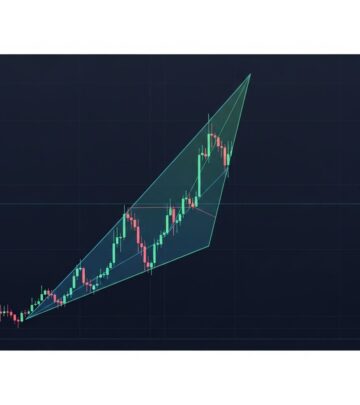
In technical analysis, a triangle is a continuation pattern that forms on a price chart when the trading range of a security becomes increasingly narrow. The pattern gets its name from the distinctive geometric shape created when upper and lower trendlines converge toward a meeting point called the apex. Triangle patterns are fundamental tools for traders seeking to identify potential breakout opportunities and manage risk effectively across all market conditions and timeframes.
Triangles share similarities with other continuation patterns such as wedges and pennants, but they possess unique characteristics that make them valuable for both continuation and potential reversal scenarios. These patterns work across stocks, forex, cryptocurrencies, and other liquid markets, functioning equally well on one-minute charts for scalping or monthly charts for long-term position trading.
What Is a Triangle Pattern?
A triangle forms when price swings progressively shrink inside two converging trendlines. With each successive swing, volatility contracts and trading volume tends to fade—a clear signal that traders are either cancelling or reducing orders while awaiting fresh information. This compression of price action creates a pressure cooker effect where participants must make decisions as the apex approaches.
To qualify as a proper triangle, a pattern must contain at least two swing highs, two swing lows, and trendlines that move toward an eventual meeting point. The slope and orientation of these converging lines determine which of the three triangle variations forms: the slope configuration creates the pattern’s identity and its associated probability characteristics.
The practical value of triangles lies in their ability to compress risk. Each triangle offers a nearby, clearly visible stop-loss location on the opposite side of the pattern, and thanks to its measurable height, traders can calculate a first profit target within seconds. This structural clarity makes triangles particularly attractive for disciplined risk management.
Anatomy of a Triangle Pattern
Understanding the component parts of a triangle strengthens recognition and trading execution. Every triangle contains five essential elements worth identifying:
- Upper Trendline: Connects the swing highs and forms the pattern’s ceiling, representing resistance
- Lower Trendline: Connects the swing lows and forms the pattern’s floor, representing support
- Apex: The convergence point where the two trendlines meet if extended indefinitely
- Entry Zone: The area where price breaks through either trendline with volume confirmation
- Base Height: The vertical distance between upper and lower trendlines at the pattern’s left edge, used to project price targets
A crucial dynamic emerges as a triangle develops: the more touches a trendline receives, the stronger that line becomes through repeated validation. Yet paradoxically, each touch also removes resting orders that were placed along that line, progressively depleting the liquidity that holds back the eventual breakout. This balance between confirmation and exhaustion determines optimal timing for entries and defines the tension that powers the breakout move.
Three Main Types of Triangle Patterns
Triangle patterns manifest in three distinct variations, each carrying different implications for traders and unique probability profiles based on decades of historical data.
Ascending Triangle Pattern
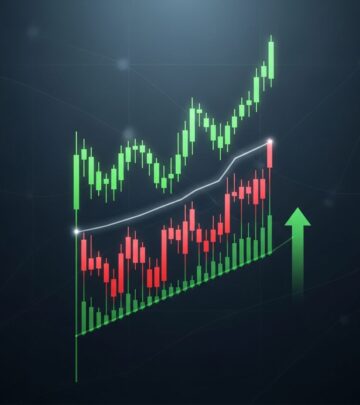
An ascending triangle forms when an upper trendline remains horizontal (indicating nearly identical highs that form a resistance level) while the lower trendline rises diagonally, showing progressively higher lows as buyers repeatedly step up their bids. This configuration represents patient accumulation, where buyers demonstrate increasing conviction despite facing consistent seller resistance at a fixed price level.
In this setup, buyers refuse to accept lower prices after each pullback, continuously raising their bids higher. Sellers, meanwhile, maintain their ground at one specific price—the horizontal resistance. The pattern resolves when buyers finally exhaust their patience and rush into the security above the resistance price with momentum, triggering additional buying pressure as the uptrend resumes. The horizontal trendline that previously served as resistance transforms into support following the breakout.
Example: A stock consolidates with a flat upper resistance and rising lower support. When a volume spike exceeds the upper trendline by 30 percent or more above average, the pattern triggers. A stop-loss placed under the last higher low protects against a failed breakout, while the triangle’s base height added to the breakout point projects the first profit target.
Ascending triangles tend to be bullish formations, indicating continuation of an upward trend or potential reversal of a downtrend, though traders must always confirm breakouts before executing positions.
Descending Triangle Pattern
The descending triangle inverts the ascending setup: support remains flat while the upper trendline declines, with each rally stalling at a progressively lower high. This pattern reveals persistent supply pressure, as sellers consistently appear sooner with each advance. Buyers eventually lose patience and confidence, and the breakdown occurs when price collapses through the lower horizontal support trendline as a downtrend resumes. The support level that previously anchored the pattern transforms into resistance following the breakdown.
Descending triangles carry bearish implications, signaling potential continuation of downtrends or reversal of established uptrends. The mechanics mirror the ascending triangle but work in the opposite direction—sellers maintain control and gradually compress buyer activity until the pattern resolves downward.
Symmetrical Triangle Pattern
Symmetrical triangles form when both the upper and lower trendlines slope toward the apex at similar angles, creating a balanced, mirror-image formation. This pattern emerges during genuine indecision—neither buyers nor sellers assert dominance, resulting in converging volatility without directional bias. Symmetrical triangles represent the purest expression of market equilibrium before resolution.
Statistically, symmetrical triangles tend to continue the prior trend slightly more than half the time. Research compiled across decades of U.S. equities shows a 54 percent continuation bias, meaning they break in the direction of the prior trend move—upward if an uptrend preceded the pattern, downward if a downtrend preceded it. Traders should watch for volume spikes and at least two closes beyond either trendline to confirm the break is valid rather than a false head-fake that traders call “throwbacks” or “pullbacks.”
Are Triangle Patterns Bullish or Bearish?
Triangle patterns carry different implications depending on type:
- Ascending Triangles: Bullish formations suggesting uptrend continuation or downtrend reversal
- Descending Triangles: Bearish formations suggesting downtrend continuation or uptrend reversal
- Symmetrical Triangles: Neutral initially but trend-dependent upon breakout direction; they break upward following uptrends and downward following downtrends
However, market unpredictability demands caution. Traders must always confirm actual breakouts with volume and price action before committing capital, never assuming outcomes based on pattern type alone. The pattern merely increases probability; it never guarantees results.
Triangle Pattern Psychology
Understanding the behavioral dynamics driving triangle patterns enhances trading success. Early in any triangle’s formation, both bulls and bears trade with confidence, each believing their directional thesis will prevail. Yet with each successive thrust in either direction, the counter-party absorbs the move, causing each thrust to fail sooner than the one before it.
As the pattern tightens toward its apex, volatility contracts significantly, bid-ask spreads narrow, and order book depth thins. This liquidity vacuum creates a dangerous environment—a single large market order can remove whatever little liquidity remains, potentially triggering cascading moves. Once the breakout begins, this same liquidity vacuum accelerates the move by triggering stop-loss orders of traders on the wrong side and attracting fresh momentum entries from breakout followers.
Throwbacks and pullbacks—those brief returns to the previously broken trendline—often appear within a handful of candles following the initial breakout. If the broken trendline now holds as support (for upside breaks) or resistance (for downside breaks), late-arriving traders initiate positions while traders trapped on the wrong side bail out, fueling the next leg of the move.
Trading Triangle Patterns: Practical Execution
Successful triangle trading requires a systematic approach combining pattern recognition, volume analysis, and disciplined risk management:
- Identification: Spot two swing highs, two swing lows, and converging trendlines
- Confirmation: Wait for a breakout with volume at least 30 percent above the 20-day average
- Entry: Take positions only after the close outside the trendline on expanding volume
- Stop-Loss Placement: Position stops on the opposite side of the pattern at the last relevant swing point
- Target Calculation: Add the triangle’s base height to the breakout point for first target projection
Historical Performance Data
Backtesting across over 4,200 trades triggered by triangle patterns reveals compelling statistics. Ascending triangles won 63 percent of the time, descending triangles 58 percent, and symmetrical triangles 55 percent. Average return per risk unit landed at +0.42R with a worst historical drawdown just above seven risk units. Applying a simple twenty-period exponential moving-average trend filter improved win rates by approximately four percentage points and trimmed maximum drawdown by roughly 25 percent. While historical backtests never guarantee future performance, they confirm the pattern’s genuine statistical merit.
Comparing Triangle Patterns
| Pattern Type | Formation | Bias | Win Rate | Market Condition |
|---|---|---|---|---|
| Ascending | Flat upper, rising lower | Bullish | 63% | Accumulation phase |
| Descending | Falling upper, flat lower | Bearish | 58% | Distribution phase |
| Symmetrical | Both lines converge equally | Trend-dependent | 55% | Indecision/consolidation |
Frequently Asked Questions
Q: What is the minimum number of touches required to confirm a triangle pattern?
A: At minimum, you need two touches on both the upper and lower trendlines to establish converging lines. However, more touches increase trendline reliability and pattern strength.
Q: Should I trade triangles on all timeframes?
A: Yes, triangles work across all timeframes—from one-minute charts for scalping to monthly charts for position trading. Choose timeframes matching your trading strategy and risk tolerance.
Q: How do I distinguish between a false breakout and a valid one?
A: Confirm breakouts with volume at least 30 percent above average and require at least two closes outside the trendline. This filtering removes many false signals and head-fakes.
Q: Can triangles appear in downtrends as well as uptrends?
A: Absolutely. Triangles form in any market condition and appear in uptrends, downtrends, and sideways markets. The prior trend determines the likely breakout direction for symmetrical triangles.
Q: What’s the relationship between triangle width and price movement magnitude?
A: The triangle’s base height—the vertical distance between upper and lower trendlines at the left edge—projects the expected price movement following breakout. Larger bases typically correlate with larger subsequent moves.
References
- Triangle Patterns in Trading: Ascending, Descending & Symmetrical Guide — Liquidity Provider. 2025. https://liquidity-provider.com/articles/triangle-patterns-in-trading-ascending-descending-symmetrical-guide/
- Technical Analysis: Chart Patterns and Continuation Patterns — Investopedia. 2024. https://www.investopedia.com/terms/t/triangle.asp
- Price Action Trading and Pattern Recognition — Financial Industry Regulatory Authority (FINRA). 2024. https://www.finra.org/
Similar Articles








Read full bio of Sneha Tete