Trial Balance: Definition, Purpose, and Accounting Guide
Master trial balance concepts: definitions, types, purposes, and practical accounting applications.
What Is a Trial Balance?
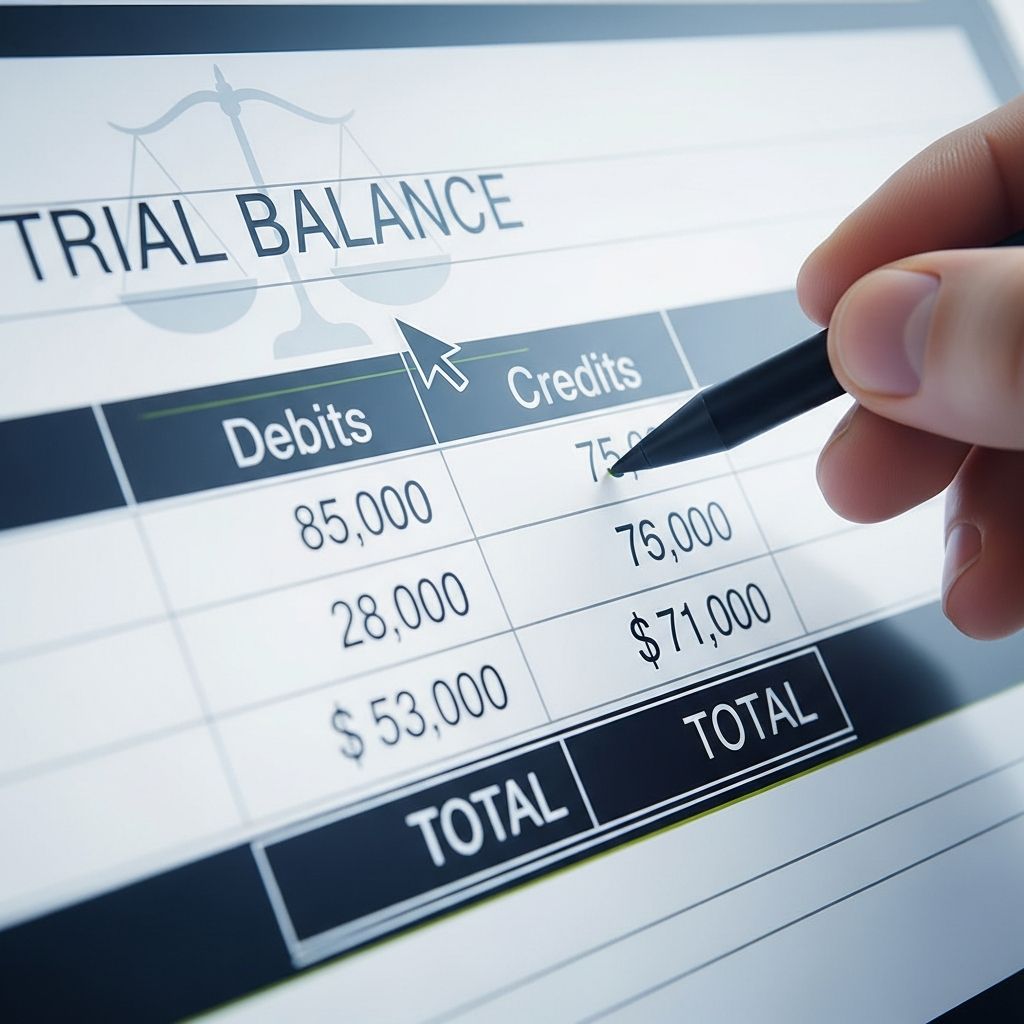
A trial balance is a financial report that lists the balances of all general ledger accounts of a company at a specific point in time. This accounting document compiles all ledger account totals into two columns—debits and credits—to verify that the total debits equal the total credits. Prepared by accountants and bookkeepers, a trial balance serves as an internal working document that checks the mathematical accuracy of the double-entry bookkeeping system before creating formal financial statements.
The trial balance includes account numbers, account descriptions, and the final debit or credit balance for each account. It represents a snapshot of your accounting system at a particular moment, typically at the end of a reporting period. Unlike the general ledger, which shows all individual transactions by account, the trial balance only displays account totals, providing a concise summary of account balances for verification purposes.
Key Purpose and Function of Trial Balance
The primary purpose of preparing a trial balance is to ensure accuracy in your bookkeeping records. By confirming that your debits and credits match, you can verify that all transactions have been recorded correctly in the ledger accounts, thereby ensuring the integrity of financial statements. This verification process is crucial before preparing formal financial reports.
Trial balances serve as an important tool for error detection. While a balanced trial balance does not guarantee complete accuracy—mathematical balance is necessary but not sufficient—it can highlight issues such as incorrect entries, unbalanced accounts, or posting mistakes. This preliminary check acts as a safeguard against more significant errors that could impact financial reporting and business decision-making.
Additionally, accountants use trial balances as the first step in audit procedures, allowing auditors to ensure there are no mathematical errors before moving on to more complex analyses. The trial balance is also prepared to identify which accounts need adjusting entries, making it an essential component of the accounting cycle.
Components of a Trial Balance
Every trial balance includes specific elements that provide essential information for verification:
- Account Number: A numerical identifier for each general ledger account
- Account Description: The name or title of each account (e.g., Cash, Accounts Payable, Revenue)
- Debit Column: Lists all accounts with debit balances, including assets and expenses
- Credit Column: Lists all accounts with credit balances, including liabilities, equity, and revenues
- Accounting Period End Date: The specific date for which the trial balance is prepared
- Total Line: The sum of all debits and all credits, which must be equal
Accounts appearing on a trial balance relate to all major accounting items, including assets, liabilities, equity, revenues, expenses, gains, and losses. Each account should reflect its appropriate debit or credit balance based on the nature of the account and the transactions recorded.
Types of Trial Balances
Accountants use three main types of trial balances at different stages of the accounting cycle, each serving a distinct purpose:
Unadjusted Trial Balance
The unadjusted trial balance is prepared immediately after recording all transactions for the period, before any adjusting entries are made. It provides an initial look at the ledger balances and is a useful tool for identifying accounts that may need adjustments. This version shows balances exactly as they are recorded, without any modifications for accruals, deferrals, or corrections. It offers your first chance to confirm that debits and credits align, catching any immediate errors before moving forward in the accounting process.
Adjusted Trial Balance
The adjusted trial balance incorporates necessary adjustments for accrued or deferred items, such as depreciation, accrued expenses, and prepaid items. This version serves as a polished snapshot of account balances after all adjustments have been posted to the general ledger. The adjusted trial balance is pivotal in ensuring that financial statements reflect an accurate and fair view of the company’s financial position. It forms the basis for preparing the income statement and balance sheet.
Post-Closing Trial Balance
The post-closing trial balance is prepared after closing entries are made, after temporary accounts (revenue and expenses) have been closed to retained earnings. This trial balance features only permanent accounts, such as assets, liabilities, and equity. It confirms that all temporary accounts have been properly closed and that the books are ready for the new financial year, with only permanent accounts carrying forward balances.
Trial Balance vs. Balance Sheet
While both the trial balance and balance sheet are important financial documents, they serve different purposes and have distinct characteristics:
| Feature | Trial Balance | Balance Sheet |
|---|---|---|
| Purpose | Internal verification tool to ensure debits equal credits | Formal financial statement showing financial position |
| Audience | Internal use only; not distributed outside the company | Shared with external stakeholders, investors, and creditors |
| Format | Two-column format (debits and credits) | Organized by assets, liabilities, and equity categories |
| Verification | Checks mathematical accuracy of the ledger | Requires audit verification and professional certification |
| Content | Lists all general ledger accounts and balances | Summarizes financial position at a specific date |
| Timing | Prepared during the accounting cycle | Prepared at the end of the accounting period |
A trial balance is a working report used to ensure that debits and credits are balanced, acting as a preliminary check on the accuracy of financial records. In contrast, a balance sheet is a formal financial statement that provides a comprehensive snapshot of a company’s assets, liabilities, and equity at a specific point in time. While the trial balance verifies your records are correct, the balance sheet shows your financial standing to external parties.
Practical Example of a Trial Balance
Consider a small business with the following accounts and balances:
| Account Name | Debit | Credit |
|---|---|---|
| Cash | $5,000 | |
| Accounts Receivable | $3,500 | |
| Inventory | $4,000 | |
| Equipment | $8,000 | |
| Accounts Payable | $2,000 | |
| Notes Payable | $5,000 | |
| Owner’s Capital | $10,000 | |
| Service Revenue | $8,500 | |
| Rent Expense | $3,000 | |
| Utilities Expense | $1,000 | |
| Total | $24,500 | $24,500 |
In this example, the total debits ($24,500) equal the total credits ($24,500), indicating that the books are balanced. Assets and expenses appear in the debit column, while liabilities, equity, and revenue appear in the credit column. This balance confirms that the double-entry bookkeeping system has been properly maintained.
Benefits of Preparing a Trial Balance
The trial balance offers numerous advantages in the accounting process:
- Error Detection: Identifies mathematical errors in ledger accounts before preparing financial statements
- Accuracy Verification: Confirms that total debits equal total credits, verifying proper application of double-entry bookkeeping
- Preparation for Adjustments: Identifies accounts that require adjusting entries for accruals and deferrals
- Audit Support: Provides auditors with a preliminary verification before conducting detailed audits
- Financial Statement Basis: Serves as the foundation for preparing income statements and balance sheets
- Internal Controls: Acts as a control mechanism to catch errors early in the accounting cycle
- Account Reconciliation: Helps reconcile accounts and identify unusual balances requiring investigation
Limitations of Trial Balance
While trial balances are valuable tools, they have important limitations that users should understand:
- Limited Error Detection: A balanced trial balance does not guarantee that all errors have been caught. Mathematical balance is necessary but not sufficient for complete accuracy
- Cannot Detect Certain Errors: Trial balances cannot identify errors such as transactions recorded in wrong accounts, duplicate transactions, or omitted transactions, as long as debits and credits remain equal
- Not a Financial Statement: The trial balance is not an official financial statement and cannot be distributed to external stakeholders
- Timing Issues: Trial balances do not account for timing differences or reconciliation issues that may exist
- Incomplete Picture: The trial balance alone does not provide a complete picture of financial position or performance
The Trial Balance in the Accounting Cycle
The trial balance is a crucial step within the broader accounting cycle. After transactions are recorded in journals and posted to the general ledger, a trial balance is prepared to verify accuracy. If errors are discovered, they must be corrected before proceeding. Once the trial balance is verified, accountants make any necessary adjusting entries and prepare an adjusted trial balance. This adjusted trial balance then serves as the basis for preparing financial statements including the income statement, balance sheet, and statement of cash flows. Finally, after closing entries are made, a post-closing trial balance is prepared to verify that temporary accounts have been properly closed.
How to Prepare a Trial Balance
Preparing a trial balance involves several systematic steps. First, list all general ledger accounts in order of liquidity (or the order they appear in the chart of accounts). Next, record the debit or credit balance for each account. Ensure that asset and expense accounts are listed in the debit column, while liability, equity, and revenue accounts are listed in the credit column. Add up both columns separately and verify that the totals match. If the totals do not match, review each account balance and posting to identify errors. Once balanced, the trial balance is ready for review and use in preparing financial statements or making adjusting entries.
Frequently Asked Questions
Q: Can a trial balance detect all accounting errors?
A: No. A balanced trial balance indicates mathematical accuracy but cannot detect errors such as transactions posted to incorrect accounts, duplicate entries, or completely omitted transactions, provided debits and credits remain equal. Additional verification procedures are necessary to identify these types of errors.
Q: How often should a trial balance be prepared?
A: Trial balances are typically prepared at the end of each accounting period (monthly, quarterly, or annually), though they can be prepared more frequently if needed for internal review or error detection purposes.
Q: Who prepares the trial balance?
A: The trial balance is typically prepared by bookkeepers or accountants who maintain the general ledger and are responsible for recording and verifying financial transactions.
Q: Is a trial balance required for external financial reporting?
A: No. The trial balance is an internal working document and is not required for external financial reporting. However, it is essential in preparing the official financial statements that are distributed externally.
Q: What should I do if my trial balance does not balance?
A: Review each account balance and verify that it matches the general ledger. Check that all transactions have been properly posted. Search for transposition errors, missing entries, or accounts recorded in the wrong column. Common errors include posting to the wrong side of an account or mathematical calculation mistakes.
References
- Trial Balance – Overview, What’s Included, and Examples — Corporate Finance Institute. 2025. https://corporatefinanceinstitute.com/resources/accounting/trial-balance/
- Trial Balance: Definition, Purpose, and Examples — Mural Pay. 2025. https://www.muralpay.com/blog/trial-balance-definition-purpose-and-examples
- Trial Balance Definition — Sage. 2025. https://www.sage.com/en-ca/blog/what-is-a-trial-balance/
- Trial Balance — Wikipedia. 2025. https://en.wikipedia.org/wiki/Trial_balance
Similar Articles








Read full bio of Sneha Tete