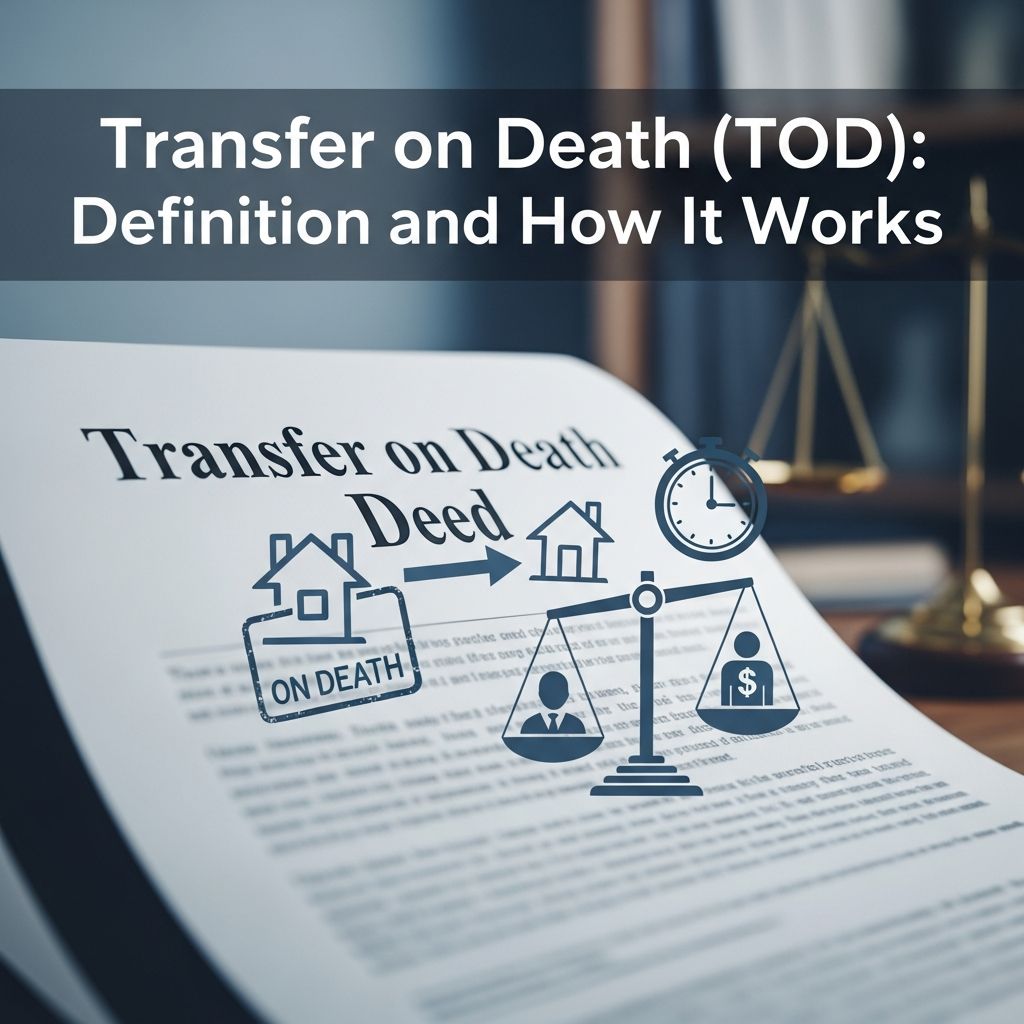
Transfer on Death (TOD): Definition and How It Works
Understand TOD accounts and how they streamline asset transfer to beneficiaries.
What Is a Transfer on Death (TOD) Account?
A transfer on death (TOD) account is a type of account registration that allows assets to automatically pass directly to a named beneficiary upon the account owner’s death, bypassing the probate process entirely. Rather than requiring your estate to go through the lengthy court procedures associated with probate, a TOD designation ensures your assets reach your intended recipient quickly and efficiently.
TOD accounts function similarly to beneficiary designations found on insurance policies or retirement accounts. When you establish a TOD account, you’re essentially naming someone to inherit the account’s contents without the need for legal intervention. This straightforward mechanism has made TOD accounts increasingly popular among individuals seeking to streamline their estate planning.
TOD designations are typically used for investment accounts, including stocks, bonds, mutual funds, and other brokerage holdings. While related to payable on death (POD) accounts—which serve the same purpose for bank accounts—TOD is the preferred term for investment-based assets.
How Transfer on Death Accounts Work
Understanding the mechanics of a TOD account helps clarify why many individuals choose this estate planning tool. The process is deliberately simple and accessible to most account holders.
Setting Up a TOD Account
Creating a TOD designation typically requires completing a simple form provided by your financial institution. In most cases, this process is completely free and involves minimal paperwork. You simply specify who you want to receive the assets upon your death, and the financial institution records this information in their system.
The account owner maintains complete control of the funds while alive. You can withdraw money, make deposits, adjust investments, and manage the account exactly as you would a standard investment account. The TOD designation does not restrict your access or control in any way during your lifetime.
After Death Transfer Process
When the account owner passes away, the transfer process begins with notification to the financial institution. The designated beneficiary or the account executor provides a copy of the death certificate to the bank or brokerage. The institution verifies the beneficiary’s identity and confirms the account owner’s death through the death certificate.
Once verification is complete, the account is re-registered in the beneficiary’s name, and the assets transfer directly to them without probate involvement. This process typically moves quickly, allowing beneficiaries to access funds far more rapidly than they could through the traditional probate system.
Key Features of TOD Accounts
Beneficiary Flexibility
TOD accounts offer significant flexibility in naming beneficiaries. You can designate a single beneficiary or multiple beneficiaries and specify exactly how you want the assets divided among them. Whether you choose equal distribution or unequal percentages, the choice remains entirely yours.
Importantly, the account owner can change beneficiary designations at any time, as long as they remain mentally competent. This flexibility allows you to adjust your beneficiary choices as life circumstances evolve—such as marriages, divorces, births of children, or changes in your relationships.
Complete Owner Control During Lifetime
A crucial advantage of TOD accounts is that beneficiaries have no access to or rights over the account while you’re alive. This protects your assets and ensures that you maintain full decision-making authority throughout your lifetime. Unlike joint account arrangements, where co-owners have immediate access to funds, TOD designations provide complete protection for your assets until your death.
Probate Avoidance
TOD accounts bypass the probate process entirely, provided the designation is properly in place and valid. This is significant because probate can be lengthy, expensive, and emotionally taxing for families. By using TOD designations, you eliminate probate-related fees, including executor and attorney costs, for the accounts with TOD designations.
It’s important to note that while TOD accounts avoid probate, they do not eliminate estate taxes or inheritance taxes. Creditors can still pursue assets in TOD accounts, and depending on your situation, capital gains taxes and other tax obligations may apply.
TOD Accounts vs. Other Estate Planning Tools
TOD vs. Joint Accounts
Some individuals establish joint accounts with their intended beneficiaries to ensure asset transfer. However, this approach carries a significant risk: the joint account holder has full access to funds during the account owner’s lifetime. This can lead to unauthorized spending, disputes, or financial vulnerability.
TOD accounts provide superior protection because beneficiaries cannot access funds until after your death. Additionally, joint accounts may complicate matters if the co-owner has creditors or marital issues, as those problems could potentially affect the account.
TOD vs. Trusts
While TOD accounts offer simplicity and cost-effectiveness, trusts provide greater control over asset distribution after death. A trust allows you to specify exactly how and when beneficiaries receive funds, which can be particularly valuable if you want to provide guidance for how assets are used or managed.
For example, with a TOD account naming your spouse as beneficiary, your spouse could potentially change the beneficiary designation after your death and disinherit your children from a prior marriage. A trust would prevent this scenario by specifying your exact wishes for asset distribution. This distinction makes trusts superior for complex family situations or when you want control extending beyond your death.
TOD vs. Wills
TOD accounts take precedence over wills in most jurisdictions. If your will directs all assets to your children but you have a TOD account naming your brother as beneficiary, your brother receives the TOD account’s contents while your children receive everything else according to your will. The TOD designation supersedes any conflicting will language.
Advantages of Transfer on Death Accounts
TOD accounts offer several compelling benefits for estate planning:
– Probate Avoidance: Assets transfer directly to beneficiaries without lengthy court proceedings, saving time and significant legal expenses.- Simplicity: Setting up a TOD account requires only a simple form, usually at no cost to the account holder.- Rapid Asset Access: Designated beneficiaries can access funds quickly without waiting for court approval or probate completion.- Owner Control: The account owner maintains complete control of all assets and decisions during their lifetime, with the ability to change beneficiaries at any time.- Privacy: Unlike probate, which is a public process involving court documents and proceedings, TOD transfers remain private.- No Immediate Tax Consequences: Simply naming a beneficiary does not trigger taxes; tax implications arise only when the account transfers upon death.
Limitations and Drawbacks
Despite their advantages, TOD accounts have important limitations worth considering:
– No Post-Death Control: You cannot specify conditions for asset use after your death. A surviving spouse could remarry and redirect assets to a new spouse’s children rather than your biological children.- Creditor Access: Although TOD accounts avoid probate, creditors can still pursue these assets to settle estate debts.- Tax Obligations: Beneficiaries may face inheritance taxes, capital gains taxes, and taxes on withdrawals from pre-tax investment accounts like IRAs and 401(k) plans.- Spousal Rights: In some states with strong spousal inheritance laws, such as Massachusetts and Colorado, a surviving spouse may have rights that take precedence over your TOD beneficiary designation.- Potential Conflicts: Multiple beneficiaries on a TOD account may create disputes about management if no clear authority is designated.
Account Complications
If a named beneficiary dies before the account owner and the designation is never updated, the account will be subject to probate upon the original owner’s death. Similarly, complications with the named beneficiary or absence of a valid TOD designation trigger probate for that account. This underscores the importance of periodically reviewing and updating your TOD designations.
TOD Accounts and State Laws
Transfer on death regulations vary by state. While many states recognize TOD designations for bank accounts, investment accounts, and even real estate through transfer on death deeds, the specific rules and procedures may differ. Some states, such as Illinois, now allow transfer on death deeds for real property, expanding the reach of this planning tool.
Additionally, state law determines whether a surviving spouse has inheritance rights that supersede TOD beneficiary designations. Before finalizing your TOD account strategy, consulting with a local estate planning attorney or financial advisor ensures your plan complies with your state’s specific requirements.
How TOD Accounts Fit Into Comprehensive Estate Planning
TOD accounts are best viewed as one component of a comprehensive estate plan rather than a complete solution. For straightforward situations where you want certain assets to pass to specific individuals and have no need for post-death conditions or controls, TOD accounts work excellently.
However, for complex family situations, substantial estates, minor children, or situations requiring ongoing management, combining TOD accounts with other tools like trusts, wills, and powers of attorney creates a more robust plan. Working with a qualified estate planning professional helps ensure your overall strategy aligns with your values and goals.
Transfer on Death Deeds for Real Property
In an expanding number of states, transfer on death designations are now available for real estate through transfer on death deeds. This allows property owners to avoid probate for their real estate, similar to how TOD accounts work for investments and bank accounts.
With a transfer on death deed, you retain full ownership and control of the property during your lifetime. Upon your death, the property transfers to the named beneficiary. This tool is particularly valuable for individuals with significant real estate holdings who want to avoid probate complications for property while maintaining complete control during their lifetime.
Frequently Asked Questions
Q: Can I change my TOD beneficiary after establishing the account?
A: Yes, as long as you remain mentally competent, you can change your TOD beneficiary at any time by completing a new designation form with your financial institution. This flexibility allows you to adjust your beneficiary choices as circumstances evolve.
Q: Will TOD accounts eliminate my estate taxes?
A: No. While TOD accounts avoid probate, they do not eliminate estate taxes or inheritance taxes. Depending on your overall estate size and state law, estate and inheritance taxes may still apply to TOD accounts. Consult with a tax professional about your specific situation.
Q: What happens if my named beneficiary dies before I do?
A: If your beneficiary dies first and you don’t update your TOD designation, the account will likely be subject to probate. It’s important to review and update your beneficiary designations periodically, especially after major life events.
Q: Do TOD accounts protect assets from creditors?
A: No. Although TOD accounts avoid probate, creditors can still pursue these assets to settle estate debts. TOD designation does not provide creditor protection.
Q: Are there fees to establish a TOD account?
A: Usually not. Setting up a TOD designation typically requires only a simple form from your financial institution and is completely free of charge.
Q: How quickly do beneficiaries receive assets from a TOD account?
A: Once the beneficiary provides a death certificate and the institution verifies identity, the transfer typically occurs quickly—usually within weeks. This is substantially faster than the probate process, which can take months or years.
Q: Can I name multiple beneficiaries on a TOD account?
A: Yes. You can name multiple beneficiaries and specify how you want assets divided among them, whether equally or in different percentages according to your wishes.
The Bottom Line
Transfer on death accounts offer a straightforward, cost-effective method for transferring investment and bank accounts to your chosen beneficiaries while avoiding probate. The simplicity of setup, combined with your complete lifetime control and the rapid transfer upon death, makes TOD accounts an attractive option for many people.
However, TOD accounts are most appropriate for relatively straightforward situations. If you have complex family dynamics, minor children, substantial assets, or want to control how assets are used after your death, incorporating TOD accounts into a broader estate plan that includes trusts and other tools provides better protection and clarity.
Regardless of which approach you choose, establishing an estate plan demonstrates care for your loved ones by ensuring your assets transfer according to your wishes while minimizing costs and complications during an already difficult time.
References
- What Is a TOD Account? — City National Bank. 2025. https://www.cnb.com/personal-banking/insights/what-is-TOD-account.html
- What Are Transfer on Death (TOD) Accounts For Estate Planning? — SmartAsset. 2025. https://smartasset.com/estate-planning/tod-account
- Investment Accounts: Transfer of Death — Fidelity Investments. 2025. https://www.fidelity.com/life-events/estate-planning/asset-strategies/brokerage
- Pitfalls of Pay on Death (POD) Accounts — ACTEC (American College of Trust and Estate Counsel). 2025. https://www.actec.org/resource-center/video/pitfalls-of-pay-on-death-accounts-pod/
Similar Articles








Read full bio of medha deb