Trade Surplus: Definition, Examples & Economic Impact
Understanding trade surplus: When exports exceed imports and boost economic growth.
Understanding Trade Surplus
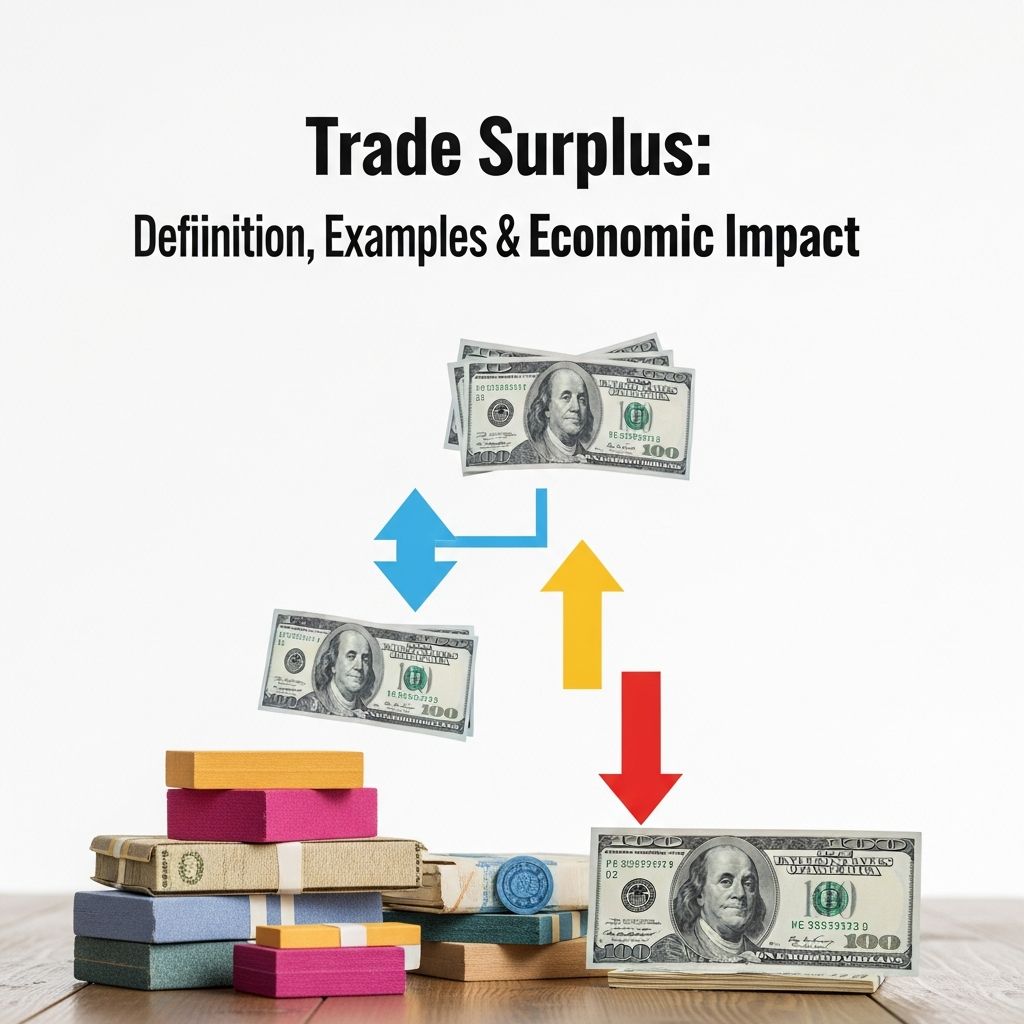
A trade surplus occurs when a country’s exports of goods and services exceed the value of its imports from other countries. This positive balance of trade is a key indicator used by economists and policymakers to assess a nation’s international competitiveness and economic health. When exports surpass imports, a country experiences a net inflow of currency from foreign buyers, which can have significant implications for economic growth, employment, and currency valuation in global markets.
The concept of trade surplus is fundamental to understanding international commerce. Countries engage in trade to leverage their competitive advantages, access resources unavailable domestically, and maximize economic efficiency. A trade surplus reflects strong demand for a nation’s products globally, indicating that foreign markets value what the country produces enough to purchase more than they sell to it.
How Trade Surplus Works
The mechanics of a trade surplus are straightforward but important to understand. Trade balance, also called the balance of trade, is calculated using a simple formula:
Balance of Trade = Value of Exports – Value of Imports
When this calculation yields a positive number, the country has a trade surplus. For example, if Country A exports goods and services valued at $600 billion while importing goods and services valued at $200 billion, the trade surplus equals $400 billion. This surplus means that more money is flowing into the country than flowing out through international transactions.
Trade surpluses can arise due to several factors. High global demand for a country’s products drives exports upward. A nation’s competitive advantages—such as advanced technology, skilled labor, natural resources, or specialized manufacturing capabilities—can contribute to export strength. Additionally, factors like favorable exchange rates, efficient supply chains, and strategic trade policies can all influence whether a country achieves a trade surplus.
Trade Surplus vs. Trade Deficit
Understanding the distinction between trade surplus and trade deficit is crucial for grasping international trade dynamics. These two concepts represent opposite sides of the balance of trade:
| Aspect | Trade Surplus | Trade Deficit |
|---|---|---|
| Definition | Exports exceed imports | Imports exceed exports |
| Trade Balance | Positive | Negative |
| Currency Impact | Increases demand for local currency, strengthens it | Decreases demand for local currency, weakens it |
| Examples | China, Germany | United States |
A trade deficit, also called a negative balance of trade, arises when a country imports more goods and services than it exports. The United States, for instance, has historically maintained a trade deficit, importing significantly more than it exports, particularly from countries like China. While trade deficits are often viewed negatively, economists note that the implications are nuanced and depend on the types of goods being traded and the underlying economic conditions.
Economic Effects of Trade Surplus
Positive Effects
Trade surpluses generally produce beneficial economic outcomes for countries that achieve them. The positive effects include:
Employment Creation: When a country experiences a trade surplus, it signals strong demand for its products domestically and internationally. This increased production activity requires more workers, leading to job creation across various sectors of the economy. Manufacturing facilities expand, logistics operations grow, and service industries supporting export activity flourish.
Economic Growth: The extra revenue generated from a trade surplus provides governments and businesses with additional capital for reinvestment. Countries can use surplus funds to upgrade industries, modernize infrastructure, invest in research and development, and expand production capacity. This reinvestment typically translates into sustained economic growth and improved living standards.
Currency Strengthening: A trade surplus increases international demand for a country’s currency, as foreign buyers need to convert their money to purchase the country’s exports. This increased demand strengthens the country’s currency relative to other currencies in foreign exchange markets. A stronger currency can have positive ripple effects throughout the economy, making imports cheaper for consumers and reducing inflation.
Capital Accumulation: The inflow of foreign currency from exports allows countries to accumulate foreign reserves and build sovereign wealth funds. These resources provide financial flexibility during economic downturns and can be deployed strategically for long-term economic benefit.
Negative Effects and Considerations
Despite their generally positive reputation, trade surpluses can present certain drawbacks and challenges:
Inflation and Higher Prices: Increased demand for domestic goods can drive up prices, potentially creating inflationary pressure within the economy. When foreign buyers compete with domestic consumers for limited goods, prices may rise, reducing purchasing power for the country’s own citizens.
Interest Rate Pressures: Economic expansion from trade surpluses can lead to higher interest rates as central banks attempt to manage inflation and economic overheating. Higher interest rates increase borrowing costs for businesses and consumers, potentially dampening investment and consumption.
Dependency on Exports: Countries heavily reliant on trade surpluses may become vulnerable to global economic downturns. Changes in international demand, global supply chain disruptions, or economic recessions in trading partner nations can quickly erode a country’s trade surplus and create economic instability.
Temporary Nature: Trade surpluses may not be sustainable indefinitely. Factors like currency appreciation, rising wages, or technological change in competitor nations can gradually reduce export competitiveness, eventually leading to trade balance shifts.
Real-World Examples of Trade Surplus
China’s Trade Surplus
China represents one of the most prominent examples of a nation with substantial trade surpluses. As the world’s dominant exporter of goods, China has consistently maintained large positive trade balances. In July 2022, China’s trade surplus reached approximately $101 billion, exceeding earlier economist estimates. This massive surplus reflects China’s position as the global manufacturing center and its export-oriented economic model.
However, economists note important context regarding China’s trade surplus. While the numbers appear strong, concerns exist about sustainability. Much of China’s recent export strength has been attributed to pandemic-related lockdowns that boosted international demand as other countries’ production capacity contracted. As global supply chains normalize and economic growth slows worldwide, China’s export advantage may diminish. Additionally, despite the impressive trade surplus figures, China faces its own economic challenges and risks that prevent the surplus alone from indicating an entirely thriving economy.
Germany’s Trade Surplus
Germany is another nation consistently experiencing trade surpluses, driven by its reputation for high-quality manufacturing, engineering expertise, and automotive production. German exports command premium prices in global markets, enabling the country to export substantially more than it imports. This sustained trade surplus has contributed to Germany’s strong currency position within the Eurozone and supported robust employment in its manufacturing sector.
Trade Balance Fundamentals
Understanding trade balance is essential for analyzing international trade flows and economic relationships. Trade balance reflects the net difference between what a country sells to the world and what it purchases from the world. Governments monitor trade balance carefully as an indicator of economic competitiveness and can implement policies to influence trade outcomes.
The balance of trade is influenced by multiple economic factors beyond simple supply and demand. Savings and investment patterns significantly impact trade balance. When current consumption exceeds domestic output, indicating lower savings rates, countries tend to import more, creating trade deficits. Conversely, when investment in productive capacity exceeds consumption, countries build export capability and may develop trade surpluses.
Policy Considerations
Governments seeking to manage their balance of trade employ various policy tools. Trade protectionism—the practice of penalizing imports through taxes, tariffs, or quotas—represents one approach, though economists debate its effectiveness. Such policies can trigger trade wars that ultimately benefit no countries involved. More sustainable approaches focus on enhancing productivity, innovation, and competitive advantages that naturally support strong export performance.
The Role of Comparative Advantage
International trade theory emphasizes the concept of comparative advantage, which plays a crucial role in determining trade patterns and balances. Countries specialize in producing goods for which they have a lower opportunity cost, fostering mutually beneficial trade relationships. Understanding comparative advantage helps explain why trade surpluses and deficits develop naturally as nations specialize according to their strengths and resource endowments.
Frequently Asked Questions
Q: What exactly is a trade surplus?
A: A trade surplus occurs when a country’s exports of goods and services exceed the value of its imports. It represents a positive balance of trade and indicates that more money is flowing into the country from international sales than flowing out for purchases.
Q: Is a trade surplus always beneficial for an economy?
A: While trade surpluses generally provide economic benefits like job creation and growth opportunities, they can also create challenges including inflation, higher interest rates, and potential dependency on export markets. The overall impact depends on economic context and how surplus funds are utilized.
Q: How is trade surplus calculated?
A: Trade surplus is calculated using the formula: Balance of Trade = Value of Exports – Value of Imports. When this result is positive, the country has a trade surplus.
Q: Which countries have trade surpluses?
A: Countries with notable trade surpluses include China and Germany, both of which are major exporters with strong manufacturing bases and competitive advantages in global markets.
Q: What is the opposite of a trade surplus?
A: The opposite of a trade surplus is a trade deficit, which occurs when imports exceed exports, resulting in a negative balance of trade. The United States, for example, has historically maintained a trade deficit.
Q: How does a trade surplus affect currency value?
A: A trade surplus increases international demand for a country’s currency as foreign buyers purchase exports and need to convert their currency. This increased demand strengthens the country’s currency relative to other currencies in global markets.
Q: Can trade surpluses be sustained long-term?
A: Trade surpluses may not be permanently sustainable. Changes in global economic conditions, currency appreciation, rising production costs, or increased competition can gradually reduce export competitiveness and impact trade balance.
References
- What is a Trade Surplus? Definition, Effects & Example — Study.com. Accessed 2025-11-29. https://study.com/academy/lesson/what-is-a-trade-surplus-definition-example.html
- Trade Surplus — Fiveable (Principles of Economics). Accessed 2025-11-29. https://fiveable.me/key-terms/principles-econ/trade-surplus
- Trade Surplus: Economics Definition + Examples — Wall Street Prep. Accessed 2025-11-29. https://www.wallstreetprep.com/knowledge/trade-surplus/
- Introducing Concepts – Trade Deficit and Surplus Explained — Pearson (Macroeconomics). Accessed 2025-11-29. https://www.pearson.com/channels/macroeconomics/learn/brian/ch-10-introducing-economic-concepts/introducing-concepts-trade-deficit-and-surplus
Similar Articles








Read full bio of medha deb