Total Enterprise Value (TEV): Definition & Calculation
Understand TEV: The complete market value of a company for M&A and valuation analysis.

What Is Total Enterprise Value (TEV)?
Total Enterprise Value (TEV), often referred to simply as enterprise value (EV), represents the total economic value of a company that would be transferred in an acquisition. Unlike market capitalization, which only considers the value of equity, TEV encompasses all claims on the company’s assets, including equity, debt, preferred stock, and minority interests, adjusted for cash and cash equivalents.
TEV provides a more comprehensive picture of a company’s true value because it accounts for the entire capital structure. This metric is particularly useful for investors, analysts, and corporate decision-makers who need to understand the real cost of acquiring or comparing companies across different capital structures and industry sectors.
Understanding the Components of Total Enterprise Value
To fully grasp TEV, it’s essential to understand its key components and how they contribute to the overall valuation:
- Market Capitalization: The market value of a company’s equity, calculated by multiplying the stock price by the total number of outstanding shares
- Total Debt: All financial obligations including long-term debt, short-term debt, and bonds
- Preferred Stock: The value of preferred shares that have priority claims over common equity
- Minority Interest: The value of ownership stakes held by non-controlling shareholders in subsidiaries
- Cash and Cash Equivalents: Subtracted from the total because they represent liquid assets that reduce the net purchase price
The TEV Formula
The standard formula for calculating Total Enterprise Value is:
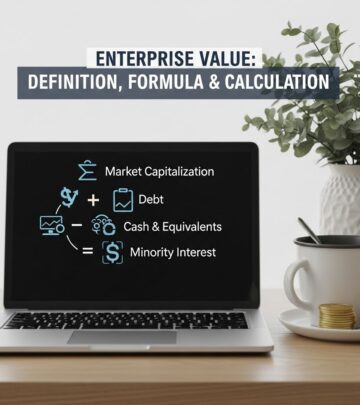
TEV = Market Capitalization + Total Debt + Preferred Stock + Minority Interest – Cash and Cash Equivalents
Alternatively, TEV can be expressed as:
TEV = Equity Value + Net Debt
Where Net Debt = Total Debt – Cash and Cash Equivalents
Step-by-Step TEV Calculation
Here’s how to calculate TEV for a company:
Step 1: Determine Market Capitalization
Multiply the current stock price by the total number of outstanding shares. This represents the market’s valuation of the company’s equity.
Step 2: Add Total Debt
Include all forms of debt obligations such as bonds, bank loans, and other financial liabilities that appear on the balance sheet.
Step 3: Add Other Obligations
Include the value of preferred stock and any minority interests in subsidiaries that represent claims on the company.
Step 4: Subtract Cash
Deduct cash and cash equivalents because an acquirer could use these funds to pay down debt, reducing the effective purchase price.
Step 5: Calculate Final TEV
Sum all components according to the TEV formula to arrive at the total enterprise value.
TEV vs. Market Capitalization: Key Differences
While often confused, TEV and market capitalization serve different purposes in financial analysis:
| Aspect | Market Capitalization | Total Enterprise Value |
|---|---|---|
| Scope | Equity value only | All stakeholder claims |
| Includes Debt | No | Yes |
| Purpose | Equity investor valuation | M&A and full company valuation |
| Comparability | Limited across different capital structures | Comparable across capital structures |
Why TEV Matters in Mergers and Acquisitions
Total Enterprise Value is fundamental to M&A analysis because it represents the actual cost of acquiring a company. When a company acquires another, it must:
- Pay shareholders for their equity stake
- Assume or pay off the target company’s debt
- Account for any preferred stock or minority interests
- Apply the benefit of any cash the target holds
Understanding TEV helps acquirers determine whether a deal is financially attractive and structure the transaction appropriately. It also enables better comparison of acquisition prices across different companies and industries.
TEV in Valuation Multiples
TEV is essential for calculating accurate valuation multiples that allow meaningful comparisons between companies:
- EV/Revenue Multiple: Enterprise Value divided by annual revenue
- EV/EBITDA Multiple: Enterprise Value divided by Earnings Before Interest, Taxes, Depreciation, and Amortization
- EV/EBIT Multiple: Enterprise Value divided by Earnings Before Interest and Taxes
- EV/FCF Multiple: Enterprise Value divided by Free Cash Flow
These multiples provide better peer comparisons than price-to-earnings ratios because they account for differences in capital structure and tax situations across companies.
Practical Example of TEV Calculation
Consider Company XYZ with the following financial characteristics:
- Stock Price: $50 per share
- Outstanding Shares: 100 million
- Total Debt: $2 billion
- Preferred Stock: $500 million
- Minority Interest: $300 million
- Cash and Cash Equivalents: $800 million
TEV Calculation:
- Market Capitalization: $50 × 100 million = $5 billion
- Plus Total Debt: $2 billion
- Plus Preferred Stock: $500 million
- Plus Minority Interest: $300 million
- Less Cash: $800 million
- Total Enterprise Value: $7 billion
TEV in Different Industries
The application and significance of TEV vary across industries. Capital-intensive industries like utilities, telecommunications, and manufacturing typically have higher debt levels, making TEV substantially different from market cap. Technology and software companies, conversely, often have lower debt and substantial cash reserves, resulting in TEV closer to market capitalization.
Common Misconceptions About TEV
Several misconceptions surround the use and interpretation of Total Enterprise Value:
- TEV equals acquisition price: While TEV represents the economic value to be transferred, the actual acquisition price may differ based on negotiation, synergies, and market conditions
- Higher TEV means better value: TEV is not inherently good or bad; it must be evaluated relative to company performance through multiples
- TEV is static: TEV changes constantly as stock prices fluctuate and debt levels change
- All components are equally important: The relative importance of each component depends on the company’s capital structure
Limitations of Total Enterprise Value
While TEV is a valuable metric, it has limitations:
- Doesn’t account for intangible factors: Brand value, management quality, and competitive advantages aren’t fully captured
- Assumes debt and preferred stock are valued at book value: Market values may differ
- Sensitive to capital structure changes: Changes in debt or equity composition significantly impact TEV
- May not reflect synergies: TEV doesn’t include potential synergies or cost savings from acquisitions
Frequently Asked Questions About TEV
Q: Why is TEV more reliable than market capitalization for comparisons?
A: TEV accounts for the entire capital structure, making it comparable across companies with different levels of debt and equity financing. This enables more accurate peer comparisons regardless of how each company is financed.
Q: How does cash impact TEV calculation?
A: Cash is subtracted from TEV because an acquirer could use the target’s cash to pay down debt, reducing the net purchase price. The more cash a company holds, the lower its TEV relative to market cap.
Q: Can TEV be negative?
A: Yes, TEV can be negative when a company has substantial cash holdings that exceed the sum of market cap and debt. This indicates that the cash alone could theoretically cover all claims on the company.
Q: How frequently should TEV be recalculated?
A: TEV should be recalculated regularly, as stock prices change daily and debt levels may shift quarterly or annually. For ongoing valuation analysis, monthly or quarterly updates are typical.
Q: Is TEV the same as equity value?
A: No. Equity value (market cap) represents only the shareholders’ stake, while TEV represents the total value to all stakeholders including debt holders, preferred stockholders, and minority interest holders.
Q: Why do analysts prefer EV multiples over price multiples?
A: EV multiples eliminate the distortion caused by different capital structures, making them more suitable for comparing companies with varying debt levels. This provides a clearer picture of operational performance relative to valuation.
References
- Corporate Finance Standards and Best Practices — CFA Institute. 2023-06-15. https://www.cfainstitute.org
- Financial Reporting and Analysis Standards — International Accounting Standards Board (IASB). 2024-01-10. https://www.ifrs.org
- SEC Guidance on Financial Disclosure Requirements — U.S. Securities and Exchange Commission. 2023-11-20. https://www.sec.gov/cgi-bin/browse-edgar
- Merger and Acquisition Valuation Methodologies — American Institute of Certified Public Accountants (AICPA). 2024-03-05. https://www.aicpa.org
- Enterprise Valuation and Financial Analysis — Financial Accounting Standards Advisory Board. 2023-09-12. https://www.fasab.gov
Similar Articles








Read full bio of Sneha Tete