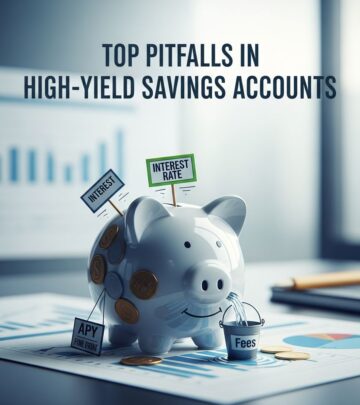
Top Pitfalls in High-Yield Savings Accounts to Dodge
Unlock the full potential of high-yield savings by steering clear of common errors that erode your earnings and efficiency.

High-yield savings accounts (HYSAs) offer a superior way to grow idle cash compared to standard savings options, often delivering annual percentage yields (APYs) several times higher. These accounts provide FDIC insurance up to $250,000 per depositor per institution, blending safety with enhanced returns ideal for emergency funds or short-term goals. Yet, many savers undermine these benefits through avoidable errors. This guide outlines critical missteps, drawing from expert analyses, and provides actionable strategies to optimize your savings journey.
Why High-Yield Savings Accounts Outshine Traditional Ones
Traditional savings accounts typically yield under 0.50% APY, while HYSAs from online banks frequently exceed 4-5% as of early 2026, despite recent Federal Reserve rate adjustments. This gap compounds significantly over time; for instance, $10,000 at 0.45% grows modestly, but at 4.5%, it could add over $450 annually. Online institutions achieve these rates by minimizing overhead costs like physical branches.
HYSAs suit liquid needs—accessible via transfers without penalties—making them perfect for buffers against unexpected expenses. However, success hinges on disciplined management amid fluctuating rates influenced by Fed policies.
Failure to Compare Rates Across Providers
The most prevalent error is settling for the first HYSA encountered without benchmarking options. Rates among ‘high-yield’ providers can differ by 1% or more, translating to hundreds in lost interest yearly on larger balances. Brick-and-mortar banks lag behind online counterparts and credit unions due to higher operational expenses.
Solution: Regularly scan comparison sites or use tools listing top APYs. Note that the leader today may slip tomorrow, so prioritize stable institutions with competitive histories rather than chasing fleeting peaks. Aim to review quarterly, especially post-Fed announcements.
Ignoring Fees, Minimums, and Hidden Costs
APY grabs attention, but overlooking fees or requirements erodes gains. Some accounts impose monthly charges if balances dip below thresholds, or limit transactions (federal rules cap at six per month, though many waive post-2020 changes).
- Examine opening deposits, maintenance minimums, and waiver conditions like linked checking accounts.
- Scrutinize transfer fees or excess withdrawal penalties.
- Evaluate mobile apps, customer support, and ATM access for usability.
Beyond rates, these factors determine net returns. A 5% APY account with $10 monthly fees nets less than a 4.5% fee-free rival.
Skipping Automated Contributions
Opening an HYSA is futile without consistent funding. Manual deposits falter amid daily spending temptations, stalling compound growth—the engine powering exponential savings.
Implement Automation: Link your checking to HYSA for payroll direct deposits or recurring transfers (e.g., $100 biweekly). Features like ’round-up’ on purchases funnel spare change automatically, building habits effortlessly. This ensures steady principal increases, amplifying interest accrual.
| Monthly Deposit | 1-Year Growth at 4.5% APY | 5-Year Growth |
|---|---|---|
| $200 | $2,449 | $13,678 |
| $500 | $6,109 | $34,195 |
| $1,000 | $12,227 | $68,390 |
Table assumes monthly compounding; actuals vary by provider.
Commingling Funds from Multiple Goals
Treating one HYSA as a catch-all for diverse objectives—like a home down payment, vacation, and car repair—clouds tracking and invites impulsive dips into unrelated pots.
Better Approach: Open separate HYSAs per goal. Most banks allow multiple without credit dings. Label them clearly (e.g., ‘Wedding Fund’) and monitor individually to stay motivated and prevent cross-contamination.
Neglecting Regular Account Reviews
‘Set it and forget it’ dooms savers to suboptimal rates or over-accumulation. As Fed cuts (e.g., late 2025 hikes in cuts) pressure yields downward, top rates shift.
Dedicate monthly check-ins: Assess balance vs. goal, compare current APY to market leaders, and adjust deposits. Once targets hit, redirect to higher-return vehicles like CDs locking today’s rates.
Overexposure: All Eggs in One HYSA Basket
Concentrating entire savings in one account risks exceeding FDIC limits ($250,000 per depositor, per ownership category, per bank). Bank failures, though rare, expose excess funds.
Additionally, with CDs matching HYSA rates amid cuts, solely relying on variable HYSAs misses fixed-rate security. Split across institutions and pair with CDs for diversification.
- Spread across 2-3 FDIC-insured banks.
- Allocate short-term needs to HYSAs, medium-term to CDs.
- Verify insurance via FDIC’s EDIE tool.
Confusing HYSAs with Daily Spending Accounts
Using HYSA for frequent access mimics checking, triggering limits or fees. Reserve it for non-essential growth; keep 1-2 months’ expenses in checking.
Post-2020, withdrawal caps eased, but best practice: Limit to goal-oriented transfers.
Overlooking Compounding and APY Nuances
Not all ‘high-yield’ labels equate; APY standardizes comparisons accounting for compounding frequency (daily bests monthly).
Select daily compounding for edge; ignore advertised simple interest.
Disregarding Direct Deposit Restrictions
Some HYSAs tie bonuses or yields to payroll direct deposits, excluding annuities or Social Security—critical for retirees. Confirm eligibility upfront.
Building Your Optimal HYSA Strategy
1. Shop rates monthly via aggregators.
2. Automate inflows.
3. Segment by goals.
4. Diversify institutions.
5. Review quarterly, reallocating as needed.
In 2026’s rate environment, HYSAs remain vital despite cuts, outperforming traditional accounts manifold.
Frequently Asked Questions
Are HYSAs FDIC-insured?
Yes, up to $250,000 per depositor per bank if offered by FDIC-member banks.
How often do HYSA rates change?
Variable, often weekly, tracking Fed funds rate.
Can I have multiple HYSAs?
Absolutely; no credit impact, enhances FDIC coverage.
What’s better: HYSA or CD?
HYSA for liquidity, CD for rate locks amid cuts.
Minimum deposit needed?
Often $0-$1,000; check specifics.
References
- 7 High-Yield Savings Account Mistakes to Avoid — Experian. 2023-10-12. https://www.experian.com/blogs/ask-experian/high-yield-savings-account-mistakes-to-avoid/
- 3 costly high-yield savings account mistakes to avoid this fall — CBS News. 2025-09-15. https://www.cbsnews.com/news/costly-high-yield-savings-account-mistakes-to-avoid-fall-2025/
- 5 High-Yield Savings Mistakes I Made (So You Don’t Have To!) — YouTube (Colin Exelby, CFP). 2024-05-20. https://www.youtube.com/watch?v=ilYD8bqafNo
- Basics of High-Yield Savings Accounts — First Fed. 2024-02-10. https://www.ourfirstfed.com/support/financial-education/basics-of-high-yield-savings-accounts
- 8 banking mistakes the middle class should avoid — KTVZ (Stacker). 2024-01-31. https://ktvz.com/stacker-money/2024/01/31/8-banking-mistakes-the-middle-class-should-avoid-to-maximize-their-savings-potential/
Similar Articles








Read full bio of Sneha Tete