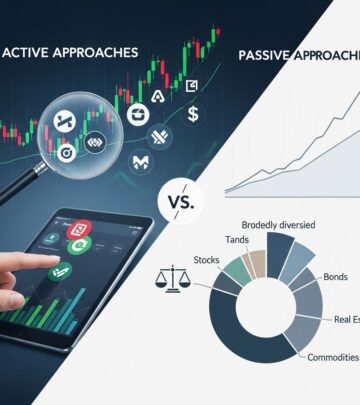
Top-Down vs Bottom-Up Investing: Strategy Comparison
Compare top-down and bottom-up investing approaches to find the strategy that aligns with your investment goals.

When it comes to building an investment portfolio, investors face numerous strategic choices. Among the most fundamental decisions is whether to adopt a top-down or bottom-up investment approach. These two distinct methodologies represent different philosophies about how to analyze markets and select individual securities. Understanding the nuances of each approach is essential for any investor looking to develop a coherent investment strategy that aligns with their financial goals and personal investment style.
What is Top-Down Investing?
Top-down investing begins with a macroeconomic analysis of the broader economy before drilling down into specific sectors and individual securities. This approach starts at the highest level by examining overall economic conditions, interest rates, inflation trends, currency movements, and geopolitical factors. Investors using this strategy ask themselves: “What economic conditions lie ahead, and which sectors are positioned to benefit?”
The top-down investor typically follows this progression:
- Analyze global and domestic macroeconomic trends
- Identify sectors that will outperform in the predicted economic environment
- Select industries within those sectors that appear most promising
- Finally, choose individual companies within the selected industries
This hierarchical approach emphasizes that investment decisions should be grounded in a comprehensive understanding of the economic landscape. Practitioners of top-down investing believe that understanding where the economy is headed provides valuable context for security selection.
What is Bottom-Up Investing?
Bottom-up investing takes the opposite approach, beginning with the analysis of individual companies and securities rather than macroeconomic forecasts. Bottom-up investors focus intensively on company-specific factors such as financial statements, earnings potential, competitive advantages, management quality, and valuation metrics. They believe that a company’s intrinsic value and prospects can be understood through careful fundamental analysis, regardless of broader economic conditions.
The bottom-up investor typically follows this sequence:
- Research individual company fundamentals thoroughly
- Analyze financial statements, including income statements, balance sheets, and cash flow statements
- Evaluate competitive positioning and market opportunities
- Assess management quality and strategic direction
- Compare current valuation to intrinsic value estimates
Bottom-up investors often employ techniques such as discounted cash flow analysis, comparable company analysis, and earnings growth projections to determine whether a stock is undervalued or overvalued relative to its fundamental worth.
Key Characteristics and Differences
| Aspect | Top-Down Approach | Bottom-Up Approach |
|---|---|---|
| Starting Point | Macroeconomic analysis | Individual company analysis |
| Focus | Economic trends, sectors, industries | Company fundamentals and valuations |
| Time Horizon | Often medium to long-term | Can be short to long-term |
| Research Emphasis | Macroeconomic data and forecasts | Financial statements and competitive analysis |
| Portfolio Construction | Sector and industry allocation first | Individual stock selection first |
| Market Timing | More dependent on timing | Less dependent on timing |
Advantages of Top-Down Investing
The top-down approach offers several meaningful advantages for investors who employ it effectively:
Sector Allocation Benefits
Top-down investors gain the advantage of strategic sector positioning. By correctly identifying which sectors will outperform during specific economic phases, investors can potentially achieve superior returns. For example, during economic expansions, technology and consumer discretionary stocks often outperform, while during recessions, defensive sectors like utilities and consumer staples tend to be more resilient.
Risk Management Through Macroeconomic Understanding
Understanding macroeconomic conditions helps investors anticipate market shifts and adjust their portfolios accordingly. This awareness can help investors avoid being caught off-guard by major economic transitions and can guide appropriate asset allocation decisions.
Diversification Across Economic Cycles
Top-down investors are well-positioned to diversify across sectors that perform differently in various economic environments, potentially smoothing returns across market cycles.
Disadvantages of Top-Down Investing
Despite its benefits, top-down investing has notable limitations:
Forecasting Challenges
Accurately predicting macroeconomic trends is extraordinarily difficult. Professional economists frequently disagree on economic forecasts, and unexpected events can render even well-researched predictions obsolete. The complexity of global economies means that forecasting accuracy is limited.
Individual Security Risk
Even when a sector is correctly identified as promising, individual companies within that sector can underperform due to company-specific problems. A top-down investor might correctly identify a growth sector but select poorly-performing companies within it.
Market Timing Risk
Top-down investing often requires precise timing of when to move in and out of various sectors. Poor timing can eliminate the potential benefits of correct sector selection.
Advantages of Bottom-Up Investing
Bottom-up investing offers compelling advantages that appeal to many successful investors:
Focus on Fundamentals
Bottom-up investors concentrate on factors they can analyze and understand: company finances, competitive advantages, management quality, and market opportunities. These factors are more controllable and analyzable than macroeconomic forecasts.
Identification of Overlooked Opportunities
By focusing on individual companies, bottom-up investors can identify undervalued stocks that the broader market has overlooked. These “hidden gems” might be in unfashionable sectors or smaller companies not closely followed by analysts.
Reduced Reliance on Market Timing
If an investor truly believes a company is undervalued, macroeconomic conditions become less critical. The company’s superior fundamentals should eventually be recognized by the market, regardless of broader economic trends.
Superior Stock Picking Returns
Investors with skill in analyzing individual companies can potentially generate returns that exceed what sector allocation alone would produce.
Disadvantages of Bottom-Up Investing
Bottom-up investing also faces meaningful challenges:
Vulnerability to Macroeconomic Shocks
A fundamentally sound company can see its stock price decline significantly during broad market downturns or economic recessions. The best analysis of a company means little if the entire market is selling off.
Diversification Challenges
Bottom-up investors may inadvertently concentrate too much of their portfolio in a single sector if multiple attractive opportunities happen to exist in that sector. This concentration can amplify risk.
Intensive Research Requirements
Thorough fundamental analysis of individual companies requires significant time and expertise. Many individual investors lack the resources or expertise to conduct adequate company analysis.
Overconfidence Risk
Bottom-up investors can become overconfident in their ability to analyze companies, leading to concentrated positions and excessive trading.
Comparing Performance and Effectiveness
Academic research and real-world experience suggest that both approaches can be effective under different circumstances. Top-down investing may provide superior returns during periods of significant economic transition, while bottom-up investing may work better during stable economic periods when company fundamentals diverge significantly from valuations.
The most successful long-term investors often employ a hybrid approach, combining macroeconomic awareness from top-down analysis with careful fundamental company analysis from bottom-up methodology. This balanced approach attempts to capture the benefits of both strategies while mitigating their individual weaknesses.
Choosing Between Top-Down and Bottom-Up Approaches
The optimal strategy depends on several factors:
- Investment Skills: Investors with strong macroeconomic forecasting abilities may favor top-down approaches, while those skilled in financial analysis may prefer bottom-up methods
- Available Time: Bottom-up investing requires more intensive research time and effort
- Market Conditions: During periods of significant economic change, top-down approaches may be more effective
- Portfolio Size: Smaller portfolios may be better served by bottom-up approaches focusing on fewer, well-analyzed stocks
- Risk Tolerance: Risk-averse investors may prefer the diversification potential of top-down sector allocation
Hybrid and Blended Approaches
Many sophisticated investors employ modified strategies that blend elements of both approaches. A common hybrid strategy might include:
- Using top-down analysis to determine appropriate sector weightings
- Using bottom-up analysis to select the best companies within those favored sectors
- Periodically reassessing macroeconomic conditions to rebalance sector allocations
- Continuously monitoring company fundamentals for changes in investment thesis
Implementation Considerations for Investors
Regardless of which approach an investor chooses, several implementation principles apply:
- Consistency: Stick with your chosen methodology rather than frequently switching strategies
- Discipline: Develop clear criteria for buying and selling and apply them consistently
- Diversification: Maintain adequate diversification to manage unsystematic risk
- Cost Control: Minimize trading costs and fees that can erode returns
- Continuous Learning: Stay informed about both company fundamentals and macroeconomic trends
Frequently Asked Questions
Q: Which investing approach is better for beginners?
A: Bottom-up investing is generally more accessible to beginners because it focuses on analyzing individual companies using publicly available financial information. However, beginners should start with diversified index funds before attempting active stock selection with either approach.
Q: Can I use both top-down and bottom-up approaches simultaneously?
A: Yes, many professional investors use a hybrid approach. They use top-down analysis to determine sector allocation and then bottom-up analysis to select individual stocks within those sectors. This combination can help balance the strengths and weaknesses of each approach.
Q: How does market timing fit into these approaches?
A: Top-down investing inherently involves more market timing because it depends on correctly predicting economic cycles. Bottom-up investing is less dependent on timing because it focuses on individual company value regardless of economic conditions.
Q: What resources do I need to successfully implement each approach?
A: Top-down investing requires access to economic data, forecasts, and sector analysis tools. Bottom-up investing requires access to company financial statements, industry analysis tools, and financial databases. Both benefit from financial education and analytical skills.
Q: How often should I reassess my strategy?
A: Reassess your strategy quarterly or when significant changes occur in your personal circumstances, financial goals, or market conditions. Frequent changes can be counterproductive; consistency is more important than constant adjustments.
Q: Are institutional investors more likely to use one approach over the other?
A: Institutional investors typically employ both approaches but often lean toward top-down for strategic asset allocation and macroeconomic positioning, combined with bottom-up analysis for security selection and portfolio construction.
References
- Securities and Exchange Commission (SEC) — Investor Education Materials — U.S. Securities and Exchange Commission. 2024. https://www.sec.gov/investor
- Principles of Corporate Finance — Richard A. Brealey, Stewart C. Myers, and Franklin Allen. McGraw-Hill Education, 2020. (Academic reference on investment analysis methodologies)
- A Random Walk Down Wall Street — Burton G. Malkiel. W.W. Norton & Company, 2019. (Analysis of market efficiency and investment strategies)
- The Intelligent Investor — Benjamin Graham. HarperBusiness, 2006. (Foundational work on fundamental analysis and bottom-up investing)
- Federal Reserve Economic Data (FRED) — Federal Reserve System. 2024. https://fred.stlouisfed.org/
Similar Articles








Read full bio of medha deb