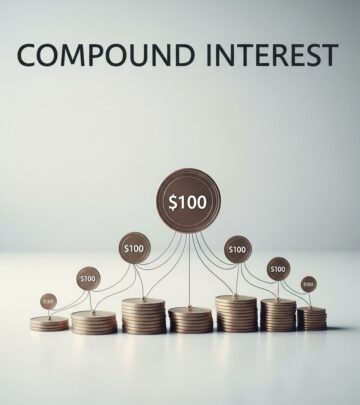
Top Compound Interest Investments
Unlock the power of compound interest with proven investment options that grow your wealth exponentially over time.

Compound interest transforms modest savings into substantial wealth by earning returns on both principal and accumulated earnings. This exponential growth mechanism rewards patient investors who reinvest their gains consistently.
Understanding the Mechanics of Compound Interest
At its core, compound interest calculates returns on the initial investment plus all previously earned interest. Unlike simple interest, which applies only to the principal, compounding creates a snowball effect that accelerates over time. For example, a $10,000 investment at 5% annual interest grows to $25,000 with simple interest after 30 years but reaches $43,219 with compounding.
The formula for compound interest is A = P(1 + r/n)^(nt), where A is the final amount, P is the principal, r is the annual rate, n is compounding frequency, and t is time in years. More frequent compounding—daily, monthly, or quarterly—amplifies growth. Time emerges as the critical factor; starting early maximizes the benefits, as even small amounts compound dramatically over decades.
| Compounding Frequency | Description | Example Benefit |
|---|---|---|
| Annually | Interest added once per year | Basic growth for long-term bonds |
| Semi-annually | Twice yearly | Common in corporate bonds; boosts returns slightly |
| Quarterly | Every three months | Used in many savings products for faster accumulation |
| Monthly/Daily | Frequent additions | Optimal for high-yield accounts; maximizes exponential effect |
Low-Risk Options for Steady Compounding
For conservative investors prioritizing capital preservation, certain bank products offer reliable compounding with minimal volatility. These vehicles suit short- to medium-term goals where safety trumps high returns.
Certificates of Deposit (CDs)
CDs lock funds for a fixed term, typically paying higher rates than standard savings. Interest compounds at maturity or through reinvestment options, providing predictable growth. A beginner-friendly choice, CDs require a minimum deposit but deliver guaranteed yields, often exceeding traditional accounts. Institutions like banks and credit unions offer various terms from months to years, with FDIC insurance up to $250,000 protecting principal.
High-Yield Savings Accounts
These accounts compound interest daily or monthly at competitive APYs, far surpassing regular savings. Liquidity allows access without penalties, making them ideal for emergency funds that still grow. Online banks drive the highest rates due to lower overhead, turning idle cash into a compounding asset.
Money Market Accounts
Combining savings-like security with check-writing privileges, money market accounts compound similarly to high-yield options. They often yield more than basic savings while maintaining stability, appealing to those needing flexibility alongside growth.
Fixed-Income Investments for Reliable Returns
Bonds provide a middle ground, balancing safety with moderate compounding potential. By reinvesting periodic interest payments, investors capture the full power of compounding.
Government and Corporate Bonds
Investors lend money to governments or companies, receiving fixed interest (coupons) in return. U.S. Treasury bonds, backed by the full faith of the government, offer low risk and semi-annual compounding. Corporate bonds yield more but carry credit risk. Manual or automatic reinvestment of coupons is essential for compounding.
Bond Funds and ETFs
These pooled vehicles simplify access, automatically reinvesting dividends for hands-off compounding. Diversified across issuers and maturities, they reduce individual bond risks while capturing market yields. Ideal for building a laddered portfolio that compounds steadily.
Equity-Based Compounding for Higher Potential
Stocks introduce volatility but unlock superior long-term returns through price appreciation and reinvested dividends. Patience is key, as markets fluctuate but historical averages reward compounding strategies.
Dividend-Paying Stocks
Companies distributing regular dividends allow reinvestment via DRIPs (Dividend Reinvestment Plans), buying more shares automatically. This dual growth—share value plus compounding payouts—outperforms non-dividend stocks over time. Blue-chip firms with decades of increases provide reliability.
- Proven performers: Utilities, consumer staples, and healthcare sectors often yield 3-5% dividends.
- Strategy tip: Focus on dividend aristocrats with 25+ years of raises.
- Risk note: Market downturns affect principal, but reinvested dividends cushion recovery.
Real Estate Investment Trusts (REITs)
REITs own income-producing properties, distributing at least 90% of taxable income as dividends. Reinvesting these high yields (often 4-8%) compounds effectively, offering real estate exposure without direct ownership. Equity REITs focus on properties, while mortgage REITs invest in loans—both compound via dividend reinvestment.
Diversification benefits shine here; REITs correlate lowly with stocks, stabilizing portfolios during equity slumps.
Strategies to Maximize Compounding Power
Beyond selecting vehicles, smart tactics amplify results. Consistency and discipline separate average savers from wealth builders.
- Start early: A 25-year-old investing $5,000 annually at 7% amasses over $1 million by 65; waiting 10 years halves it.
- Reinvest everything: Automation prevents spending temptations, fueling uninterrupted growth.
- Dollar-cost average: Regular contributions smooth volatility, buying more shares when prices dip.
- Minimize fees: Low-cost index funds and ETFs preserve compounding by reducing drag.
- Diversify: Blend low-risk (CDs, bonds) with growth (stocks, REITs) for balanced risk-return.
Balancing Risk and Reward in Compounding
| Investment Type | Avg. Annual Return | Risk Level | Best For |
|---|---|---|---|
| CDs/High-Yield Savings | 4-5% | Low | Short-term safety |
| Bonds/Bond Funds | 3-6% | Low-Medium | Income stability |
| Dividend Stocks | 7-10% (total return) | Medium-High | Long-term growth |
| REITs | 8-12% (total return) | Medium-High | Diversification |
Lower-risk options guarantee principal but cap upside; equities demand tolerance for drawdowns but historically deliver 7-10% annualized returns. Align choices with time horizon and risk appetite—retirees favor bonds, young professionals equities.
Common Pitfalls to Avoid
Many undermine compounding through impatience or errors. Frequent withdrawals halt momentum, while high fees erode gains. Inflation can erode real returns, so target rates above 2-3%. Taxes on non-retirement accounts interrupt flow—use tax-advantaged vehicles like IRAs or 401(k)s.
Frequently Asked Questions
What is the fastest way to compound interest?
Higher returns via stocks or REITs compound quickest, but require risk tolerance and long horizons. For safety, opt for frequent compounding in high-yield accounts.
How does compounding frequency affect growth?
More frequent intervals (daily vs. annual) yield marginally higher amounts due to earlier reinvestment.
Are CDs better than savings for compounding?
CDs offer higher fixed rates for locked terms; savings provide liquidity with competitive variable rates.
Can I compound interest in retirement accounts?
Yes, IRAs and 401(k)s supercharge compounding tax-deferred or tax-free.
What’s the role of time in compounding?
Time is paramount; 30 years at 5% turns $10,000 into $43,219 vs. $25,000 simple.
References
- Best Compound Interest Investments — Bankrate. 2023-10-15. https://www.bankrate.com/investing/best-compound-interest-investments/
- Simple vs. Compound Interest Explained — Thrivent. 2024-02-20. https://www.thrivent.com/insights/investing/simple-vs-compound-interest-explained
- Compound Interest — TD Direct Investing. 2023-11-10. https://www.td.com/ca/en/investing/direct-investing/articles/compound-interest
- Compound Interest: Definition, Formula, Benefits & More — Credit Union of Colorado. 2024-01-05. https://www.ccu.com/learn/banking-basics/what-is-compound-interest/
- What is Compounding Interest? — Citizens Bank. 2023-09-12. https://www.citizensbank.com/learning/what-is-compounding-interest.aspx
- What is Compound Interest? — Investor.gov (SEC). 2024-03-01. https://www.investor.gov/additional-resources/information/youth/teachers-classroom-resources/what-compound-interest
Similar Articles








Read full bio of Sneha Tete